
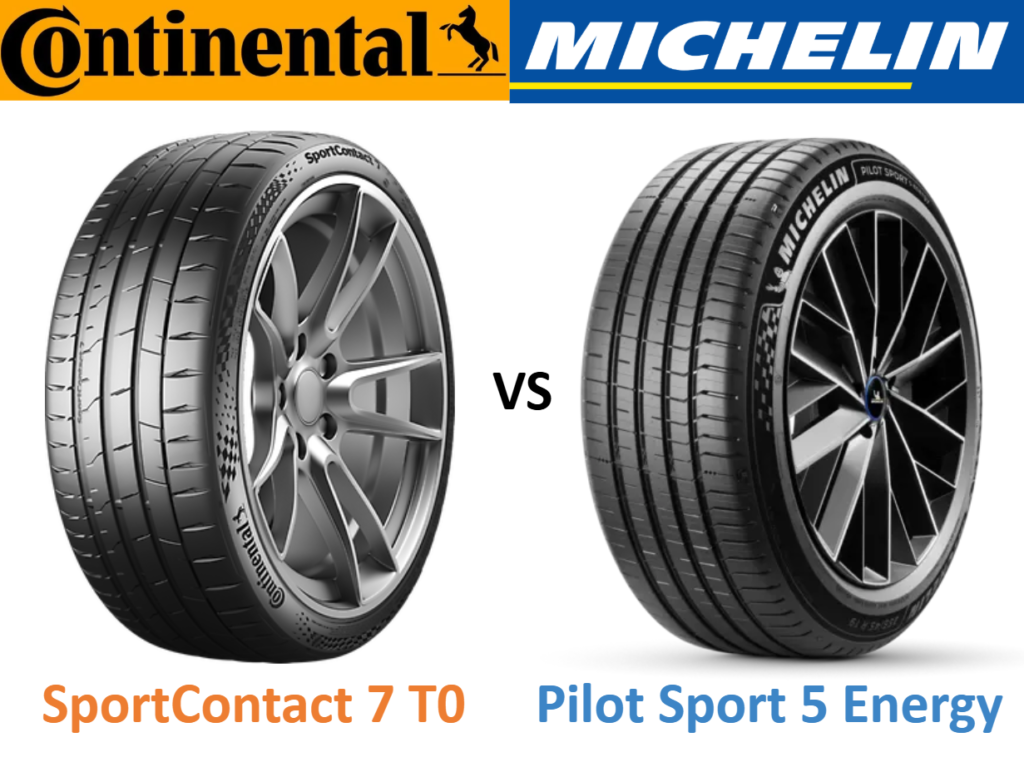
Continental SportContact 7 T0 vs Michelin Pilot Sport 5 Energy: How much rolling resistance can you cut before you start giving up grip? With its new Energy range, Michelin is pushing that trade-off further. The Pilot Sport 5 Energy is designed to lower rolling resistance while keeping the sharp handling and strong grip drivers expect from a Pilot Sport. Its rival is the Continental SportContact 7 T0, the Tesla-approved version of one of the benchmarks in ultra-high-performance tires. Which tire grips harder in the wet, and which rolls more efficiently?
Table of Contents
Results: Continental SportContact 7 T0 vs Michelin Pilot Sport 5 Energy
The results presented here are from TÜV SÜD’s 713367264-S3-01 report. The accompanying graph provides a side-by-side comparison of the Continental SportContact 7 T0 vs Michelin Pilot Sport 5 Energy across various performance categories, with the Continental SportContact 7 serving as the benchmark at 100%.
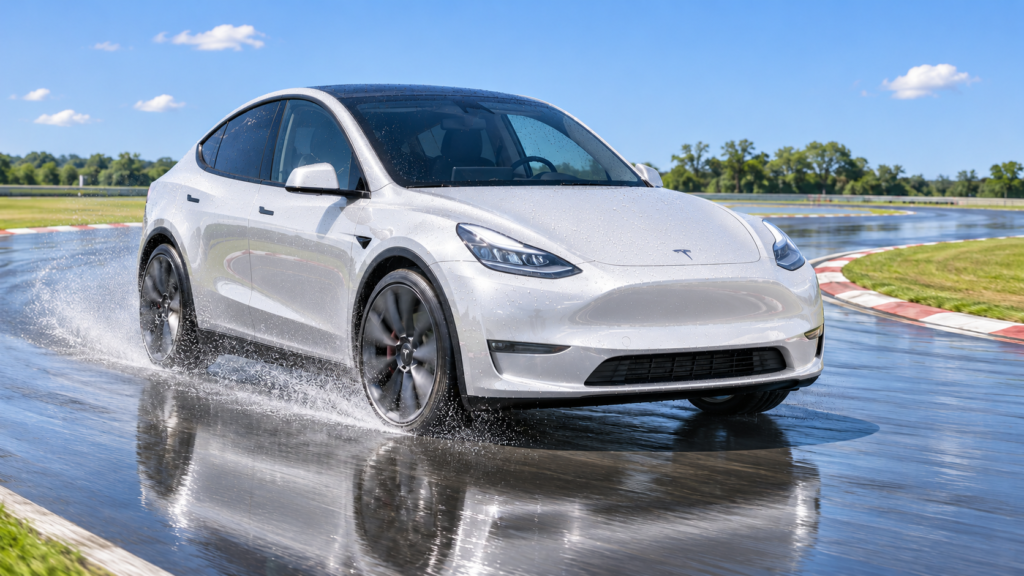
The tire size of interest is the 255/45 R19 tire size, a popular choice for vehicles like the Volvo XC40 & Audi A6. For further insights into various tire sizes, feel free to consult our latest tire size table. The tests were conducted using a Tesla Model Y as the test vehicle.
Wet
In wet braking from 80 to 20 km/h, the Michelin Pilot Sport 5 Energy needed 33.1 metres, compared with 38.9 metres for the Continental SportContact 7 T0. That’s 5.8 metres shorter, giving Michelin an 18% lead on the performance index.
In wet handling, the Michelin’s estimated lap time was 80.0 seconds versus 84.5 seconds for the Continental. That’s 4.5 seconds quicker, with a 6% lead on the performance index. Both lap times were estimated using a reference lap from a similar test. The Michelin also scored 8.17 versus 6.92 in the driver’s assessment, 1.25 points higher, with a 6% lead on the supplied index.
The Michelin led in every wet test, with the biggest gap coming under braking.
Pilot Sport 5 Energy :
- +18% in wet braking
- +6% in wet handling (lap time)
- +6% in wet handling (subj)
Dry
From 100 km/h, the Michelin Pilot Sport 5 Energy stopped in 34.1 metres, compared with 35.2 metres for the Continental SportContact 7 T0. That’s 1.1 metres shorter, giving Michelin a 3% lead on the performance index. Michelin kept its braking edge in the dry, though the gap was much smaller than in the wet.
Pilot Sport 5 Energy :
- +3% in dry braking
Rolling Resistance
The Continental SportContact 7 T0 recorded 5.6 kg/t in rolling resistance, compared with 6.4 kg/t for the Michelin Pilot Sport 5 Energy. Michelin’s rolling resistance was 0.8 kg/t higher, putting it 12% behind on the performance index. After trailing in wet and dry braking, Continental takes the lead on efficiency.
Pilot Sport 5 Energy :
- -12% in rolling resistance
Price
In 255/45 R19, the Continental SportContact 7 T0 costs €242 per tire, while the Michelin Pilot Sport 5 Energy costs €285. Michelin is €43 more per tire, or 18% more expensive, adding €172 to the cost of a set of four. That’s the premium for Michelin’s stronger braking and wet handling, while Continental costs less and rolls more efficiently.
Tire size: 255/45R19
Difference: +18% more expensive for Pilot Sport 5 Energy
Summary
As a tire engineer, I’d pay the extra €43 per tire for the Michelin Pilot Sport 5 Energy if wet grip were my priority. It stopped 5.8 metres shorter in the wet, handled better on the wet track, and kept a smaller braking edge in the dry.
I’d choose the Continental SportContact 7 T0 if I wanted lower rolling resistance and a lower purchase price. Tread life is still the open question, so I can’t say which tire offers better value per kilometre.
Dr Edwin Pang