
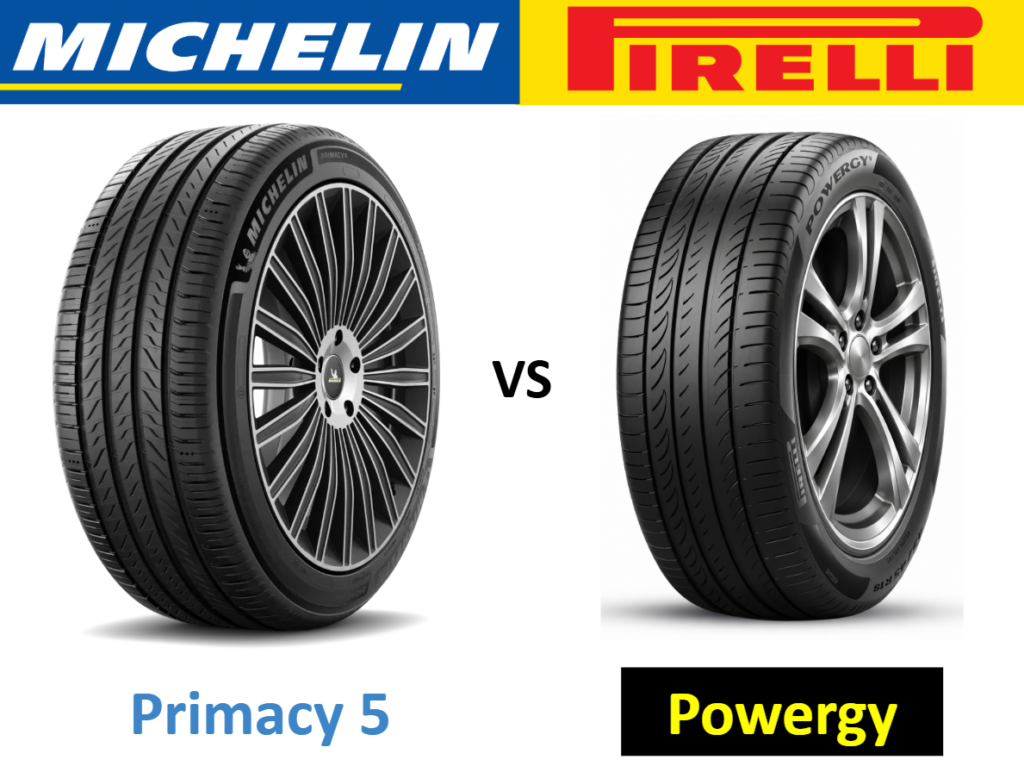
Michelin Primacy 5 vs Pirelli Powergy—a battle in the summer touring segment, where everyday comfort meets real-world grip. Michelin brings its focus on lasting safety and comfort, while Powergy represents Pirelli’s everyday driving formula: safety, efficiency and comfort. But when the road turns wet and the braking distances count, which one delivers? Let’s put these two head to head.
Table of Contents
Results: Michelin Primacy 5 vs Pirelli Powergy
The results presented here are from Auto Zurnal’s 2026 Summer Tire Test, where 10 of the best summer tire models were selected. The accompanying graph provides a side-by-side comparison of the Michelin Primacy 5 vs Pirelli Powergy across various performance categories, with the Michelin Primacy 5 serving as the benchmark at 100%.
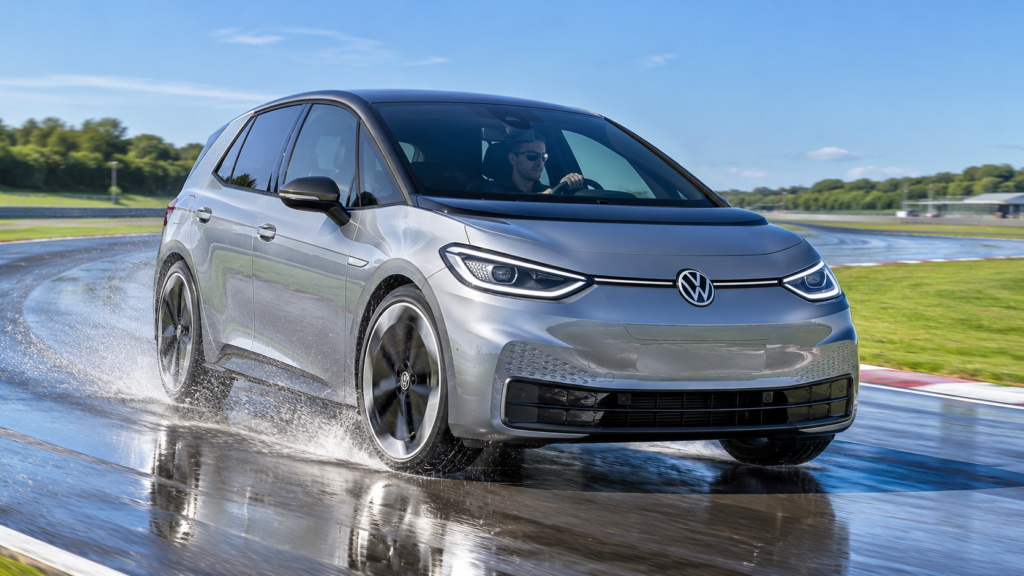
The tire size of interest is the 215/55R18 tire size, a popular choice for vehicles like the BYD Atto 3 & Mazda CX-30. For further insights into various tire sizes, feel free to consult our latest tire size table. The tests were conducted using a Volkswagen ID3 as the test vehicle.
Wet
The Michelin Primacy 5 stops in 47.8 metres, 1.6 metres shorter than the Pirelli Powergy’s 49.4 metres, putting Pirelli 3% behind in wet braking. Pirelli fights back in wet handling, completing the lap in 86.3 seconds—1.0 second faster and 1% better than Michelin’s 87.3 seconds.
Michelin also leads in aquaplaning resistance, reaching 77.8 km/h compared with Pirelli’s 74.8 km/h—a 3.0 km/h difference, putting Pirelli 4% behind. Overall, Michelin offers stronger wet braking and aquaplaning resistance, while Pirelli takes a small win in wet handling.
Pirelli Powergy :
- -3% in wet braking
- +1% in wet handling (lap time)
- -4% in aquaplaning
Dry
The Pirelli Powergy stops in 37.2 metres, 1.1 metres shorter and 3% better than the Michelin Primacy 5’s 38.3 metres in dry braking from 100 km/h.
Pirelli also leads in subjective dry handling, scoring 7.2 points against Michelin’s 6.7—a 0.5-point advantage, putting it 5% ahead on your comparison index. Overall, Pirelli takes both dry categories, combining shorter stops with better handling scores.
Pirelli Powergy :
- +3% in dry braking
- +5% in dry handling (subj)
NVH
The Michelin Primacy 5 and Pirelli Powergy are equally comfortable, both scoring 6.5 points, with no difference in subjective comfort.
Pirelli produces less external noise at 80 km/h, measuring 71.4 dB against Michelin’s 72.7 dB—1.3 dB lower and 2% ahead on the comparison index. Overall, both offer the same comfort, while Pirelli has the quieter result for noise measured outside the car.
Pirelli Powergy :
- 0% in comfort
- +2% in exterior noise (-1.3 dB)
Efficiency
The Pirelli Powergy uses 13.34 kWh/100 km compared with the Michelin Primacy 5’s 13.78 kWh/100 km—0.44 kWh/100 km less, giving Pirelli a 3% advantage in electricity consumption at 80 km/h.
Pirelli also records lower rolling resistance at 0.667 against Michelin’s 0.677—a 0.010 difference and a 1% advantage after rounding. Overall, Pirelli wins both efficiency measures, using less energy and requiring less effort to roll.
Pirelli Powergy :
- +2% in rolling resistance
- +3% in energy consumption
Price
For 215/55R18, the Michelin Primacy 5 costs €166 per tyre, while the Pirelli Powergy costs €120. That makes Pirelli €46 cheaper per tyre, a saving of 28%, adding up to €184 across a set of four.
Tire size: 215/55R18
Difference: -28% more cheaper for Pirelli Powergy
Summary
As a tyre expert, I would choose the Michelin Primacy 5 for its shorter wet braking distance and stronger aquaplaning resistance. The trade-off is paying more while giving up some dry performance and efficiency.
The Pirelli Powergy offers shorter dry braking, quicker wet handling, lower external noise and lower energy consumption, with equal comfort. At 28% cheaper, it would be my value pick—provided you accept its weaker wet braking and aquaplaning resistance.
Dr Edwin Pang