
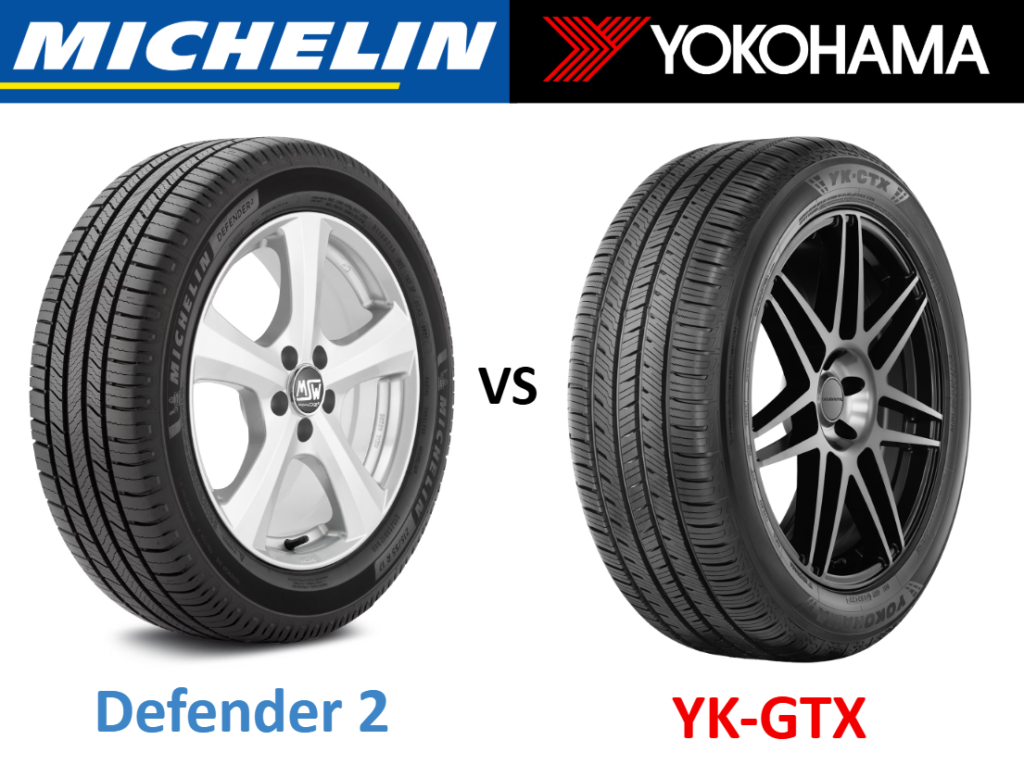
Big miles, everyday comfort, and all-season confidence—this is a battle for the long haul. The Michelin Defender 2 takes on the Yokohama YK-GTX in the all-season touring segment, where long tread life is a major selling point. Michelin brings its premium positioning, while Yokohama fields a challenger available exclusively at Discount Tire. Can this exclusive contender give buyers a reason to look beyond Michelin? Let’s see who delivers when the miles—and the braking distances—start adding up.
Table of Contents
Results : Michelin Defender 2 vs Yokohama YK-GTX
The test results are based on Treadwell data from Discount Tire. The graph below compares the Michelin Defender 2 vs Yokohama YK-GTX across key performance categories.
For subjective evaluations, each point is treated as equivalent to a 5% difference. For example, if Tire A scores a 4 and Tire B scores a 3, Tire A is considered 5% better than Tire B in that category.
Wet
The Yokohama YK-GTX stops in 149 feet in wet braking, while the Michelin Defender 2 needs 160 feet. That is an 11-foot shorter stopping distance, giving Yokohama a 7% advantage. Yokohama also leads in wet handling, scoring 4/5 against Michelin’s 3.5/5. That is a 0.5-point lead, equivalent to a 2.5% advantage on your comparison scale. With shorter stopping distances and a higher handling score, the YK-GTX comes out ahead in the wet.
YK-GTX :
- +7% Wet Braking
- +2.5% Wet Handling
Winter
The Yokohama YK-GTX scores 3.5/5 for winter performance, compared with 2.5/5 for the Michelin Defender 2. That is a 1-point lead, giving Yokohama a 5% advantage on the comparison scale. The YK-GTX therefore takes another win, strengthening its case for drivers who also face winter conditions.
YK-GTX :
- +5% Snow
Mileage
The Michelin Defender 2 has a median mileage of 61,500 miles, compared with 55,000 miles for the Yokohama YK-GTX. That puts Yokohama 6,500 miles behind, or 11% lower on mileage. Michelin takes the win here, offering more miles before replacement to counter Yokohama’s wet and winter advantages.
YK-GTX :
- -11% Mileage
Dry
The Yokohama YK-GTX stops in 127 feet in dry braking, while the Michelin Defender 2 needs 133 feet. That is a 6-foot shorter stopping distance, giving Yokohama a 5% advantage. Michelin leads in dry handling, scoring 3.5/5 against Yokohama’s 3/5. That puts Yokohama 0.5 points behind, or 2.5% lower on the comparison scale. The dry results are split: Yokohama stops sooner, while Michelin earns the higher handling score.
YK-GTX :
- +5% Dry Braking
- -2.5% Dry Handling
Noise Vibration & Harshness (NVH)
The Michelin Defender 2 scores 4/5 for quiet ride, compared with 3.5/5 for the Yokohama YK-GTX. That puts Yokohama 0.5 points behind, or 2.5% lower on the comparison scale. Ride comfort is equal at 4/5, with a 0% difference. Michelin therefore has the edge for a quieter drive, while both deliver the same level of comfort.
YK-GTX :
- -2.5% Quiet Ride
- 0% Comfort
Fuel Consumption
The Michelin Defender 2 scores 3/5 for fuel efficiency, compared with 2.5/5 for the Yokohama YK-GTX. That puts Yokohama 0.5 points behind, or 2.5% lower on the comparison scale. Michelin takes the advantage here, adding better fuel efficiency to its longer mileage.
YK-GTX :
- -2.5% Fuel Efficiency
Price
In size 215/55R17, the Yokohama YK-GTX costs $176 per tire, compared with $210 for the Michelin Defender 2. That makes Yokohama $34 cheaper per tire, or 16% less expensive, saving $136 across a set of four. Combined with its stronger wet performance, the YK-GTX makes a strong case for value.
Tire size: 215/55R17
- Defender 2: $210
- YK-GTX : $176
Difference: -16% more cheaper for YK-GTX
Conclusion:
As a tire engineer, I would choose the Michelin Defender 2 for its longer mileage, quieter ride, better fuel efficiency and stronger dry handling. The trade-off is paying more while accepting longer wet and dry stopping distances. The Yokohama YK-GTX delivers better braking, wet handling and winter ratings, with equal ride comfort—all for 16% less. For me, Yokohama offers the stronger overall value, while Michelin suits drivers who prioritize longevity and refinement.
Dr Edwin Pang