
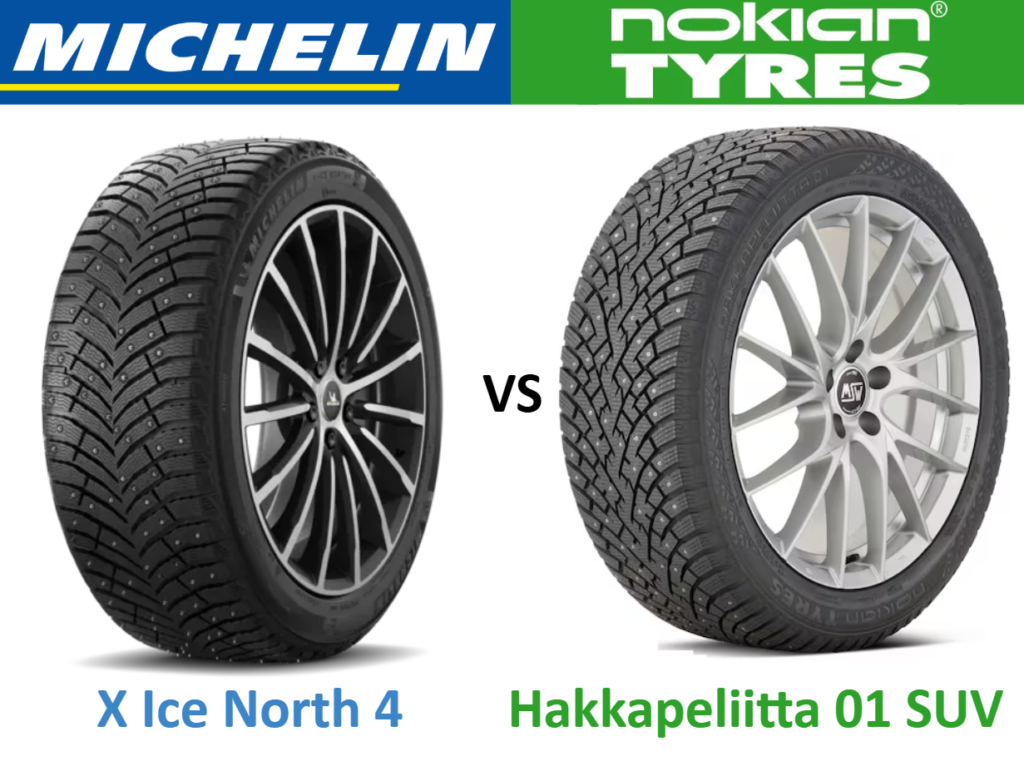
The Michelin X-Ice North 4 vs Nokian Hakkapeliitta 01 SUV is one of the most fascinating battles in the studded winter segment. Michelin’s X-Ice North 4 is a proven benchmark, while the all-new Hakkapeliitta 01 SUV arrives with Nokian’s headline-grabbing retractable stud technology—part engineering innovation, part gimmick, and undoubtedly part marketing story.
But winter tires are ultimately judged by what happens on snow and ice, not by the technology printed on the brochure. So enough about the clever studs and big claims. Can Nokian’s radical new Hakkapeliitta 01 SUV actually outperform Michelin’s established X-Ice North 4 when conditions turn brutal? Let’s put them head-to-head and find out.
Table of Contents
Results : Michelin X-Ice North 4 vs Nokian Hakkapeliitta 01 SUV
The results were taken from Vi Bilagare 2026 studded tire test. The graph below shows the comparison between Michelin X-Ice North 4 vs Nokian Hakkapeliitta 01 SUV based on the relevant performance category. The Michelin X Ice North 4 was set as a reference hence at the 100% mark. The handling criteria shown in the test are evaluated objectively through lap times except for dry handling.
Note that for subjective evaluation, we equate 1 point as 5%. Hence for example if tire A is graded 5 while tire B is graded 4, A is better than B by 5%. The tire size of interest is 215/65R17 which is a common tire size for Audi A3 and the Skoda Kodiaq. You can check out our latest tire size table for more information. The testing vehicle of choice is a Volkswagen Tiguan.
Ice
On ice, the Nokian Hakkapeliitta 01 SUV has the advantage across all three tests. In ice acceleration, it reaches 25 km/h in 10.43 seconds, 0.12 seconds quicker than the Michelin X-Ice North 4 at 10.55 seconds, giving Nokian a 1% advantage.
The gap becomes more noticeable in ice braking. The Nokian stops in 10.81 meters, 0.58 meters shorter than the Michelin’s 11.39 meters, a 5% advantage. In ice handling, the Nokian completes the course in 77.95 seconds, 1.12 seconds faster than the Michelin at 79.07 seconds, giving it another 1% advantage. Overall, the new Hakkapeliitta 01 SUV shows a small but consistent edge over the X-Ice North 4 on ice, with its strongest gain coming under braking.
Hakkapeliitta 01 SUV :
- +1% in ice acceleration
- +5% in ice braking
- +1% in ice handling
Snow
On snow, the Michelin X-Ice North 4 has the advantage in acceleration and braking. It accelerates from 5–35 km/h in 4.87 seconds, 0.18 seconds quicker than the Nokian Hakkapeliitta 01 SUV at 5.05 seconds, giving the Nokian a 4% disadvantage. In snow braking, the Michelin stops in 13.94 meters, 0.20 meters shorter than the Nokian’s 14.14 meters, a 1% advantage for Michelin.
The Nokian Hakkapeliitta 01 SUV turns the result around slightly in snow handling, completing the course in 69.10 seconds, 0.39 seconds faster than the Michelin at 69.49 seconds, giving Nokian a 1% advantage. Overall, the Michelin has the small edge in straight-line snow performance, while the Nokian claws back a narrow advantage around the handling track.
Hakkapeliitta 01 SUV :
- -4% in snow acceleration
- -1% in snow braking
- +1% in snow handling
Wet
In the wet, the Nokian Hakkapeliitta 01 SUV clearly outperforms the Michelin X-Ice North 4. In wet braking, the Nokian stops in 56.06 meters, which is 4.89 meters shorter than the Michelin’s 60.95 meters, giving it a 9% advantage. In wet handling, the Nokian completes the lap in 40.46 seconds, 1.16 seconds faster than the Michelin at 41.62 seconds, a 3% advantage.
The Nokian also performs better in aquaplaning, reaching 69.0 km/h, which is 1.1 km/h higher than the Michelin’s 67.9 km/h, giving it a 2% advantage. Overall, the Hakkapeliitta 01 SUV has the stronger wet performance, with its biggest gain coming in wet braking.
Hakkapeliitta 01 SUV :
- +9% in wet braking
- +3% in wet handling
- +2% in aquaplaning
Dry
In the dry, braking performance is almost identical. The Michelin X-Ice North 4 stops in 52.28 meters, just 0.27 meters shorter than the Nokian Hakkapeliitta 01 SUV at 52.55 meters, which rounds to 0% difference.
The bigger gap comes in dry handling. The Michelin scores 5/5, while the Nokian manages only 2/5, a difference of 3 points, corresponding to a 15% disadvantage for the Nokian in the normalized comparison. Overall, dry braking is essentially a tie, but the Michelin feels considerably stronger and more confident in dry handling.
Hakkapeliitta 01 SUV :
- 0% in dry braking
- -15% in subjective dry handling
Fuel Consumption
In fuel consumption, the Michelin X-Ice North 4 is slightly more efficient. It uses 6.432 L/100 km, which is 0.087 L/100 km less than the Nokian Hakkapeliitta 01 SUV at 6.519 L/100 km, giving the Nokian a 1% disadvantage.
Hakkapeliitta 01 SUV :
- -1% in fuel consumption
Noise
In interior noise at 70 km/h, the Nokian Hakkapeliitta 01 SUV is quieter. It records 65.6 dB, which is 1.6 dB lower than the Michelin X-Ice North 4 at 67.2 dB, giving the Nokian a 2% advantage.
Hakkapeliitta 01 SUV :
- +2% in interior noise (-1.6 dB)
Price
For the tested 215/65 R17 size, the Michelin X-Ice North 4 costs €173, while the Nokian Hakkapeliitta 01 SUV costs €196. That makes the Nokian €23 more expensive, or about 12% more than the Michelin. So while the Hakkapeliitta 01 SUV brings newer technology and stronger results in areas such as wet performance and cabin noise, the Michelin starts with a clear price advantage.
Tire size: 215/65 R17
- X Ice North 4 : € 173
- Hakkapeliitta 01 SUV : € 196
Difference: +12% more expensive for Hakkapeliitta 01 SUV.
Conclusion
From a tire expert’s point of view, the Nokian Hakkapeliitta 01 SUV is the more impressive tire on ice and in the wet. It delivers better ice braking, stronger wet braking and handling, better aquaplaning resistance, and a quieter cabin. The Michelin X-Ice North 4, however, is stronger in snow acceleration and braking, slightly more efficient, significantly better in dry handling, and €23 cheaper in this size.
The big story is Nokian’s automatic stud retraction system, but based on this test, I think it feels somewhat overhyped. The technology sounds clever, yet the Hakkapeliitta 01 SUV’s very poor dry handling score of 2/5 versus Michelin’s 5/5 shows that the concept still comes with a serious compromise. For me, the Nokian is the stronger choice for maximum ice and wet performance, while the Michelin remains the more balanced and better-value all-round studded tire.
Dr Edwin Pang