
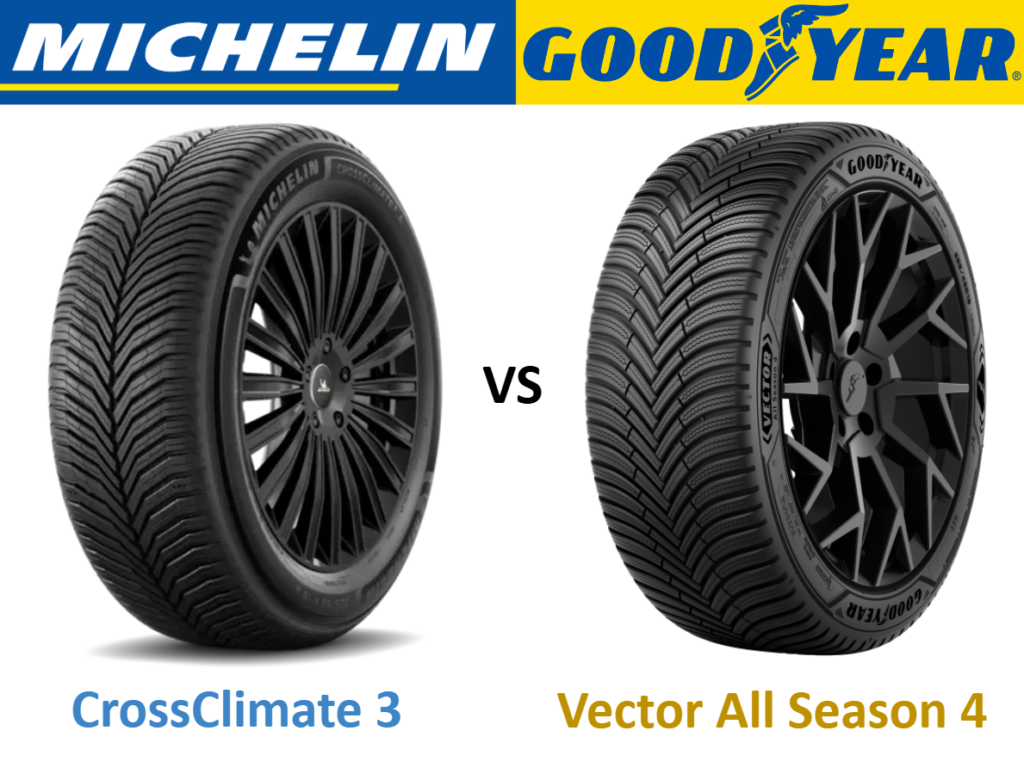
Michelin CrossClimate 3 vs Goodyear Vector All Season 4: Can the all-new Goodyear Vector All Season 4 beat the tire that helped define the snow-certified all-season segment? The Michelin CrossClimate 3 carries the legacy of the original CrossClimate, which made the Three-Peak Mountain Snowflake a selling point for year-round tires. Now Goodyear wants the crown. Let’s see who comes out on top, starting in the wet.
Table of Contents
Results: Michelin CrossClimate 3 vs Goodyear Vector All Season 4
Results below were taken from AutoBild’s 2026 All Season Tire test with a total of 15 tires tested. The graph below shows the comparison between Michelin CrossClimate 3 vs Goodyear Vector All Season 4 based on the relevant performance category. The Michelin CrossClimate 3 was set as a reference hence at the 100% mark.
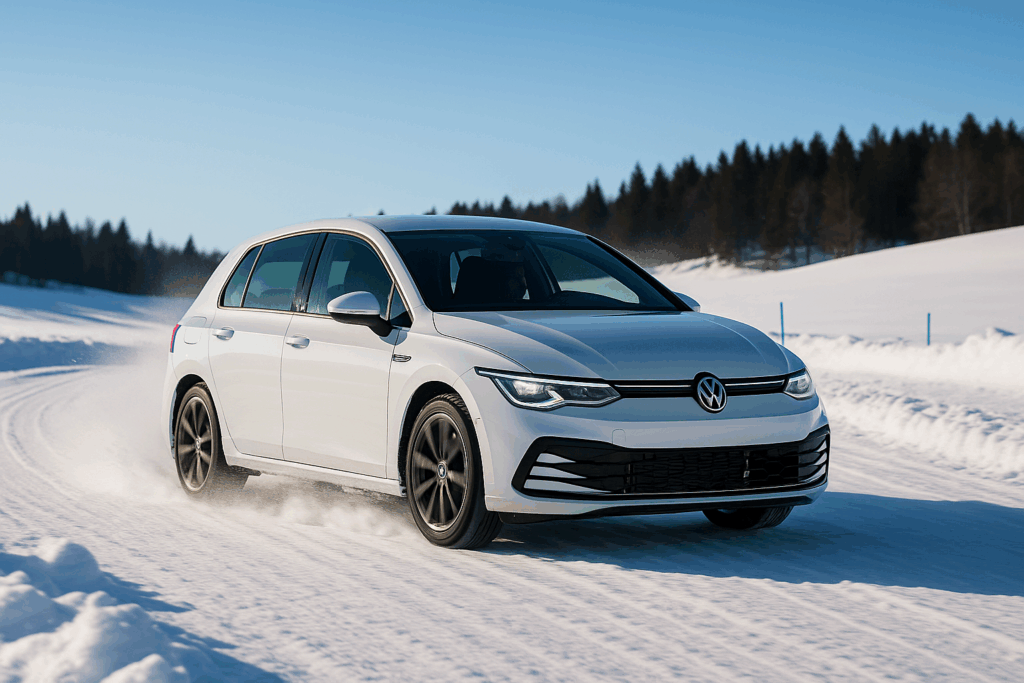
Since we are talking about the all season with 3 peak mountain certification segment, the snow performances was tested. The tire size of interest is 225/45 R17 which is a common tire size for Volkswagen Golf & Audi A3. You can check out our latest tire size table for more information. The testing vehicle is a Volkswagen Golf.
Wet
The Goodyear Vector All Season 4 stopped 2.9 metres sooner than the Michelin CrossClimate 3 in wet braking, a 7% advantage. It was 2.7 km/h faster in wet handling, a 4% advantage, and resisted straight aquaplaning at a 1.76 km/h higher speed, a 2% advantage.
Goodyear wins all three wet tests, with its biggest gain in braking.
Vector All Season 4 :
- +7% in wet braking
- +4% in wet handling
- +2% in straight aquaplaning
Snow
On snow, the Michelin CrossClimate 3 stopped 1.1 metres sooner than the Goodyear Vector All Season 4, putting Goodyear 4% behind in braking. Goodyear pulled back in snow traction, generating 48 N more force for a 2% advantage.
In snow handling, Michelin was just 0.2 km/h faster, a 0% difference after rounding. Michelin has the edge in stopping, Goodyear has the edge in getting moving, and they’re effectively tied through the corners.
Vector All Season 4 :
- -4% in snow braking
- +2% in snow traction
- 0% in snow handling
Wear
The Goodyear Vector All Season 4 is projected to last 3,950 km longer than the Michelin CrossClimate 3, a 7% mileage advantage. Goodyear also shed 1 gram less rubber in the abrasion test, a 0% difference after rounding. So Goodyear has the edge in tread life, while abrasion is effectively a tie.
Vector All Season 4 :
- +7% in mileage
- 0% in abrasion
Dry
In dry braking, the Goodyear Vector All Season 4 stopped 0.7 metres sooner than the Michelin CrossClimate 3, a 2% advantage. Goodyear was also 0.5 km/h faster in dry handling, scored as a 0% difference in the comparison. So Goodyear has a small edge in stopping, while dry handling is effectively tied.
Vector All Season 4 :
- +2% in dry braking
- 0% in dry handling
NVH
The Michelin CrossClimate 3 scored 0.2 points higher than the Goodyear Vector All Season 4 for ride comfort, putting Goodyear 1% behind on the comparison index. Michelin was also 1.1 dB quieter in the external noise test, where Goodyear trailed by 2% on the index. So Michelin takes both tests, with a slightly more comfortable ride and less noise as it passes by.
Vector All Season 4 :
- -1% in subjective comfort
- -2% in exterior noise (+1.1 dB)
Rolling Resistance
The Goodyear Vector All Season 4 had 0.35 kg/t lower rolling resistance than the Michelin CrossClimate 3, a 5% advantage on the comparison index. That gives Goodyear the efficiency edge, as it takes less energy to keep rolling.
Vector All Season 4 :
- +5% in rolling resistance
Price
In 225/45 R17, the Goodyear Vector All Season 4 costs €101 per tire, compared with €116 for the Michelin CrossClimate 3. That makes the Goodyear €15 cheaper per tire, a 13% saving that adds up to €60 on a set of four.
Tire size: 225/45 R17
- CrossClimate 3 : € 116
- Vector All Season 4 : € 101
Difference: -13% more cheaper for Vector All Season 4
Conclusion from a Tire Expert’s Perspective:
As a tire engineer, I’d choose the Goodyear Vector All Season 4 for most drivers. It won all three wet tests, stopping 2.9 metres sooner in the wet. It also had lower rolling resistance, is projected to last 3,950 km longer, and costs €15 less per tire.
I’d choose the Michelin CrossClimate 3 if snow braking were my priority. It stopped 1.1 metres sooner on snow, scored slightly higher for ride comfort, and produced less external noise. For me, the trade-off comes down to where I need the shorter stop most: wet roads or snow.
Dr Edwin Pang