
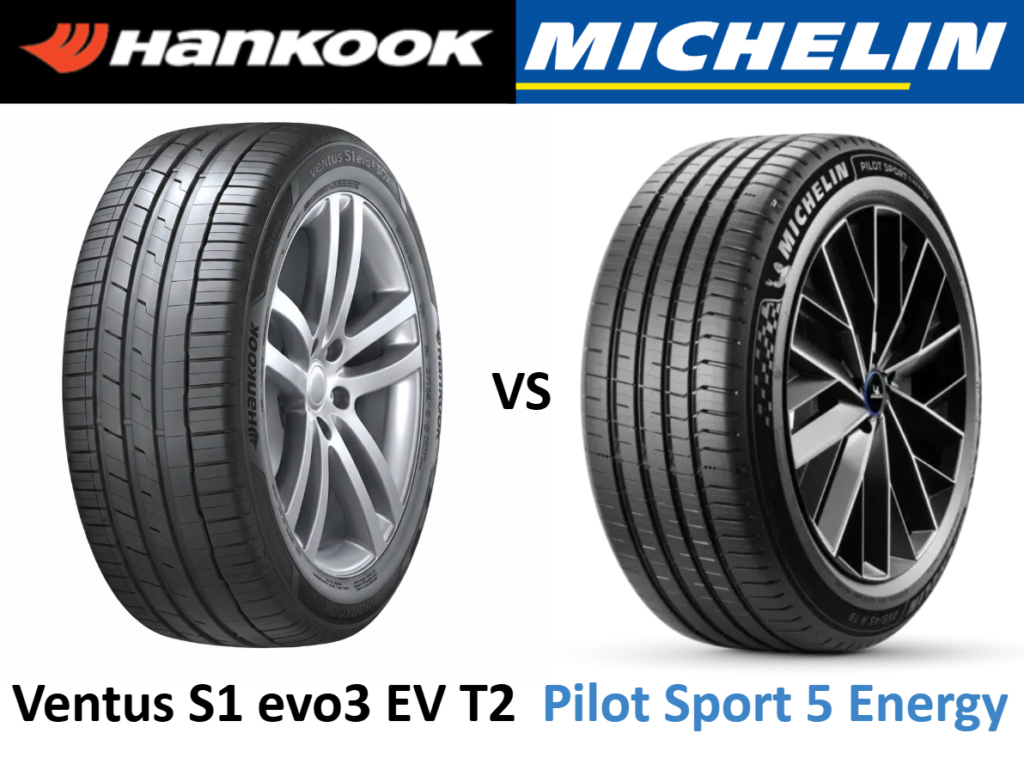
Hankook Ventus S1 evo3 EV T2 vs Michelin Pilot Sport 5 Energy: Can Michelin’s newest Pilot Sport beat the tire Tesla picked for the Model Y? The Hankook Ventus S1 evo3 EV T2 is a Tesla-approved factory fitment, and it’s going head-to-head with the newly launched Michelin Pilot Sport 5 Energy, built to combine sporty handling with low rolling resistance.
The big question is whether Michelin can stop shorter in the wet and still match the efficiency of Tesla’s factory Hankook.
Table of Contents
Results: Hankook Ventus S1 evo3 EV T2 vs Michelin Pilot Sport 5 Energy
The results presented here are from TÜV SÜD’s 713367264-S3-01 report. The accompanying graph provides a side-by-side comparison of the Hankook Ventus S1 evo3 EV T2 vs Michelin Pilot Sport 5 Energy across various performance categories, with the Hankook Ventus S1 evo3 EV T2 serving as the benchmark at 100%.
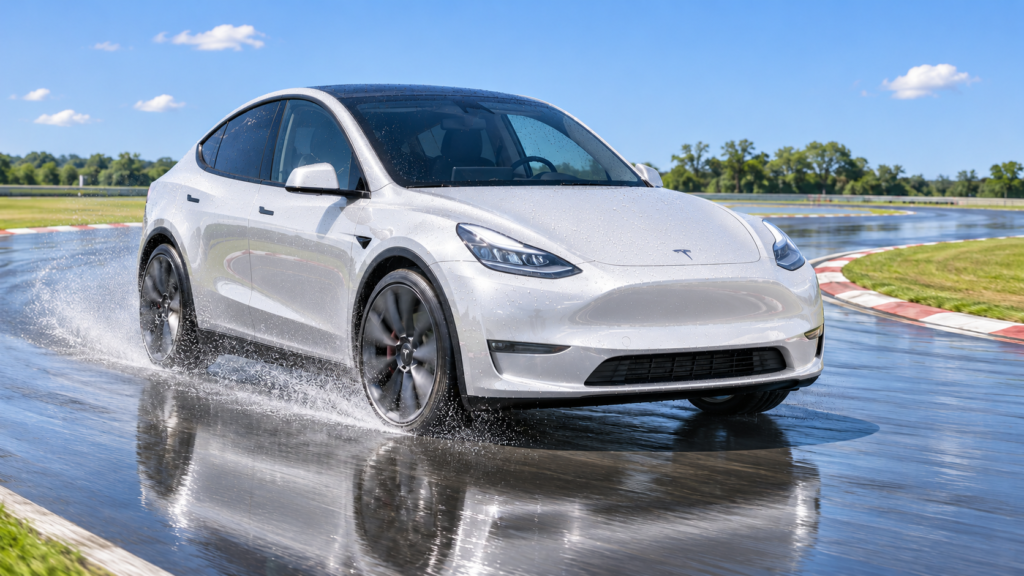
The tire size of interest is the 255/45 R19 tire size, a popular choice for vehicles like the Volvo XC40 & Audi A6. For further insights into various tire sizes, feel free to consult our latest tire size table. The tests were conducted using a Tesla Model Y as the test vehicle.
Wet
In wet braking from 80 to 20 km/h, the Michelin Pilot Sport 5 Energy needed 33.1 metres versus 39.4 metres for the Hankook Ventus S1 evo3 EV T2. That’s 6.3 metres shorter, a 19% advantage on the performance index.
The Michelin also lapped the wet course 4.6 seconds quicker, a 6% advantage, and scored 1.09 points higher in the driver’s handling assessment, also a 6% advantage.
Michelin wins all three wet tests, with braking showing the biggest gap.
Pilot Sport 5 Energy :
- +19% in wet braking
- +6% in wet handling (lap time)
- +6% in wet handling (subj)
Dry
From 100 km/h, the Michelin Pilot Sport 5 Energy stopped in 34.1 metres, compared with 36.0 metres for the Hankook Ventus S1 evo3 EV T2. That’s 1.9 metres shorter, a 6% advantage on the performance index. Michelin leads in both braking tests, with a bigger gap in the wet.
Pilot Sport 5 Energy :
- +6% in dry braking
Rolling Resistance
The Hankook Ventus S1 evo3 EV T2 recorded a rolling resistance coefficient of 6.0 versus 6.4 for the Michelin Pilot Sport 5 Energy. Michelin’s coefficient was 0.4 higher, putting it 6% behind on the performance index. Michelin led in the wet, while Hankook takes the rolling resistance round.
Pilot Sport 5 Energy :
- -12% in rolling resistance
Price
In 255/45R19, the Hankook Ventus S1 evo3 EV T2 costs €226 per tire, while the Michelin Pilot Sport 5 Energy costs €261. The Michelin is €35 more per tire, a 15% premium that adds €140 to the cost of a set of four.
Tire size: 255/45R19
Difference: +15% more expensive for Pilot Sport 5 Energy
Summary
As a tire engineer, I’d choose the Michelin Pilot Sport 5 Energy for a Model Y that regularly sees wet roads. It needed 6.3 metres less to slow from 80 to 20 km/h in the wet, handled better on the wet course, and stopped 1.9 metres shorter in the dry. The wet braking margin is what would make me pay the premium.
If efficiency and upfront cost came first, I’d stick with the Tesla-approved Hankook Ventus S1 evo3 EV T2. It has lower rolling resistance and saves €140 on a set of four.
Dr Edwin Pang