
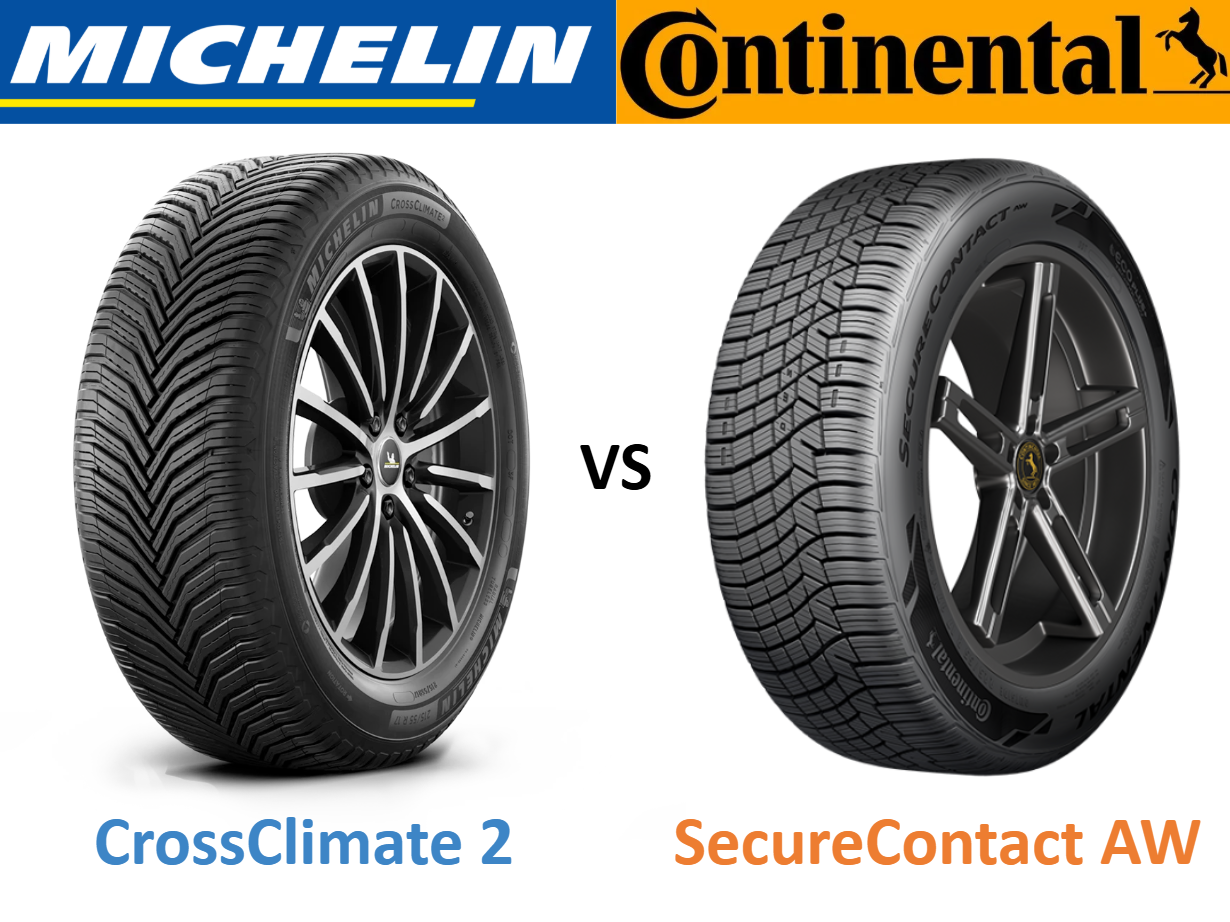
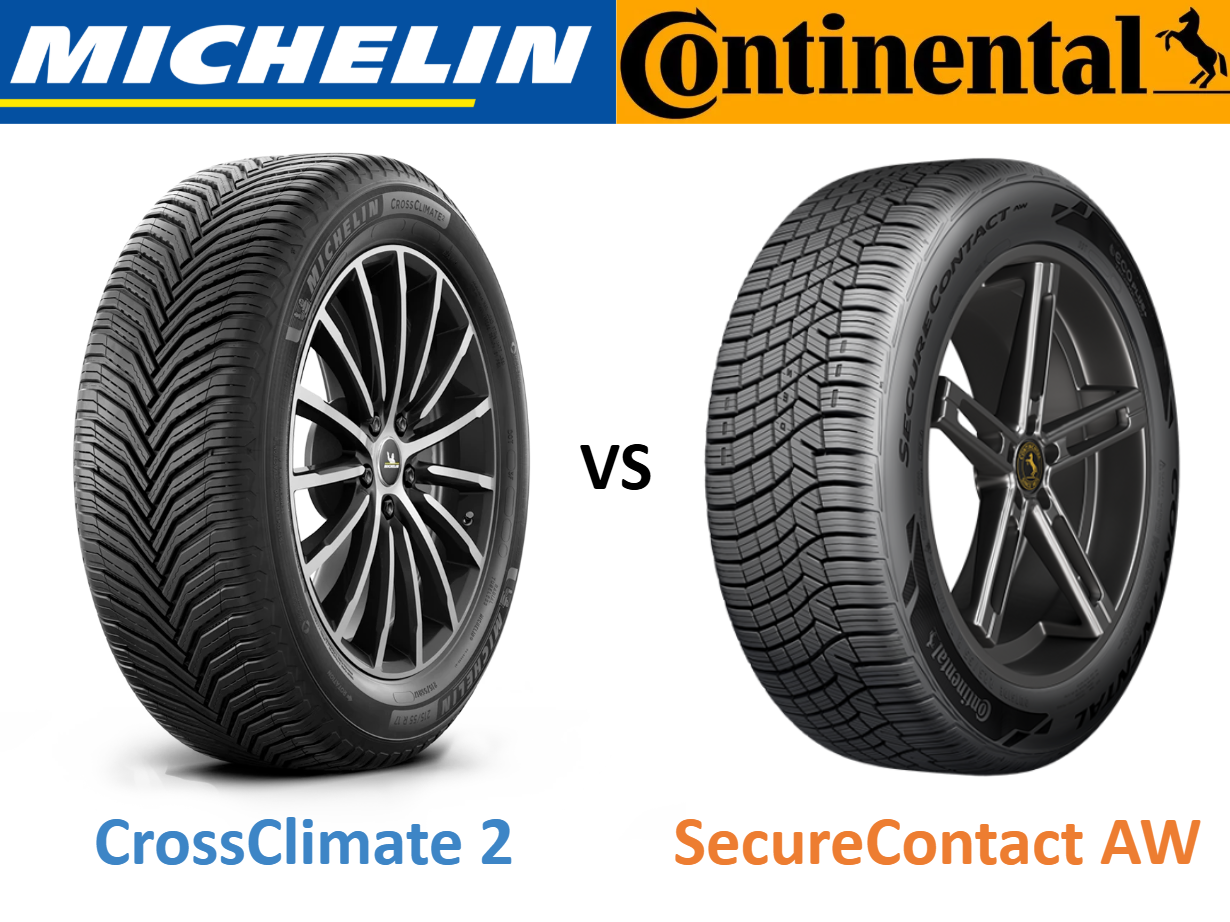
Michelin CrossClimate 2 vs Continental SecureContact AW — the wait is finally over. Continental’s long-awaited entry into the true all-weather space has arrived, and this time it comes fully armed with the 3-Peak Mountain Snowflake certification, signaling real winter capability beyond traditional all-season limits . For years, the CrossClimate 2 has stood as the undisputed benchmark in this segment — the tire everyone else has been chasing.
But now, with the SecureContact AW stepping in as a fresh 2026 challenger, promising strong wet performance, balanced touring comfort, and genuine year-round usability, the stage is set for a serious showdown. So the question is simple: can Continental’s newest all-weather weapon finally dethrone the segment leader — or does Michelin still hold the crown? Let’s find out.
Table of Contents
Results: Michelin CrossClimate 2 vs Continental SecureContact AW
Results below were taken from the Tyre Review’s “All Weather Tire Test. The graph below shows the comparison between Michelin CrossClimate 2 vs Continental SecureContact AW based on the relevant performance category. Michelin CrossClimate 2 was set as a reference hence at the 100% mark. Note that for subjective evaluation, we equate 1 point as 5%. Hence for example if tire A is graded 7 while tire B is graded 6, A is better than B by 5%.
As both tires are categorized as all weather tires, Tyre Review has included snow & ice in its testing portfolio. The tire size of interest is 235/45R18 which is a common tire size for Volkswagen Passat & Honda Accord. You can check out our latest tire size table for more information.
Wet
In wet braking, the Continental SecureContact AW stops 0.95 feet shorter than the Michelin CrossClimate 2, which equals a 1% advantage. In wet handling, the SecureContact AW completes the lap 2.20 seconds faster, translating to a 3% improvement over the CrossClimate 2. However, in straight aquaplaning, the CrossClimate 2 maintains stability at 3.18 mph higher speed, giving it a clear 7% advantage over the SecureContact AW.
Overall, the SecureContact AW delivers slightly better wet braking and clearly stronger wet handling, while the CrossClimate 2 still dominates in aquaplaning resistance, making this a balanced trade-off between cornering performance and straight-line water evacuation.
SecureContact AW :
- +1% in wet braking
- +3% in wet handling
- -7% in aquaplaning
Snow
In snow braking, the Michelin CrossClimate 2 stops 0.72 feet shorter than the Continental SecureContact AW, which is about a 1% advantage. In snow traction, both tires perform identically with no measurable difference, translating to a 0% gap. In snow handling, the CrossClimate 2 completes the lap 2.01 seconds faster, giving it a 2% advantage over the SecureContact AW.
Overall, the CrossClimate 2 holds a slight but consistent edge in snow performance, particularly in braking and handling, while traction remains equal between both tires.
SecureContact AW :
- -1% in Snow braking
- 0% in Snow traction
- -2% in Snow handling
Ice
In ice braking, the Michelin CrossClimate 2 stops 0.33 feet shorter than the Continental SecureContact AW, which equals a 2% advantage. In ice traction, the CrossClimate 2 completes the test 0.39 seconds faster, translating to a 7% improvement over the SecureContact AW.
Overall, the CrossClimate 2 clearly holds the advantage on ice, delivering both shorter braking distances and stronger traction, showing a more confident performance in low-grip conditions.
SecureContact AW :
- -2% in Ice braking
- -7% in Ice traction
Dry
In dry braking, the Michelin CrossClimate 2 stops 7.32 feet shorter than the Continental SecureContact AW, which is a clear 5% advantage. In dry handling, the SecureContact AW completes the lap 0.17 seconds faster, translating to essentially a 0% difference between both tires.
Overall, the CrossClimate 2 shows a clear edge in dry braking, while both tires are effectively matched in dry handling with only a negligible difference separating them.
SecureContact AW :
- -5% in dry braking
- 0% in dry handling
Noise
In noise performance, the Continental SecureContact AW is 1.8 dB quieter than the Michelin CrossClimate 2, which translates to a 2% advantage.
SecureContact AW :
- +2% in exterior noise (-1.8 dB)
Rolling Resistance
In rolling resistance, the Continental SecureContact AW records 0.41 N/kN lower resistance than the Michelin CrossClimate 2, which translates to a 5% advantage.
SecureContact AW :
- +5% in rolling resistance
Mileage
In terms of mileage, one of the key reasons the Michelin CrossClimate 2 has built such a strong reputation is its outstanding longevity. In the latest Consumer Reports testing, it achieved an impressive 95,000 miles in real-world measured results, reinforcing its position as one of the longest-lasting all-weather tires on the market. While we currently do not have comparable mileage data for the Continental SecureContact AW, it is unlikely to match this level of durability, given how exceptionally high the CrossClimate 2 has set the benchmark.
Price
In terms of price, the Continental SecureContact AW comes in $27 cheaper than the Michelin CrossClimate 2, which is a 15% lower cost.
Tire size: 215/55R17
- CrossClimate 2 : $ 209
- SecureContact AW : $ 182
Difference: -15% more cheaper for SecureContact AW
Summary
From my perspective as a tire engineer, both tires clearly have their strengths. The Continental SecureContact AW impresses with stronger wet handling, better efficiency, lower noise, and a more attractive price point, making it a very compelling modern all-weather option. However, the Michelin CrossClimate 2 still stands out where it matters most — it delivers more consistent performance across all conditions, with clear advantages in aquaplaning, snow, ice, and especially dry braking, combined with its proven, class-leading mileage of up to 95,000 miles.
The truth is, the CrossClimate 2 still reigns as the best all-weather tire because it doesn’t just excel in one or two areas — it delivers the most complete, dependable performance package with unmatched longevity, and that balance is exactly what defines a true segment leader.
Dr Edwin Pang