
Goodyear Assurance MaxLife 2 vs WeatherReady 2 — a battle between pure mileage-focused all-season efficiency and all-weather versatility with 3-Peak Mountain certification. The MaxLife 2 is built to maximize longevity and value, while the WeatherReady 2 trades some wear for stronger wet grip and real winter capability — so the question is simple: do you prioritize maximum lifespan, or year-round confidence in all conditions?
Table of Contents
Results: Goodyear Assurance MaxLife 2 vs WeatherReady 2
Results below were taken from the Tire Rack’s “Touring all season road test. A total of 11 tires were tested this time around in Tire Rack’s own proving ground. The graph below shows the comparison between Goodyear Assurance MaxLife 2 vs WeatherReady 2 based on the relevant performance category. Goodyear Assurance MaxLife 2 was set as a reference hence at the 100% mark. Note that for subjective evaluation, we equate 1 point as 5%. Hence for example if tire A is graded 7 while tire B is graded 6, A is better than B by 5%.
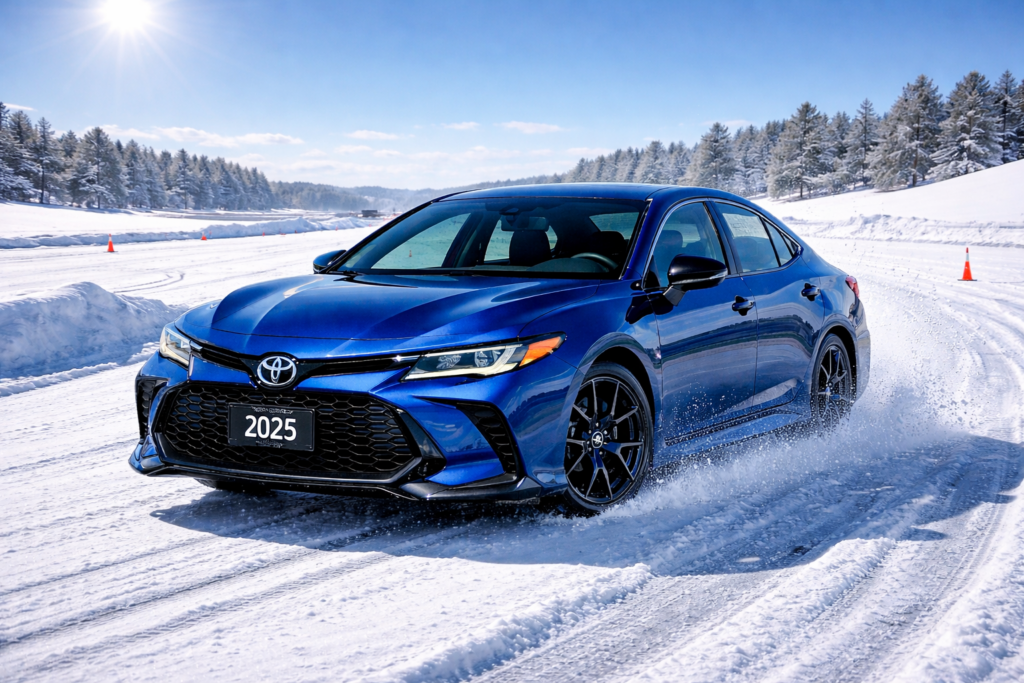
As both tires are categorized as all season tires, Tire Rack has included snow & ice in its testing portfolio. The tire size of interest is 215/55R17 which is a common tire size for Toyota Camry. You can check out our latest tire size table for more information. The testing vehicle is a 2025 Toyota Camry.
Wet
In wet braking, the WeatherReady 2 stops 10 feet shorter than the Assurance MaxLife 2, translating to a 7% advantage. In wet handling, it carries stronger grip with a 0.89-second faster lap time, about a 3% improvement, while also feeling more secure subjectively with a 1.12-point higher score, equivalent to a 6% gain in driver confidence.
Overall, the WeatherReady 2 consistently outperforms the MaxLife 2 in wet conditions, clearly showing its all-weather strength, while the MaxLife 2 remains more focused on longevity rather than outright wet grip.
WeatherReady 2 :
- +7% in wet braking
- +6% in wet handling (subj)
- +3% in wet handling (lap time)
Dry
In dry braking, the WeatherReady 2 stops just 1 foot shorter than the Assurance MaxLife 2, which is about a 1% advantage. In subjective dry handling, it also edges ahead slightly with a 0.13-point higher score, translating to a 1% improvement in driver feel.
Overall, both tires perform very closely in dry conditions, with the WeatherReady 2 holding a small but consistent edge, while the difference remains minimal in real-world driving.
WeatherReady 2 :
- +1% in dry braking
- +1% in dry handling (subj)
Noise/Comfort/Ride Quality
In noise, comfort, and ride quality, the Assurance MaxLife 2 scores 0.25 points higher than the WeatherReady 2, which translates to about a 1% advantage.
WeatherReady 2 :
- -1% in average of Noise, Comfort & Ride Quality.
Snow
In snow braking, the WeatherReady 2 stops 4.16 feet shorter than the Assurance MaxLife 2, which is about a 5% advantage. Under acceleration, it gains traction earlier with a 3.11 feet shorter distance, translating to a strong 10% improvement. In snow handling, it completes the lap 3.82 seconds faster, about a 7% gain, while also delivering a much more confident feel with a 1.50-point higher subjective score, equivalent to an 8% advantage.
Overall, the WeatherReady 2 clearly dominates in snow — exactly what you would expect from a tire with 3-Peak Mountain Snowflake certification — while the MaxLife 2, as a traditional all-season tire, cannot match its true winter capability.
WeatherReady 2 :
- +5% in Snow braking
- +10% in Snow Acceleration
- +8% in Snow handling (subj)
- +7% in Snow handling (lap time)
Ice
In ice braking, the WeatherReady 2 stops 1.70 feet shorter than the Assurance MaxLife 2, translating to about a 3% advantage. Overall, the WeatherReady 2 holds a small but consistent edge on ice, reinforcing its 3-Peak Mountain Snowflake capability, while the MaxLife 2 falls slightly behind as a standard all-season tire.
WeatherReady 2 :
- +3% in Ice braking
UTQG ratings
In UTQG treadwear, the Assurance MaxLife 2 carries a 120-point higher rating (820 vs 700), which translates to about a 17% advantage in expected wear. This aligns closely with the mileage warranty, where the MaxLife 2 offers 25,000 miles more (85k vs 60k), equivalent to a 42% longer warranty coverage.
Overall, the MaxLife 2 clearly leads in longevity and long-term value, while the WeatherReady 2 sacrifices that wear advantage to deliver stronger performance capability.
| Brand | Tireline | Size | Tread Wear | Traction | Temperature |
|---|---|---|---|---|---|
| Goodyear | Assurance MaxLife 2 | All | 820 | A | B |
| Goodyear | WeatherReady 2 | All | 700 | A | A |
Price
At this size, the WeatherReady 2 is $8 cheaper than the Assurance MaxLife 2, translating to about a 4% price difference. Overall, the gap is small, and pricing alone isn’t significant enough to drive the decision — the choice should come down to whether you prioritize longer mileage (MaxLife 2) or stronger all-weather performance (WeatherReady 2).
Tire size: 215/55R17
- Assurance MaxLife 2 : $ 211
- WeatherReady 2 : $ 203
Difference: -4% more cheaper for WeatherReady 2
Summary
From my perspective as a tire engineer, the Assurance MaxLife 2 stands out for its exceptional mileage, comfort, and long-term value, making it a strong choice for drivers focused on durability and cost efficiency. On the other hand, the WeatherReady 2 clearly delivers superior wet, snow, and overall all-weather performance, backed by its 3-Peak Mountain Snowflake certification, giving it a real edge in safety when conditions turn challenging. Ultimately, both are well-optimized for their purpose — it simply comes down to whether you prioritize maximum lifespan or year-round confidence.
Dr Edwin Pang