
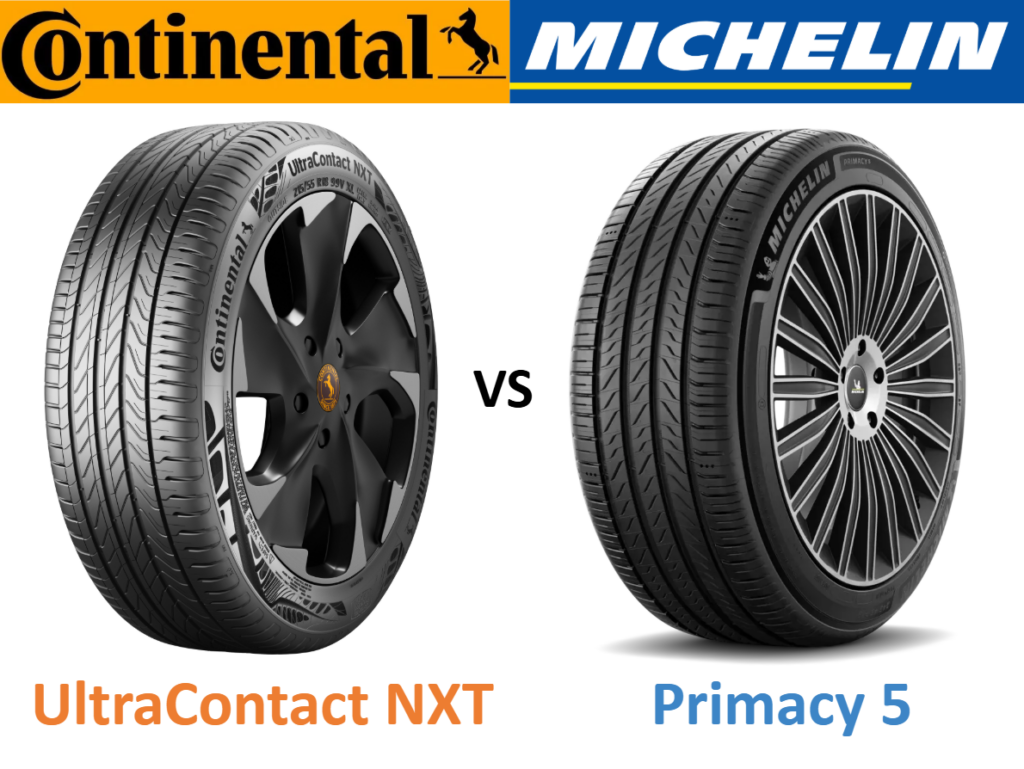
Continental UltraContact NXT vs Michelin Primacy 5 — a battle between eco innovation and premium touring performance. The UltraContact NXT is Continental’s bold sustainability-focused tire, using a high share of renewable, recycled, and certified materials while still targeting strong real-world summer performance. The Michelin Primacy 5 takes the more traditional premium touring route, focusing on safety, comfort, mileage, and efficiency. So the question is simple: can Continental’s eco-focused challenger take on Michelin’s latest touring benchmark in the eco summer segment?
Table of Contents
Results: Continental UltraContact NXT vs Michelin Primacy 5
The results presented here are from the AutoZurnal Eco Summer Tire Test, where 10 of the best summer ECO tire models were selected. The accompanying graph provides a side-by-side comparison of the Continental UltraContact NXT vs Michelin Primacy 5 across various performance categories, with the Continental UltraContact NXT serving as the benchmark at 100%.
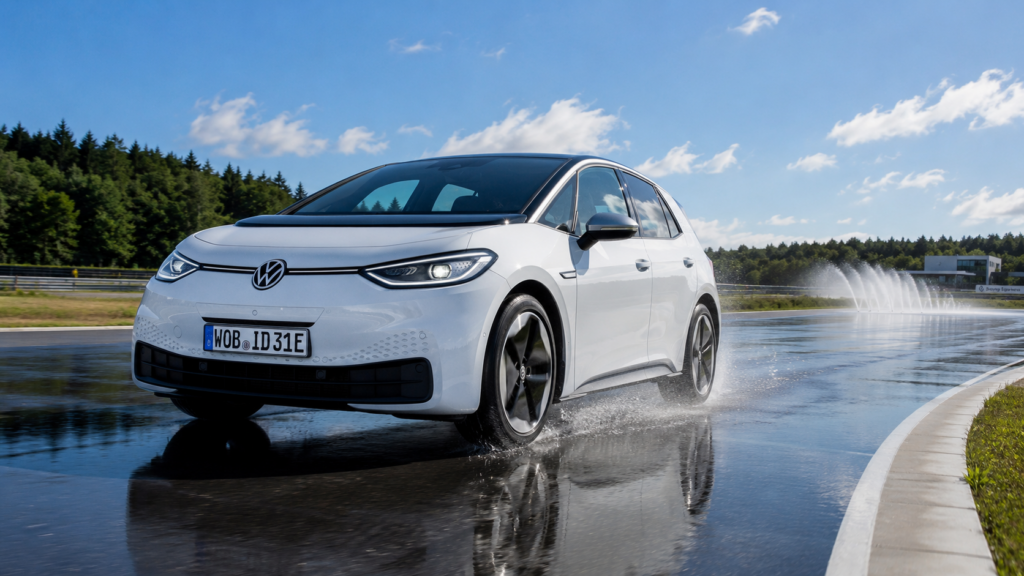
The tire size of interest is the 215/55R18 tire size, a popular choice for vehicles like the BYD Atto 3 & Mazda CX-30. For further insights into various tire sizes, feel free to consult our latest tire size table. The tests were conducted using a standard Volkswagen ID.3 as the test vehicle.
Wet
In wet braking, the Continental UltraContact NXT stops slightly shorter at 47.2 m, beating the Michelin Primacy 5 by 0.6 m, which is around 1% better. Wet handling is basically equal, with the Continental completing the lap in 87.0 seconds, just 0.3 seconds faster than the Michelin, but the difference remains 0%. However, in straight aquaplaning, the Michelin Primacy 5 pulls ahead clearly at 77.8 km/h, which is 3.3 km/h faster than the Continental, or 4% better.
Overall, the UltraContact NXT has the tiny edge in wet braking, both tires are equal in wet handling, but the Primacy 5 delivers the stronger aquaplaning safety margin.
Primacy 5 :
- -1% in wet braking
- 0% in wet handling
- +4% in aquaplaning
Efficiency
In rolling resistance, the Continental UltraContact NXT is clearly more efficient at 5.87 N/kN, beating the Michelin Primacy 5 by 0.90 N/kN, which is around 13% better. This advantage also carries into energy consumption, where the Continental uses 12.95 kWh/100km compared to 13.78 kWh/100km for the Michelin, saving 0.83 kWh/100km, or around 6% better.
Overall, this is where the UltraContact NXT really shows its eco-focused strength, delivering lower rolling resistance and better real-world efficiency than the Primacy 5.
Primacy 5 :
- -13% in rolling resistance
- -6% in energy consumption
Dry
In dry braking, the Continental UltraContact NXT stops shorter at 37.0 m, beating the Michelin Primacy 5 by 1.3 m, which is around 3% better. In subjective dry handling, the Continental also has the edge with 7.00 points compared to 6.69 points for the Michelin, a difference of 0.31 points, or around 2% better. Overall, the UltraContact NXT is slightly stronger in dry conditions, offering shorter braking and a sharper handling feel than the Primacy 5.
Primacy 5 :
- -3% in dry braking
- -2% in dry handling
Noise & Comfort
In subjective comfort, both tires are completely equal at 6.5 points, giving a 0% difference between the Continental UltraContact NXT and Michelin Primacy 5. For noise, the Continental is slightly quieter at 72.4 dB compared to 72.7 dB for the Michelin, a small 0.3 dB advantage, but still effectively a 0% difference. Overall, both tires are evenly matched in comfort and noise, with the UltraContact NXT having only a very tiny edge in measured cabin refinement.
Primacy 5 :
- 0% in subjective comfort
- 0% in exterior noise (+0.3 dB)
Price
In price, the Michelin Primacy 5 is slightly more expensive at €156, compared to €151 for the Continental UltraContact NXT. That makes the Michelin €5 more expensive, or around 3% higher. Overall, pricing is very close, but the UltraContact NXT offers a small value advantage while also delivering stronger efficiency-focused performance.
Tire size: 215/55 R18
- UltraContact NXT : € 151
- Primacy 5 : € 156
Difference: +3% more expensive for Primacy 5
Summary
From my tire expert point of view, the Continental UltraContact NXT is the more convincing tire in this test. It has the advantage in wet braking, dry braking, dry handling, rolling resistance, energy consumption, and price, which makes it a very strong eco-focused summer tire that does not feel like a big compromise. The Michelin Primacy 5 still has its clear advantage in straight aquaplaning, giving it the better safety margin in standing water, while comfort and noise are basically equal between both tires.
The only missing piece here is mileage, which was not tested. That is important because the Primacy line is traditionally very strong in wear, and if the Primacy 5 delivers a much longer tread life, it could still tip the scale back toward Michelin. But based purely on the tested results, the UltraContact NXT is the stronger all-round performer, especially when efficiency is part of the equation.
Dr Edwin Pang