
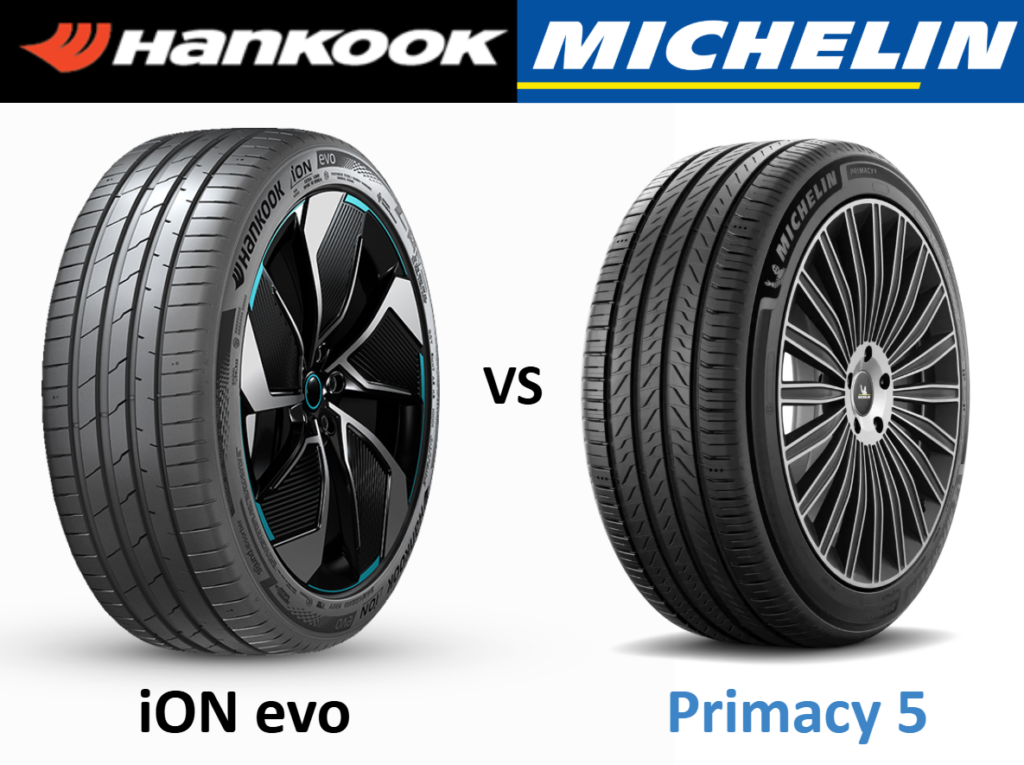
Hankook iON evo vs Michelin Primacy 5: This is a battle between a dedicated EV tire and a new-generation premium touring tire. The Hankook iON evo is built specifically for electric vehicles, focusing on low rolling resistance, reduced noise, and handling the extra weight and instant torque of EVs. The Michelin Primacy 5, launched last year, takes a more wholesome approach, aiming to deliver strong wet safety, long mileage, comfort, and efficiency for a wider range of vehicles. So the key question is simple: does an EV-specific tire still hold the advantage, or can Michelin’s latest touring flagship match it with a more balanced all-round package?
Table of Contents
Results: Hankook iON Evo vs Michelin Primacy 5
The results presented here are from the AutoZurnal Eco Summer Tire Test, where 10 of the best summer ECO tire models were selected. The accompanying graph provides a side-by-side comparison of the Hankook iON Evo vs Michelin Primacy 5 across various performance categories, with the Hankook iON Evo serving as the benchmark at 100%.
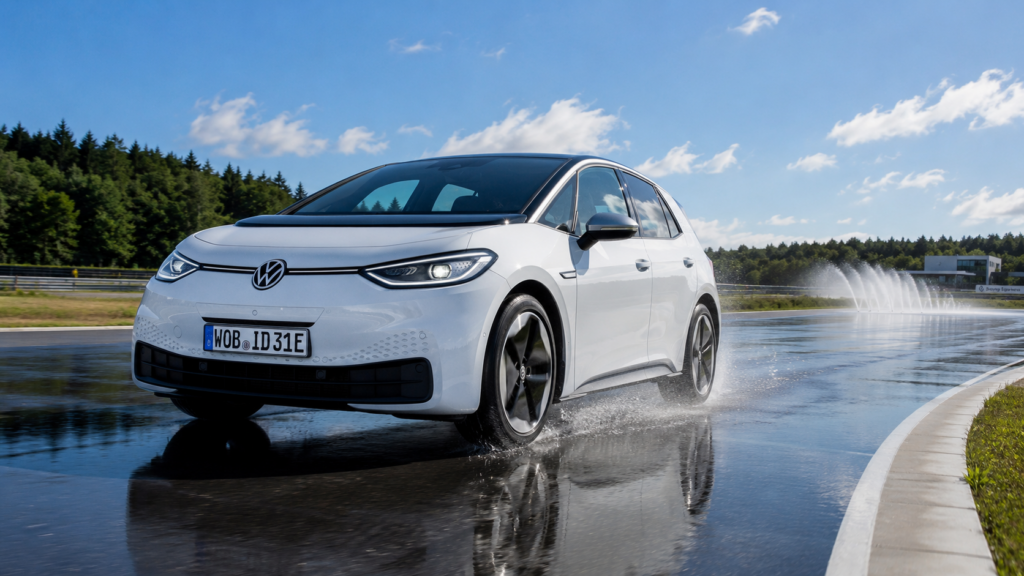
The tire size of interest is the 215/55R18 tire size, a popular choice for vehicles like the BYD Atto 3 & Mazda CX-30. For further insights into various tire sizes, feel free to consult our latest tire size table. The tests were conducted using a standard Volkswagen ID.3 as the test vehicle.
Wet
In wet braking, the Michelin Primacy 5 stops 0.8 meters shorter than the Hankook iON evo, giving it a small 2% advantage. But once the road starts turning, the Hankook fights back strongly, completing the wet handling lap 3.7 seconds faster, which is a clear 4% advantage over the Michelin. In straight-line aquaplaning, the Hankook also pulls ahead, resisting water at 3.7 km/h higher speed, giving it a strong 5% advantage.
Overall, the Michelin Primacy 5 has the slight edge in wet braking, but the Hankook iON evo shows stronger wet handling and aquaplaning resistance, making it the more confident wet performer overall.
Primacy 5 :
- +2% in wet braking
- -4% in wet handling
- -5% in aquaplaning
Wear
For mileage, we referenced the 2025 AutoBild EV tire test, where the Michelin Primacy 4+ achieved 44,920 km, while the Hankook iON evo reached 43,120 km. Since Michelin claims the newer Primacy 5 improves wear by 18% over the Primacy 4+, we estimated the Primacy 5 mileage at 53,006 km. That puts the Primacy 5 around 9,886 km ahead of the iON evo, giving Michelin a strong 23% advantage in projected mileage.
Primacy 5 :
- +23% in mileage
Efficiency
For efficiency, the Michelin Primacy 5 has the advantage. In rolling resistance, it records 6.77 N/kN compared to 7 N/kN for the Hankook iON evo, making it 0.23 N/kN lower, or around 3% better. In energy consumption, the Michelin also uses 0.34 kWh/100 km less, with 13.78 kWh/100 km versus 14.12 kWh/100 km for the Hankook, giving it a 2% advantage.
Overall, while the Hankook iON evo is a dedicated EV tire, the Michelin Primacy 5 shows slightly better efficiency here, with lower rolling resistance and lower energy consumption.
Primacy 5 :
- +3% in rolling resistance
- +2% in energy consumption
Dry
In dry braking, the Hankook iON evo stops 3.5 meters shorter than the Michelin Primacy 5, giving it a strong 9% advantage. In subjective dry handling, the Hankook also feels sharper and more controlled, scoring 7.75 points compared to 6.69 points for the Michelin, which gives the Hankook a clear 5% advantage based on raw score difference.
Overall, dry performance is where the Hankook iON evo clearly pulls ahead, with stronger braking and a noticeably more confident handling feel compared to the Michelin Primacy 5.
Primacy 5 :
- -9% in dry braking
- -5% in dry handling
Noise & Comfort
In comfort, the Hankook iON evo scores 7.00 points compared to 6.50 points for the Michelin Primacy 5, giving the Hankook a small 3% advantage based on our defined percentage index. In exterior noise, the Hankook is also slightly quieter at 71.9 dB versus 72.7 dB, making it 0.8 dB lower, or around 1% better.
Overall, the Hankook iON evo has a slight edge in refinement, offering marginally better comfort and lower noise compared to the Michelin Primacy 5.
Primacy 5 :
- -3% in subjective comfort
- -1% in exterior noise (+0.8 dB)
Price
In price, the Michelin Primacy 5 is more expensive at €156 compared to €143 for the Hankook iON evo in size 215/55 R18. That makes the Michelin €13 more expensive, or around 9% higher than the Hankook.
So while the Primacy 5 brings strong mileage and efficiency advantages, the Hankook iON evo offers a lower entry price with stronger dry performance, comfort, and wet handling.
Tire size: 215/55 R18
- iON Evo : € 143
- Primacy 5 : € 156
Difference: +9% more expensive for Primacy 5
Summary
From my tire expert point of view, this is a very interesting battle because both tires win in very different ways. The Michelin Primacy 5 stands out with better wet braking, lower rolling resistance, lower energy consumption, and a huge projected mileage advantage, making it the stronger choice for drivers who prioritize long-term efficiency and tire life. But the Hankook iON evo hits back with stronger wet handling, better aquaplaning resistance, clearly superior dry braking, sharper dry handling, slightly better comfort, lower noise, and a more attractive price. Overall, the Michelin feels like the smarter long-distance efficiency tire, while the Hankook feels like the more dynamic and EV-focused performer.
Dr Edwin Pang