
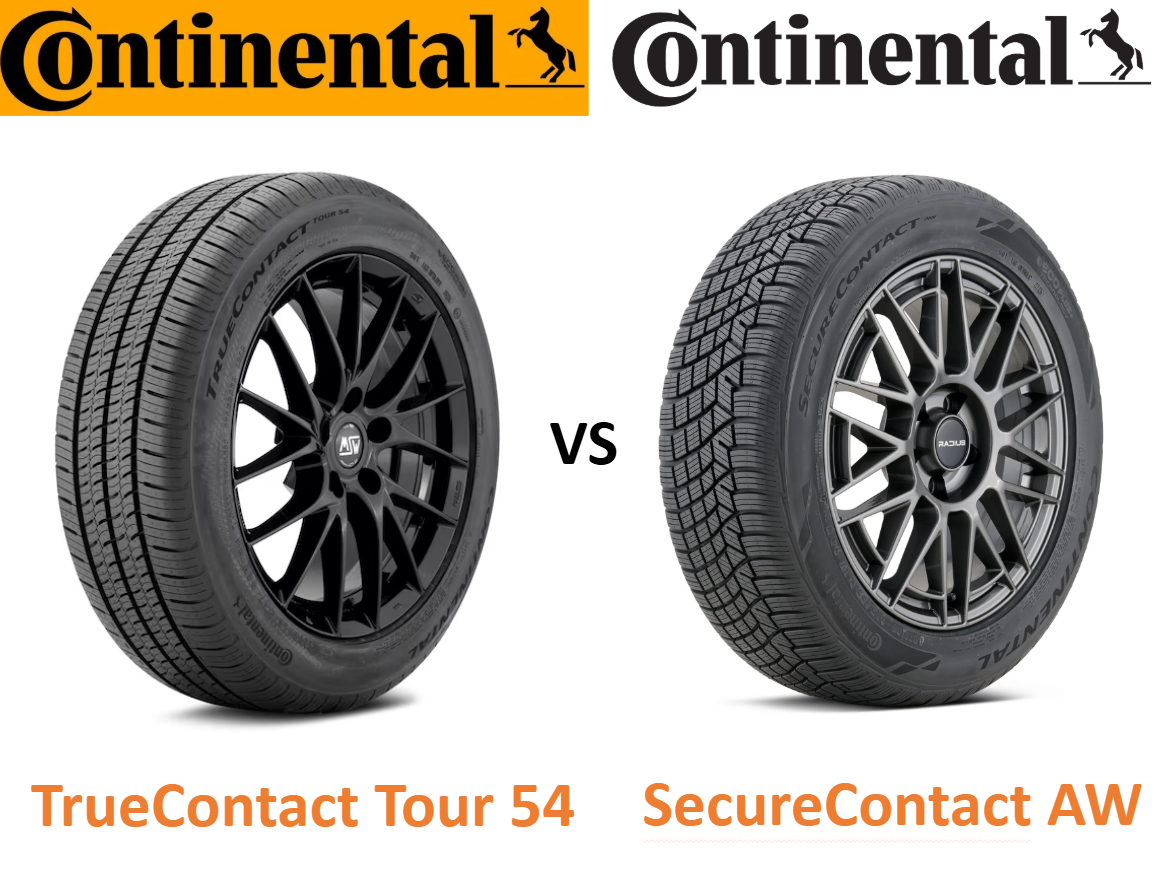
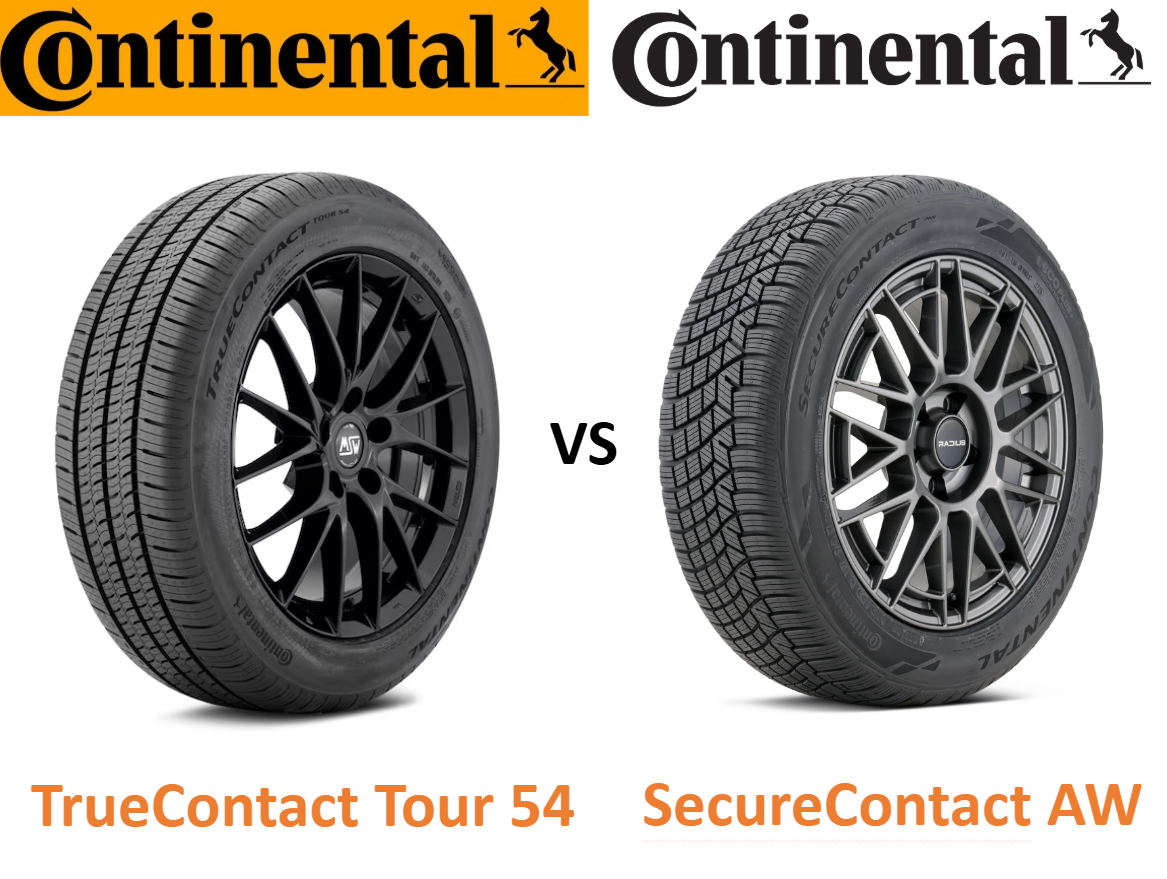
Continental TrueContact Tour 54 vs Continental SecureContact AW: The Continental TrueContact Tour 54 represents Continental’s traditional strength — a mileage-focused all-season built for durability and everyday balance — but now it faces a new challenger from within: the Continental SecureContact AW, the brand’s first true all-weather touring tire designed to go further with stronger wet grip and genuine winter capability. This isn’t just an update, it’s a shift in philosophy — setting up a compelling battle between long-lasting efficiency and next-generation all-weather confidence.
Table of Contents
Results: Continental TrueContact Tour 54 vs Continental SecureContact AW
Results below were taken from the Tire Rack’s “Continental’s All Weather Test. A total of 3 tires were tested this time around in Tire Rack’s own proving ground. The graph below shows the comparison between Continental TrueContact Tour 54 vs Continental SecureContact AW based on the relevant performance category. The Continental TrueContact Tour 54 was set as a reference hence at the 100% mark. Note that for subjective evaluation, we equate 1 point as 5%. Hence for example if tire A is graded 7 while tire B is graded 6, A is better than B by 5%.
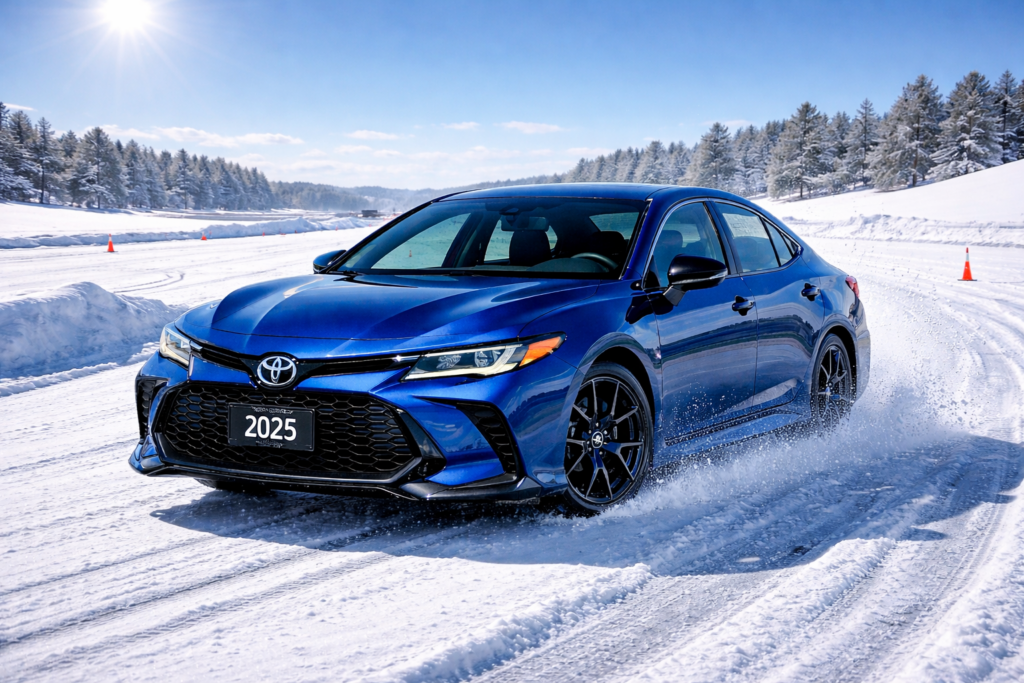
As both tires are categorized as all season tires, Tire Rack has included snow & ice in its testing portfolio. The tire size of interest is 215/55R17 which is a common tire size for Toyota Camry. You can check out our latest tire size table for more information. The testing vehicle is a 2025 Toyota Camry.
Wet
In wet braking, the Continental TrueContact Tour 54 stops shorter at 153 feet, while the Continental SecureContact AW needs 157 feet, giving the TrueContact Tour 54 a 4-foot advantage, which translates to about 3% better braking performance. However, in wet handling, the SecureContact AW turns the tables, completing the lap in 33.12 seconds compared to 33.78 seconds, making it 0.66 seconds faster, or about 2% better.
Overall, the TrueContact Tour 54 has a slight edge in straight-line wet stopping, but the SecureContact AW delivers stronger performance when it comes to handling and control in wet conditions.
SecureContact AW :
- -3% in wet braking
- +2% in wet handling (lap time)
Dry
In dry braking, the Continental TrueContact Tour 54 stops shorter at 132 feet, while the Continental SecureContact AW takes 136 feet, giving the TrueContact Tour 54 a 4-foot advantage, which translates to about 3% better braking performance. Overall, the TrueContact Tour 54 holds a clear edge in dry stopping distance.
SecureContact AW :
- -3% in dry braking
Snow
In snow braking, the Continental SecureContact AW stops shorter at 60.70 feet, compared to 66.85 feet for the Continental TrueContact Tour 54, giving it a 6.15-foot advantage, or about 10% better braking performance. In snow acceleration, the SecureContact AW again leads, needing 25.42 feet versus 31.46 feet, making it 6.04 feet shorter, or about 24% better. This advantage continues in snow handling, where the SecureContact AW scores 6.25 vs 5.50, a 0.75-point gap, translating to roughly 14% better subjective performance.
Overall, the SecureContact AW clearly dominates in snow, delivering significantly stronger traction, acceleration, and control compared to the TrueContact Tour 54.
SecureContact AW :
- +10% in Snow braking
- +24% in Snow Acceleration
- +4% in Snow handling (subj)
Ice
In ice braking, the Continental SecureContact AW stops at 55.60 feet, just 0.10 feet shorter than the Continental TrueContact Tour 54 at 55.70 feet, which is effectively a 0% difference. We are actually surprised here — despite the SecureContact AW’s strong snow advantage, both tires perform almost identically on ice.
SecureContact AW :
- 0% in Ice braking
Mileage & UTQG ratings
The Continental TrueContact Tour 54 clearly leads in durability, with a treadwear rating of 840 vs 700, meaning it offers about 20% higher wear potential, supported by its 80,000-mile warranty vs 60,000 miles, a 20,000-mile advantage or roughly 33% longer coverage.
On the other hand, both tires share the same traction and temperature grades (A/A), so the difference is not in safety ratings but in philosophy. Overall, the TrueContact Tour 54 is built to last significantly longer, while the SecureContact AW trades some lifespan for improved all-weather performance.
| Brand | Tireline | Size | Tread Wear | Traction | Temperature |
|---|---|---|---|---|---|
| Continental | TrueContact Tour 54 | All | 840 | A | A |
| Continental | SecureContact AW | All | 700 | A | A |
Price
In 215/55R17, the Continental TrueContact Tour 54 is $173, while the Continental SecureContact AW is $182, a $9 difference (~5%).
Tire size: 215/55R17
- TrueContact Tour 54 : $ 173
- SecureContact AW : $ 182
Difference: +5% more expensive for SecureContact AW.
Summary
From my perspective as a tire engineer, the trade-off is very clear — an all-season like the Continental TrueContact Tour 54 gives you longer mileage, lower cost per km, and balanced everyday performance, but it reaches its limits when conditions get more extreme. On the other hand, an all-weather like the Continental SecureContact AW delivers stronger grip in wet and real capability in snow, giving you more confidence year-round, but you pay for it with shorter lifespan and a slight price premium. If you drive mostly in mild conditions, I’d still lean toward the all-season for its efficiency, but if you want that extra safety margin when weather turns unpredictable, the all-weather is the smarter choice.
Dr Edwin Pang