
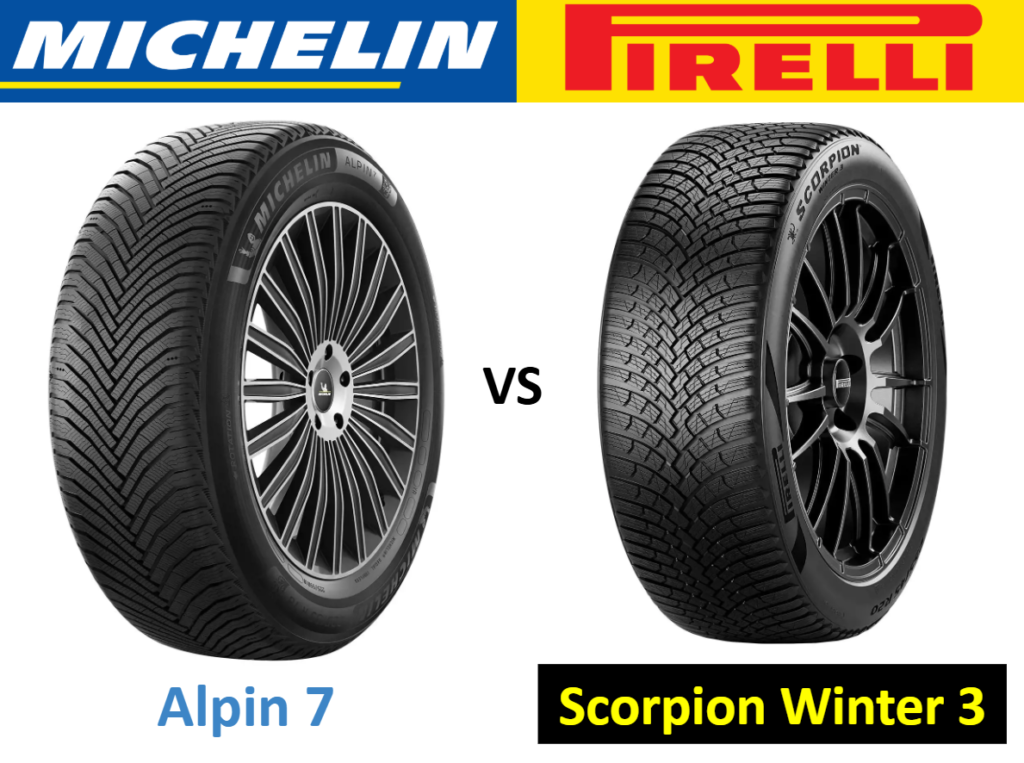
Michelin Alpin 7 vs Pirelli Scorpion Winter 3: The battle of the new generation of Central European winter tires is on. The Michelin Alpin 7 takes on the Pirelli Scorpion Winter 3 in a head-to-head where wet braking matters just as much as snow grip. Which tire comes out on top when the track goes from soaked to snow-covered?
Table of Contents
Results: Michelin Alpin 7 vs Pirelli Scorpion Winter 3
Results below were taken from 2026 Al Volante Winter Tyre Test Test with a total of 6 tires tested. The graph below shows the comparison between Michelin Alpin 7 vs Pirelli Scorpion Winter 3 based on the relevant performance category. The Michelin Alpin 7 was set as a reference hence at the 100% mark.
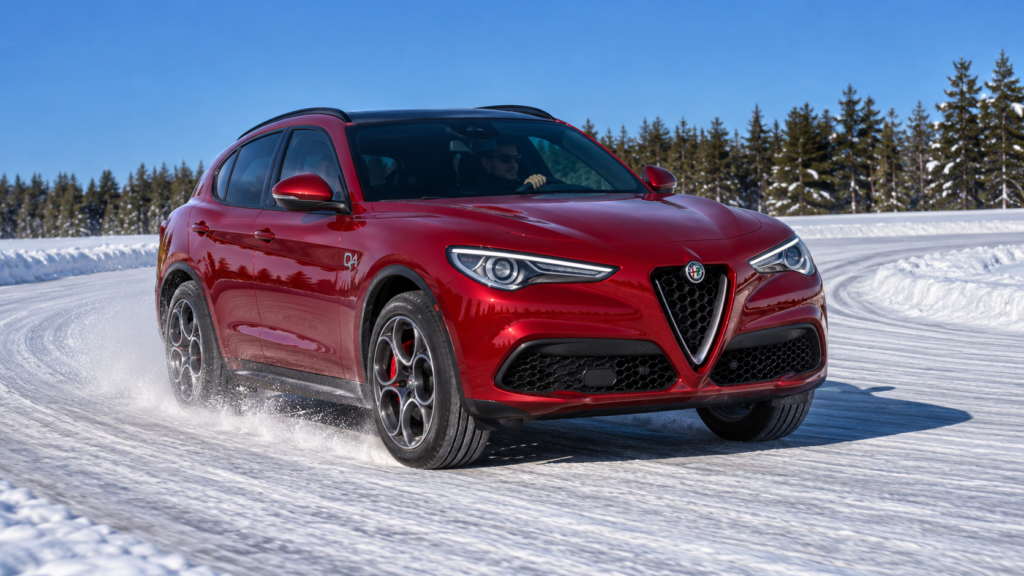
Since we are talking about the middle European winter segment with both tires having the converted 3 peak mountain logo, snow performances was tested. The tire size of interest is 235/60R18 which is a common tire size for Volvo XC60 & Honda CRV. You can check out our latest tire size table for more information. The testing vehicle is a Alfa Romeo Stelvio Q4.
Wet
The Pirelli Scorpion Winter 3 stopped 1.8 metres shorter than the Michelin Alpin 7 from 80 to 10 km/h, scoring 7% higher on the wet braking index. It also completed the wet handling lap 4.9 seconds quicker, a 5% advantage.
In straight aquaplaning, the Pirelli held on to 96.5 km/h, compared with 91.7 km/h for the Michelin. That’s 4.8 km/h faster, a 5% advantage. The Pirelli takes the wet round, with its biggest edge in braking.
Scorpion Winter 3 :
- +7% in wet braking
- +5% in wet handling
- +5% in straight aquaplaning
Snow
The Pirelli Scorpion Winter 3 stopped 0.25 metres shorter than the Michelin Alpin 7 from 35 to 5 km/h on snow, a 2% advantage. It also accelerated from 5 to 35 km/h 0.08 seconds quicker, giving it another 2% edge in snow traction.
On the 700-metre snow handling course, the Pirelli lapped 0.8 seconds quicker, a 1% advantage. The Pirelli takes the snow round by a narrow margin.
Scorpion Winter 3 :
- +2% in snow braking
- +2% in snow traction
- +1% in snow handling
Dry
In dry braking from 100 to 10 km/h, the Pirelli Scorpion Winter 3 stopped in 40.1 metres, compared with 40.5 metres for the Michelin Alpin 7. That’s 0.4 metres shorter, giving the Pirelli a narrow 1% advantage.
Scorpion Winter 3 :
- +1% in dry braking
Noise
At 80 km/h, the Michelin Alpin 7 recorded 71.3 dB(A) of pass-by noise, compared with 71.7 dB(A) for the Pirelli Scorpion Winter 3. The Michelin was 0.4 dB(A) quieter, and the Pirelli scored 1% lower on the noise index.
Scorpion Winter 3 :
- -1% in exterior noise (+0.4 dB)
Rolling Resistance
The Michelin Alpin 7 recorded 6.9 N/kN of rolling resistance, compared with 7.8 N/kN for the Pirelli Scorpion Winter 3. The Michelin was 0.9 N/kN lower, and the Pirelli scored 12% lower on the rolling resistance index.
Scorpion Winter 3 :
- -12% in Rolling resistance
Price
In 235/60 R18, the Pirelli Scorpion Winter 3 costs €159 per tire, compared with €175 for the Michelin Alpin 7. That makes the Pirelli €16 cheaper per tire, a 9% saving.
Tire size: 235/60 R18
- Alpin 7 : € 175
- Scorpion Winter 3 : € 159
Difference: -9% more cheaper for Scorpion Winter 3
Conclusion from a Tire Expert’s Perspective:
From my perspective as a tire engineer, I’d pick the Pirelli Scorpion Winter 3 for wet grip and upfront value. It stopped 1.8 metres shorter in the wet, had a small edge on snow and in dry braking, and costs €16 less per tire.
I’d choose the Michelin Alpin 7 if lower rolling resistance and slightly quieter running were my priorities. Mileage wasn’t tested, so I’d leave the question of long-term value open.
Dr Edwin Pang