
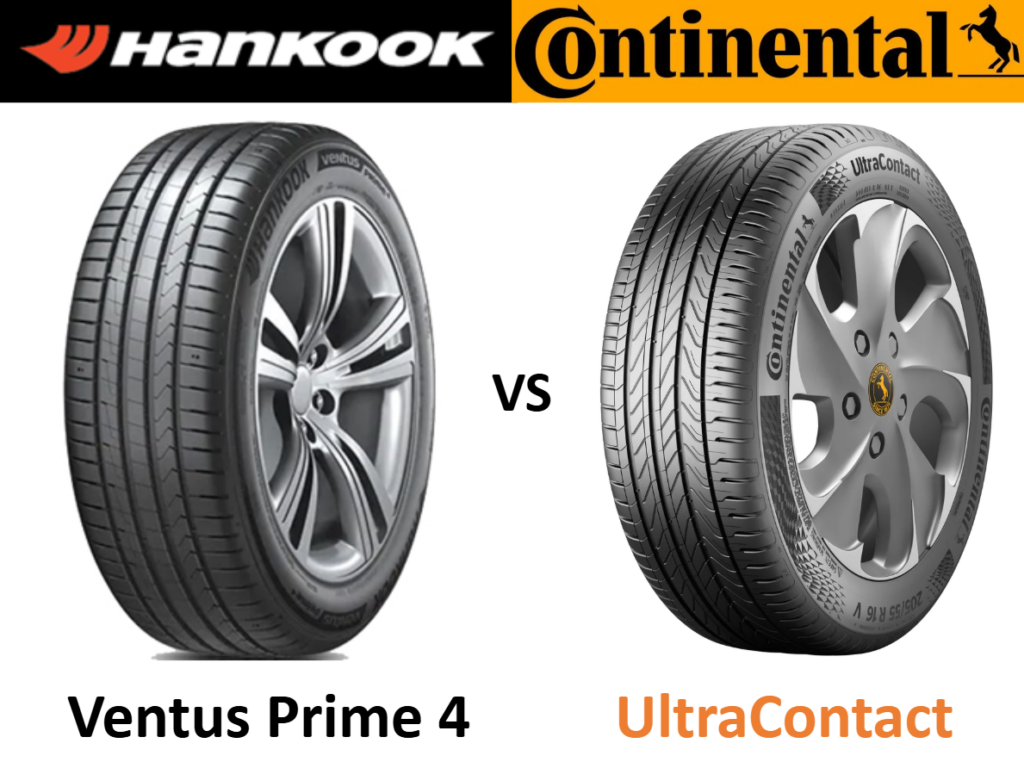
The Hankook Ventus Prime 4 vs Continental UltraContact battle brings together two highly capable summer tires built for everyday performance. Hankook’s Ventus Prime 4 promises a strong balance of wet grip, comfort, and value, while Continental’s UltraContact focuses on safety, efficiency, and long-lasting performance. With both targeting the same demanding drivers, which summer tire delivers the better overall package? Let’s find out.
Table of Contents
Results: Hankook Ventus Prime 4 vs Continental UltraContact
The results featured here are from the expansive 2023 ADAC Summer Tire Test, an ambitious endeavor showcasing 50 of the market’s leading tires, a scale of testing that only ADAC would undertake. As highlighted in the introduction, we’ve included wear test results to provide a comprehensive overview of overall performance. The accompanying graph presents a side-by-side comparison of the Hankook Ventus Prime 4 vs Continental UltraContact across various performance categories, with the Hankook Ventus Prime 4 serving as the benchmark at the 100% mark.
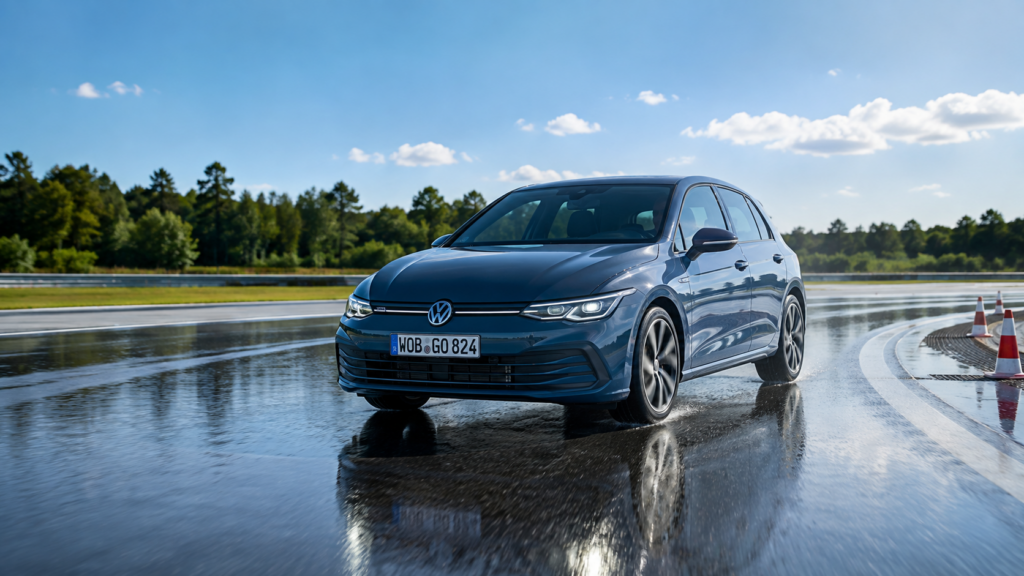
The tire size of interest is the 205/55R16 tire size, a popular choice for vehicles like the 2018 Volkswagen Golf and Toyota Corolla Altis. For further insights into various tire sizes, feel free to consult our latest tire size table. The tests were conducted using a standard Volkswagen Golf 8 as the test vehicle.
Wet
In the wet, the Hankook Ventus Prime 4 has the advantage. It stops 2.5 meters shorter in wet braking, at 35.8 m versus 38.3 m for the Continental UltraContact, putting the Continental 7% behind. In straight aquaplaning, the Hankook also holds on to 1.1 km/h more speed, reaching 77.6 km/h versus 76.5 km/h, with the Continental 1% behind.
Overall, the Ventus Prime 4 is the stronger wet performer, with its biggest advantage coming from wet braking
UltraContact :
- -7% in wet braking
- -1% in straight aquaplaning
Dry
In dry braking, the Hankook Ventus Prime 4 holds a small advantage, stopping 0.5 meters shorter at 36.6 m versus 37.1 m for the Continental UltraContact. This puts the Continental 1% behind.
UltraContact :
- -1% in dry braking
Wear
In wear, the Continental UltraContact has a clear advantage, lasting 13,700 km longer at 55,900 km versus 42,200 km for the Hankook Ventus Prime 4. This gives the Continental a 32% advantage.
The Continental also performs better in abrasion, producing 15.1 mg/km/t less abrasion at 52.5 mg/km/t versus 67.6 mg/km/t for the Hankook. This gives the Continental a 29% advantage.
Overall, the UltraContact is clearly stronger for longevity, combining significantly higher mileage with lower abrasion.
UltraContact :
- +32% in mileage
- +29% in abrasion
Noise
In noise, the Continental UltraContact has a slight advantage, producing 0.7 dB less noise at 71.0 dB versus 71.7 dB for the Hankook Ventus Prime 4. This gives the Continental a 1% advantage.
UltraContact :
- +1% in exterior noise (-0.7 dB)
Fuel Consumption
In fuel consumption, the Continental UltraContact has a small advantage, using 0.1 l/100 km less fuel at 5.7 l/100 km versus 5.8 l/100 km for the Hankook Ventus Prime 4. This gives the Continental a 2% advantage.
UltraContact :
- +2% in fuel consumption
Price
For 205/55 R16, the Hankook Ventus Prime 4 costs €70, while the Continental UltraContact costs €83. That is a €13 difference, making the UltraContact 19% more expensive. The UltraContact therefore carries a noticeable price premium, so the key question is whether its stronger wear performance is enough to justify the extra cost.
Tire size: 205/55 R16
- Ventus Prime 4 : € 70
- UltraContact : € 83
Difference: +19% more expensive for UltraContact
Summary
From my perspective as a tire expert, the Hankook Ventus Prime 4 is the better choice for drivers who prioritize wet safety and value, with stronger wet braking, slightly better aquaplaning resistance, and a lower purchase price. The Continental UltraContact, however, is the stronger long-term option, offering much better wear, lower abrasion, slightly lower noise, and better fuel efficiency. If you want the sharper safety-to-price package, I would choose the Ventus Prime 4. If mileage and long-term efficiency matter more, the UltraContact justifies its higher price.
Dr Edwin Pang