
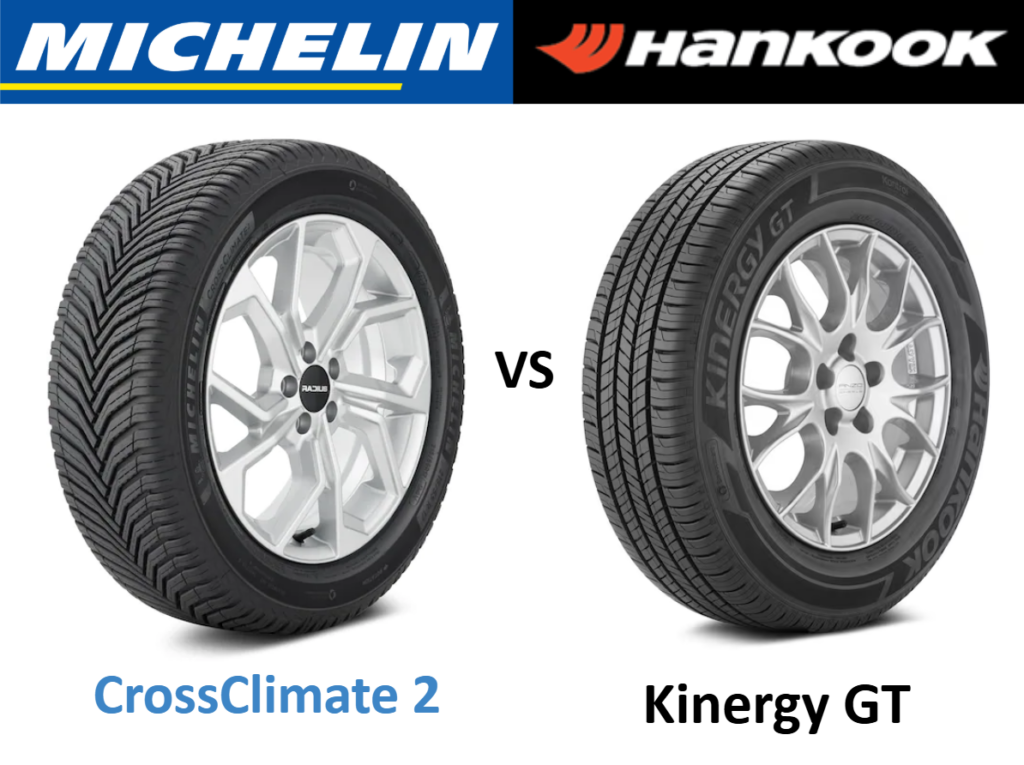
Michelin CrossClimate 2 vs Hankook Kinergy GT — a true all-season showdown. The CrossClimate 2 represents the new generation of all-weather tires, backed by the 3-Peak Mountain Snowflake for real winter capability and year-round versatility. The Kinergy GT stays true to the traditional all-season formula, focusing on everyday dry and wet comfort at a practical value.
Winter-ready innovation vs classic all-season balance — two different philosophies, one daily-drive battle.
Table of Contents
Results : Michelin CrossClimate 2 vs Hankook Kinergy GT
The test results are based on Treadwell data from Discount Tire. The graph below compares the Michelin CrossClimate 2 vs Hankook Kinergy GT across key performance categories.
For subjective evaluations, each point is treated as equivalent to a 5% difference. For example, if Tire A scores a 4 and Tire B scores a 3, Tire A is considered 5% better than Tire B in that category.
Wet
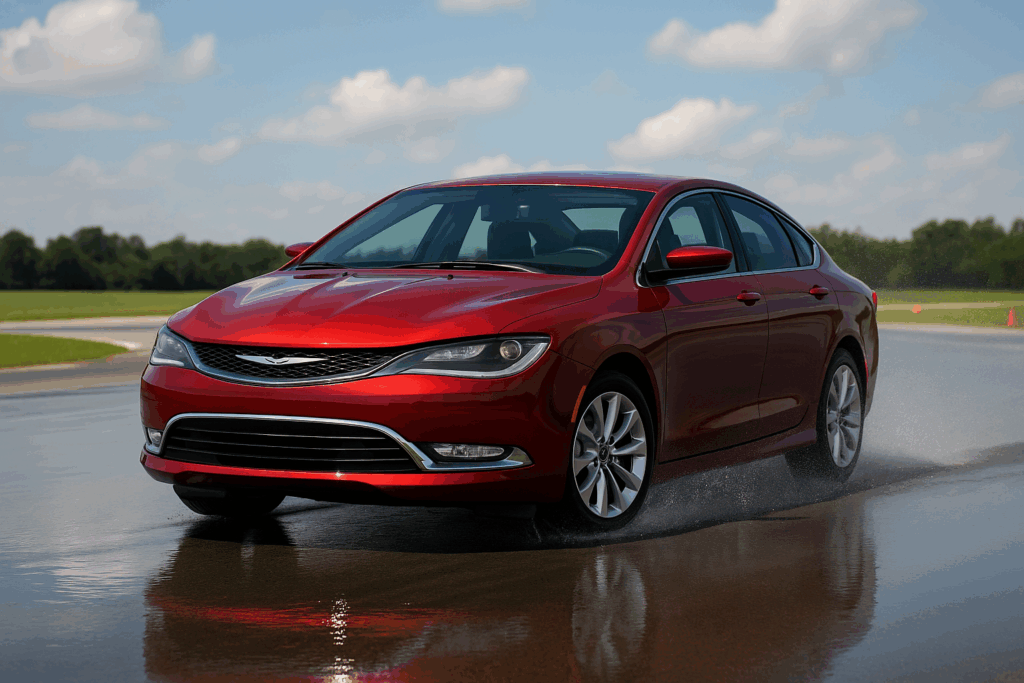
In wet braking, the Michelin CrossClimate 2 stops in 145 feet, which is 10 feet shorter than the Hankook Kinergy GT at 155 feet — giving the Michelin a 6% advantage in stopping distance. In wet handling, the Michelin scores 4/5 versus 3/5 for the Hankook, delivering a 1-point higher rating, which translates to a 5% advantage in overall wet handling confidence.
Overall, the Michelin CrossClimate 2 clearly leads in wet safety and control, offering shorter braking and stronger handling, while the Hankook Kinergy GT delivers adequate wet performance but sits a step behind the Michelin’s all-weather capability.
Kinergy GT :
- -6% Wet Braking
- -5% Wet Handling
Winter
In winter performance, the Michelin CrossClimate 2 scores 4.5/5 compared to 2/5 for the Hankook Kinergy GT, giving the Michelin a 2.5-point advantage — equal to a 12% higher winter capability rating.
Overall, the CrossClimate 2 operates in a completely different league in cold and snowy conditions thanks to its 3-Peak Mountain Snowflake design, while the Kinergy GT delivers only basic light-snow usability typical of a traditional all-season tire.
Kinergy GT :
- -13% Winter
Mileage
In mileage, the Michelin CrossClimate 2 is rated for 55,000 miles, which is 23,000 miles more than the Hankook Kinergy GT at 32,000 miles — giving the Michelin a 42% longer projected tread life.
Kinergy GT :
- -42% Mileage
Dry
In dry braking, the Michelin CrossClimate 2 stops in 125 feet, which is 4 feet shorter than the Hankook Kinergy GT at 129 feet — giving the Michelin a 3% advantage in stopping distance. In dry handling, the Hankook Kinergy GT scores 4/5 compared to 3.5/5 for the Michelin, delivering a 0.5-point higher rating, equal to a 14% advantage in overall dry handling feel.
Kinergy GT :
- -3% Dry Braking
- +3% Dry Handling
Noise Vibration & Harshness (NVH)
In quiet ride, the Hankook Kinergy GT scores 4/5 compared to 3.5/5 for the Michelin CrossClimate 2, giving the Hankook a 0.5-point advantage — equal to a 2% quieter ride rating. In ride comfort, the Hankook again leads with 4/5 versus 3.5/5 for the Michelin, another 0.5-point gap that translates to a 2% advantage in comfort.
Kinergy GT :
- +2% Quiet Ride
- +2% Comfort
Fuel Consumption
In fuel efficiency, the Michelin CrossClimate 2 scores 3.5/5 compared to 2.5/5 for the Hankook Kinergy GT, giving the Michelin a 1-point advantage — equal to a 5% higher fuel efficiency rating.
Kinergy GT :
- -5% Fuel Efficiency
Price
In price, the Hankook Kinergy GT costs $150 compared to $189 for the Michelin CrossClimate 2, making the Hankook $39 cheaper — a 26% lower price than the Michelin.
Tire size: 205/55R16
- CrossClimate 2 : $ 189
- Kinergy GT : $ 150
Difference: -26% more cheaper for Kinergy GT
Conclusion:
From my perspective as a tire expert, both tires have clear strengths. The Michelin CrossClimate 2 is the better all-rounder, with stronger wet and winter safety, longer mileage and better fuel efficiency — ideal if you want maximum year-round capability. The Hankook Kinergy GT focuses on comfort and value, offering a quieter, smoother ride at a much lower price, making it a smart choice for everyday urban driving.
Dr Edwin Pang