
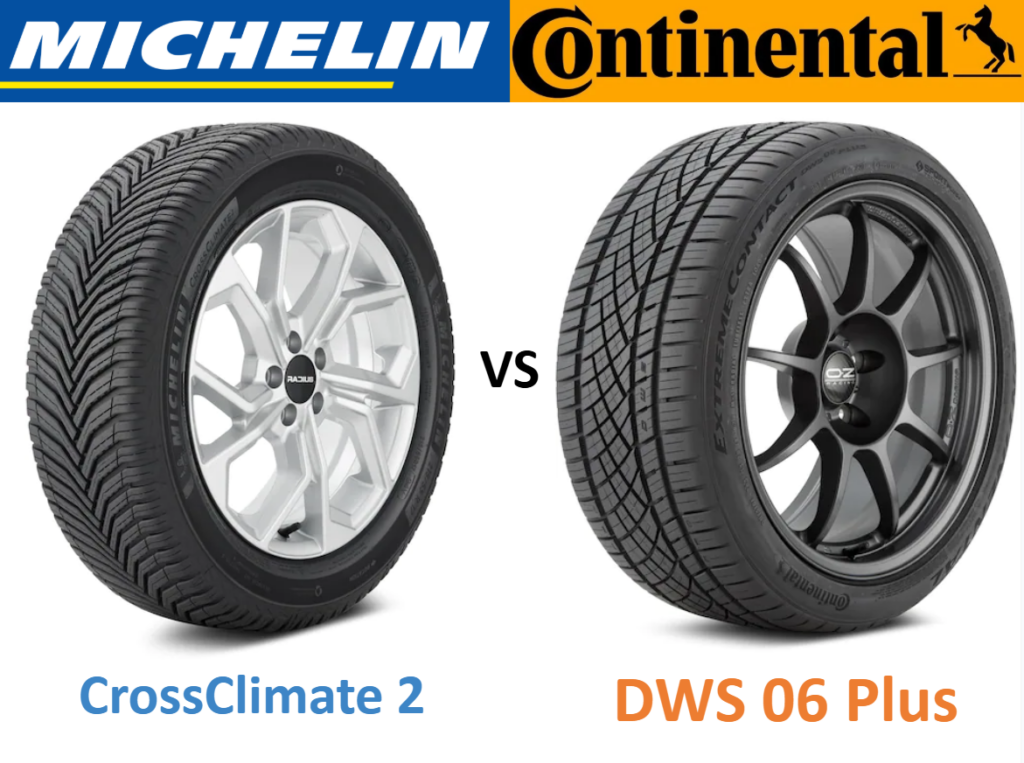
Michelin CrossClimate 2 vs Continental ExtremeContact DWS 06 Plus — this is a battle of philosophy. On one side, the Michelin CrossClimate 2: a true 3-Peak Mountain Snowflake all-weather tire, built to deliver serious winter capability without sacrificing dry and wet stability. On the other, the Continental ExtremeContact DWS 06 Plus: an ultra-high-performance all-season, engineered with sharper handling, stronger steering feel, and sporty road manners in mind. All-weather security versus UHP all-season precision — same four seasons, completely different priorities. So what are the real differences?
Table of Contents
Results: Michelin CrossClimate 2 vs Continental ExtremeContact DWS 06 Plus
Results below were taken from the Tire Rack’s “EV Specific vs Non EV Tires” test. A total of 11 tires were tested this time around in Tire Rack’s own proving ground. The graph below shows the comparison between Michelin CrossClimate 2 vs Continental ExtremeContact DWS 06 Plus based on the relevant performance category. The Michelin CrossClimate 2 was set as a reference hence at the 100% mark. Note that for subjective evaluation, we equate 1 point as 5%. Hence for example if tire A is graded 7 while tire B is graded 6, A is better than B by 5%.
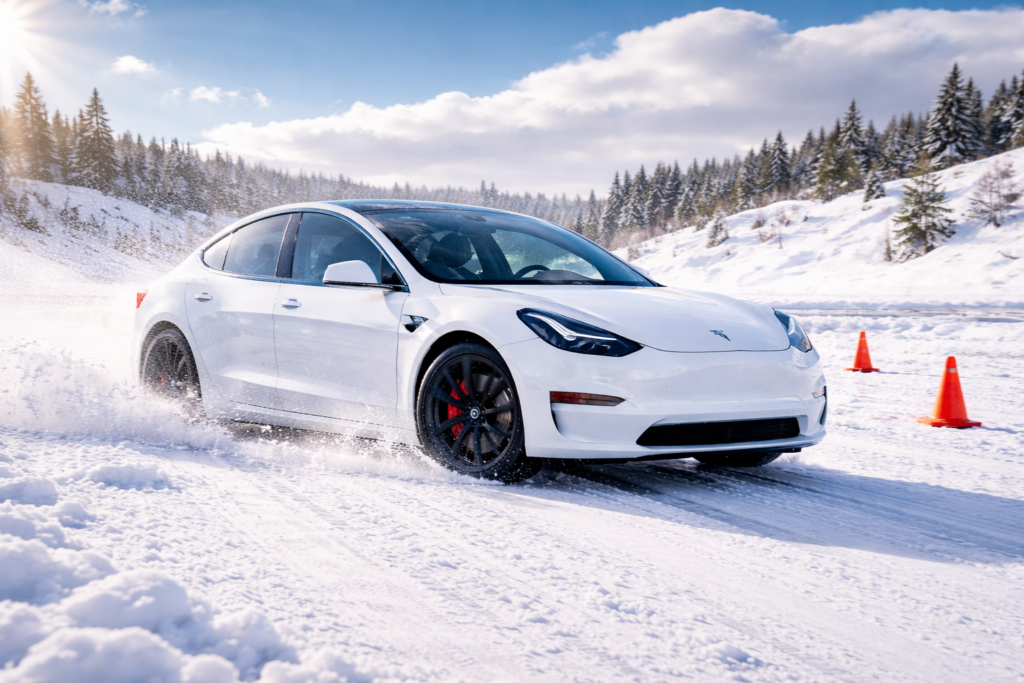
As both tires are categorized as all season tires, Tire Rack has included snow & ice in its testing portfolio. The tire size of interest is 235/40R19 which is a common tire size for Audi A4 & BMW 3 series. You can check out our latest tire size table for more information. The testing vehicle is a 2023 Model 3 Performance.
Wet
In wet braking, the Continental ExtremeContact DWS 06 Plus stops 9.5 feet shorter than the Michelin CrossClimate 2, which equals about a 7% advantage in emergency braking distance. In subjective wet handling, the Continental scores 1.31 points higher, translating to roughly a 7% stronger handling impression.
On wet lap time, the Continental is 1.24 seconds quicker, giving it about a 4% faster performance around the circuit. Overall, the DWS 06 Plus clearly shows stronger wet-focused capability, while the CrossClimate 2 leans more toward balanced all-weather security rather than outright wet handling sharpness.
ExtremeContact DWS 06 Plus :
- +7% in wet braking
- +7% in wet handling (subj)
- +4% in wet handling (lap time)
Dry
In dry braking, the Continental ExtremeContact DWS 06 Plus stops 1.8 feet shorter than the Michelin CrossClimate 2, which is about a 2% advantage in braking distance. In subjective dry handling, the Continental scores 0.75 points higher, translating to roughly a 4% stronger handling impression.
On dry lap time, the Continental is 0.37 seconds quicker, giving it about a 1% faster lap performance. Overall, the DWS 06 Plus delivers a slightly sharper and sportier dry driving experience, while the CrossClimate 2 remains more neutral and comfort-oriented in its approach.
ExtremeContact DWS 06 Plus :
- +2% in dry braking
- +4% in dry handling (subj)
- +1% in dry handling (lap time)
Noise/Comfort/Ride Quality
In noise, comfort, and ride quality, both the Michelin CrossClimate 2 and the Continental ExtremeContact DWS 06 Plus score exactly the same at 7.25. This means there is 0 point difference, translating to a 0% performance gap between them.
ExtremeContact DWS 06 Plus :
- 0% in average of Noise, Comfort & Ride Quality.
Snow
In snow braking, the Michelin CrossClimate 2 stops 18.93 feet shorter than the Continental ExtremeContact DWS 06 Plus, which equals about an 18% shorter braking distance. In snow acceleration from 0 to 12 mph, the Michelin reaches speed 14.27 feet sooner, translating to roughly a 39% stronger traction performance.
On subjective snow handling, the Michelin scores 2.0 points higher, a 10% advantage in driver confidence, and on snow lap time it is 6.55 seconds quicker, delivering about an 11% faster performance around the course. Overall, the CrossClimate 2 clearly dominates in true winter conditions, while the DWS 06 Plus is not designed to compete at this level in snow-focused performance.
ExtremeContact DWS 06 Plus :
- -18% in Snow braking
- -39% in Snow Acceleration
- -10% in Snow handling (subj)
- -11% in Snow handling (lap time)
Ice
In ice braking, the Michelin CrossClimate 2 stops 5.7 feet shorter than the Continental ExtremeContact DWS 06 Plus, which translates to about a 12% shorter braking distance.
ExtremeContact DWS 06 Plus :
- -12% in Ice braking
Mileage
In mileage, Consumer Reports projects 95,000 miles for the Michelin CrossClimate 2 compared to 50,000 miles for the Continental ExtremeContact DWS 06 Plus, even though the test sizes differ. That is a 45,000-mile advantage, translating to roughly a 90% longer projected lifespan for the CrossClimate 2.
Overall, the CrossClimate 2 clearly leads in long-term durability, while the DWS 06 Plus prioritizes performance over extended tread life.
Efficiency
At 100% charge range, the Michelin CrossClimate 2 delivers 250 miles compared to 237 miles for the Continental ExtremeContact DWS 06 Plus. That is a 13-mile advantage, translating to roughly a 5% longer driving range.
ExtremeContact DWS 06 Plus :
- -5% in efficiency
Price
For tire size 235/40R19, the Michelin CrossClimate 2 is priced at $280, while the Continental ExtremeContact DWS 06 Plus comes in at $241. That is a $39 difference, making the DWS 06 Plus about 16% cheaper.
Tire size: 235/40R19
- CrossClimate 2 : $ 280
- ExtremeContact DWS 06 Plus : $ 241
Difference: -16% more cheaper for ExtremeContact DWS 06 Plus.
Summary
From my perspective as a tire engineer, I’m genuinely impressed that the Michelin CrossClimate 2 stays so close to the Continental ExtremeContact DWS 06 Plus in dry and wet conditions. The DWS 06 Plus clearly has the edge in sharper handling, shorter wet braking, and a more performance-driven feel, but the CrossClimate 2 is not far behind in real-world terms. The performance gap on dry and wet roads is noticeable, yet not dramatic for daily driving.
Where each tire truly shines is in its core strength. The CrossClimate 2 stands out with its strong snow and ice performance, exceptional projected mileage, and slightly better efficiency, making it a true all-weather long-term solution. The DWS 06 Plus, on the other hand, delivers sportier steering response, stronger wet grip, and a more attractive price point. In the end, both tires are excellent — one leans toward all-weather durability and winter security, while the other focuses on dynamic all-season performance.
Dr Edwin Pang