
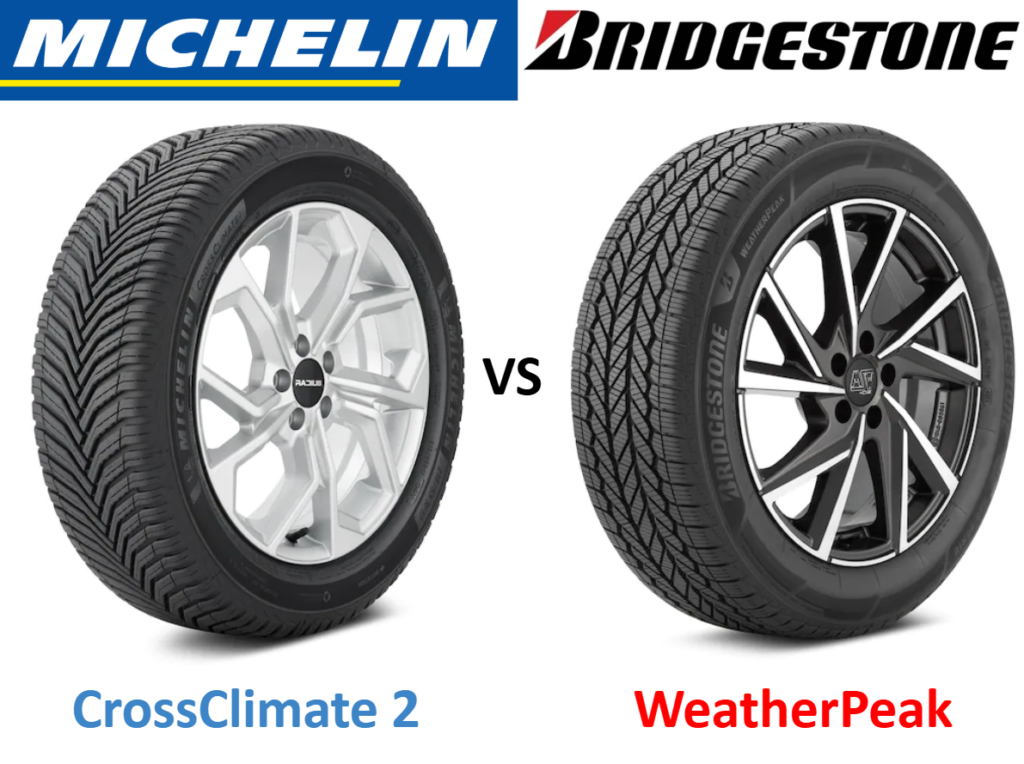
The Michelin CrossClimate 2 vs Bridgestone WeatherPeak is one last all-weather battle between two of the biggest tire brands in the world. For years, the CrossClimate 2 has been the benchmark that defined the category, while the WeatherPeak stood as Bridgestone’s answer to Michelin’s all-weather dominance. But with Bridgestone’s new UltraWeather now arriving as the successor to the WeatherPeak, this comparison feels like a changing of the guard — the old challenger taking one final shot before the next generation steps in.
Table of Contents
Results: Michelin CrossClimate 2 vs Bridgestone WeatherPeak
Results below were taken from the Tire Rack’s “All-Weather vs. Winter Tires: The Definitive Test“. A total of 10 tires were tested this time around in Tire Rack’s own proving ground. The graph below shows the comparison between Michelin CrossClimate 2 vs Bridgestone WeatherPeak based on the relevant performance category. The Michelin CrossClimate 2 was set as a reference hence at the 100% mark. Note that for subjective evaluation, we equate 1 point as 5%. Hence for example if tire A is graded 7 while tire B is graded 6, A is better than B by 5%.
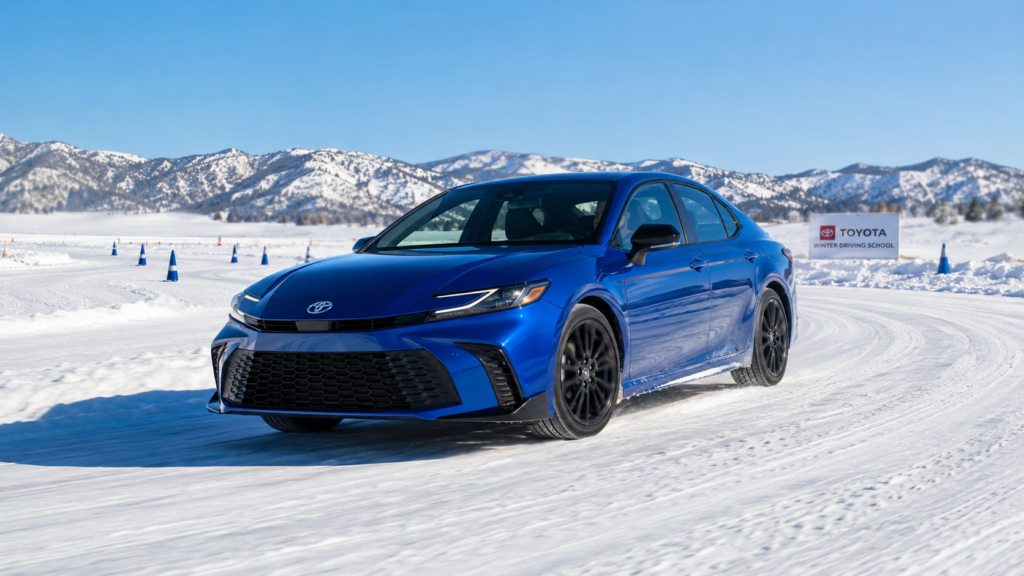
As both tires are categorized as all season tires, Tire Rack has included snow & ice in its testing portfolio. The tire size of interest is 215/55R17 which is a common tire size for Chevrolet Cruze Eco & Toyota Camry Hybrid XLE. You can check out our latest tire size table for more information. The testing vehicle is a 2025 Toyota Camry.
Wet
In wet braking, the Michelin CrossClimate 2 stops in 99.6 feet, while the Bridgestone WeatherPeak needs 110.7 feet. That means the Michelin stops 11.1 feet shorter, giving it a 10% advantage in wet braking. In simple terms, the CrossClimate 2 has the stronger wet safety performance, while the WeatherPeak needs more distance to come to a stop on slippery roads.
WeatherPeak :
- -10% in wet braking
Snow
In snow braking, the Bridgestone WeatherPeak stops in 58.63 feet, while the Michelin CrossClimate 2 needs 72.38 feet, meaning the WeatherPeak stops 13.75 feet shorter, giving it a 23% advantage. In snow acceleration, the WeatherPeak also leads, needing 25.91 feet compared with 30.70 feet for the Michelin, a difference of 4.79 feet, or an 18% advantage.
In subjective snow handling, the Bridgestone scores 6.58 versus 6.25 for the Michelin, giving it a small 0.33-point advantage, or 2% better. However, in snow handling lap time, both tires are almost identical, with Michelin at 57.95 seconds and Bridgestone at 58.04 seconds, only 0.09 seconds apart, which is effectively a 0% difference. Overall, the WeatherPeak is clearly stronger in snow braking and acceleration, while handling performance between the two is very close.
WeatherPeak :
- +23% in Snow braking
- +18% in Snow Acceleration
- +2% in Snow handling (subj)
- 0% in Snow handling(lap time)
Ice
In ice braking, the Michelin CrossClimate 2 stops in 53.0 feet, while the Bridgestone WeatherPeak needs 54.1 feet. That means the Michelin stops 1.1 feet shorter, giving it a small 2% advantage in ice braking. Overall, both tires are very close on ice, but the CrossClimate 2 has a slight edge in stopping performance.
WeatherPeak :
- -2% in Ice braking
Wear
In actual tested mileage from Consumer Reports, the Michelin CrossClimate 2 lasts 95,000 miles, while the Bridgestone WeatherPeak lasts 60,000 miles. That means the Michelin delivers 35,000 miles more tread life, giving it a huge 37% advantage in tested mileage. Overall, the CrossClimate 2 is clearly the stronger long-life tire, while the WeatherPeak gives up a significant amount of wear performance.
WeatherPeak :
- -37% in mileage
Dry
In dry braking, the Michelin CrossClimate 2 stops in 83.1 feet, while the Bridgestone WeatherPeak needs 96.6 feet. That means the Michelin stops 13.5 feet shorter, giving it a clear 14% advantage in dry braking. Overall, the CrossClimate 2 is much stronger in dry-road stopping performance, while the WeatherPeak needs noticeably more distance to come to a stop.
WeatherPeak :
- -14% in dry braking
Noise/Comfort/Ride Quality
In noise, comfort, and ride quality, the Michelin CrossClimate 2 scores 7.50, while the Bridgestone WeatherPeak scores 7.17. That means the Michelin is 0.33 points higher, giving it a small 2% advantage in overall refinement. Overall, the CrossClimate 2 is slightly more comfortable and quieter, while the WeatherPeak remains close but just a bit less polished on the road.
WeatherPeak :
- -2% in average of Noise, Comfort & Ride Quality.
Price
In price for size 215/55R17, the Bridgestone WeatherPeak costs $195, while the Michelin CrossClimate 2 costs $209. That means the Michelin is $14 more expensive, making the CrossClimate 2 around 7% higher in price.
Tire size: 215/55R17
- WeatherPeak : $ 195
- CrossClimate 2: $ 209
Difference: +7% more expensive for CrossClimate 2
Summary
From my tire expert point of view, the Michelin CrossClimate 2 is the more complete tire overall. It delivers stronger wet braking, dry braking, ice braking, ride comfort, and especially tread life, making it the better choice for drivers who want long-term value, safety, and refinement. The Bridgestone WeatherPeak, however, still has a clear advantage in snow performance, especially in snow braking and acceleration, where it feels more focused and confident in deeper winter conditions. So if I wanted the best all-round all-weather tire, I would choose the CrossClimate 2, but if snow traction is the top priority and price matters more, the WeatherPeak still makes a strong case.
Dr Edwin Pang