
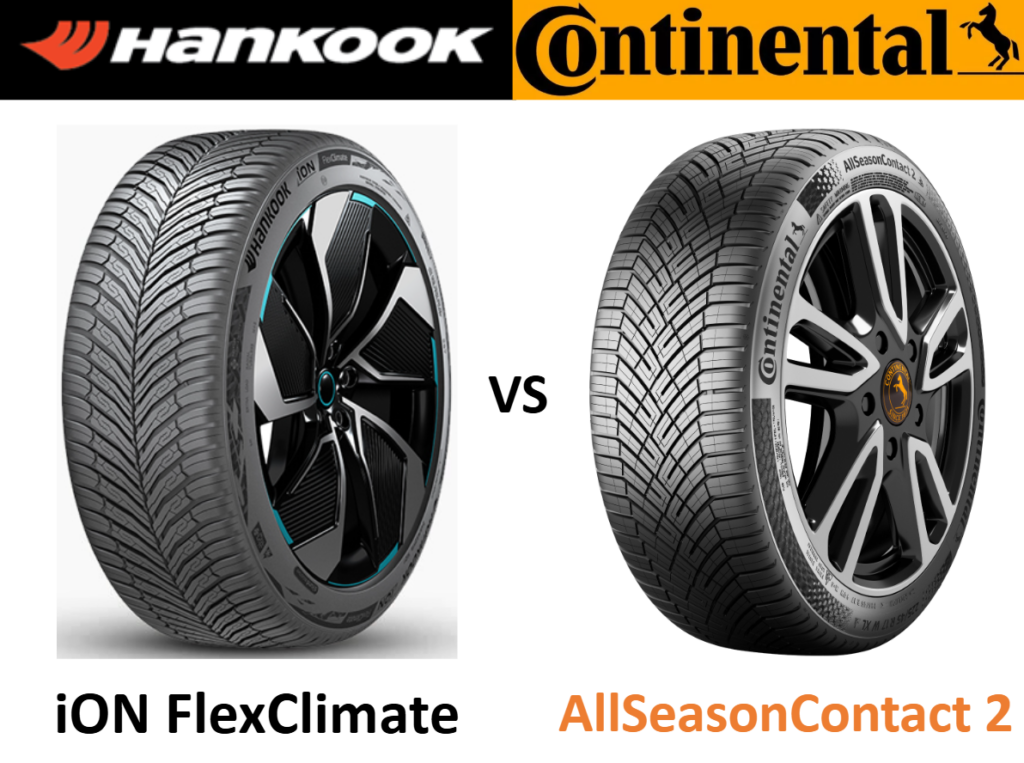
The Hankook iON FlexClimate vs Continental AllSeasonContact 2 is a battle between an EV-focused all-season tire and a proven standard all-season tire with 3-Peak Mountain certification. Hankook brings the EV efficiency and torque-focused approach, while Continental counters with all-round, winter-ready confidence. So can the EV specialist beat the all-season benchmark?
Table of Contents
Results: Hankook iON FlexClimate vs Continental AllSeasonContact 2
Results below were taken from the 2026 Auto Bild EV All Season Tire Test with a total of 8 tires tested. The graph below shows the comparison between Hankook iON FlexClimate vs Continental AllSeasonContact 2 based on the relevant performance category. The Hankook iON FlexClimatetire was set as a reference hence at the 100% mark.
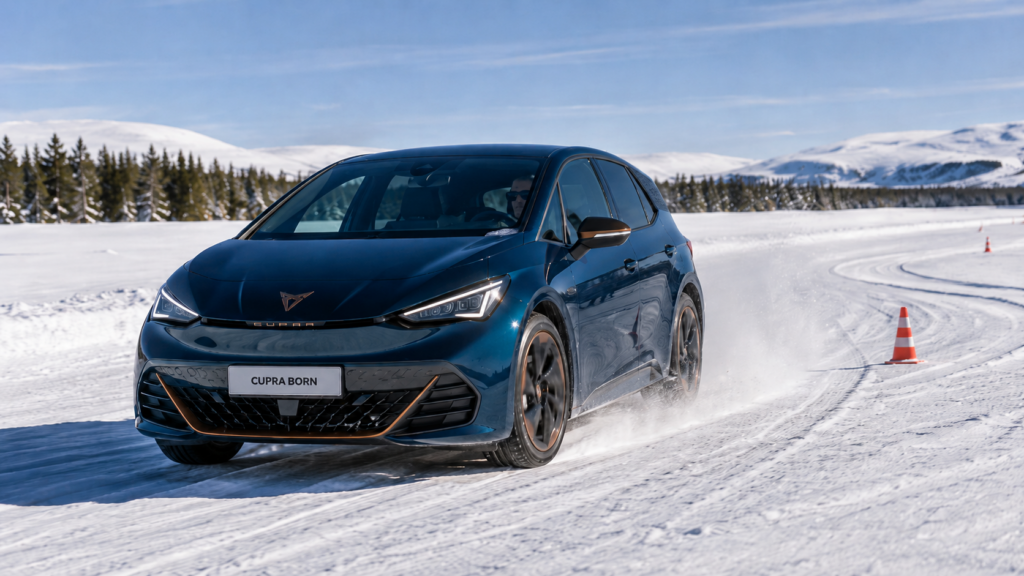
It’s important to note that for subjective tests, the evaluation was based on average lap speed which is commonly used in magazine tests. The tire size of interest is a 215/55R18 which is a common tire size for BYD Atto 3. You can check out our latest tire size table for more information. The testing vehicle of choice is a Kia EV3 for summer while Cupra Born for winter.
Wet
In the wet tests, the Hankook iON FlexClimate clearly leads the Continental AllSeasonContact 2 across all areas. It stops 1.5 m shorter, which matches around 4% better wet braking, carries 1.2 km/h more speed, around 2% better wet handling, and has a strong 6.2 km/h higher aquaplaning speed, around 8% better resistance. Overall, Hankook has the stronger wet package, especially when standing water becomes the main challenge.
AllSeasonContact 2 :
- -4% in wet braking
- -2% in wet handling
- -8% in aquaplaning
Snow
In snow, the Continental AllSeasonContact 2 has a small but consistent edge over the Hankook iON FlexClimate. It stops 0.1 m shorter from 50–0 km/h, which is around 1% better, delivers 71 N more traction, around 2% better, and carries 0.9 km/h higher speed in snow handling, also around 2% better. Overall, Continental is slightly stronger on snow, but the gap is small, showing that the EV-focused Hankook still performs very close to the standard all-season benchmark.
AllSeasonContact 2 :
- +1% in snow braking
- +2% in snow traction
- +2% in snow handling
Mileage
For mileage, the Hankook iON FlexClimate lasts 54,560 km, while the Continental AllSeasonContact 2 reaches 48,070 km. That gives Hankook a clear 6,490 km longer wear life, or around 12% better mileage. Overall, Hankook has the stronger durability result here, making it the better choice if long-term wear is a key priority.
AllSeasonContact 2 :
- -12% in mileage
Rolling Resistance
For rolling resistance, the Continental AllSeasonContact 2 is more efficient at 7.05 N/kN, while the Hankook iON FlexClimate records 7.41 N/kN. That gives Continental a 0.36 N/kN lower rolling resistance, or around 5% better efficiency. Overall, Continental has the advantage here, which should help slightly with energy consumption and EV driving range.
AllSeasonContact 2 :
- +5% in rolling resistance
Dry
In dry braking, the Hankook iON FlexClimate stops in 39.8 m, while the Continental AllSeasonContact 2 needs 42.0 m, giving Hankook a clear 2.2 m shorter stopping distance, or around 5% better performance. In dry handling, Hankook also carries 92.6 km/h compared to 90.8 km/h for Continental, a 1.8 km/h higher handling speed, or around 2% better. Overall, Hankook is stronger in the dry, especially under braking, while Continental trails slightly in both dry safety and handling performance.
AllSeasonContact 2 :
- -5% in dry braking
- -2% in dry handling
Noise
For drive-by noise, both tires are almost identical. The Continental AllSeasonContact 2 is slightly quieter at 71.1 dB(A), while the Hankook iON FlexClimate measures 71.3 dB(A), giving Continental a tiny 0.2 dB(A) advantage, effectively 0% difference. Overall, noise is basically a draw, with no meaningful real-world gap between the two.
AllSeasonContact 2 :
- 0% in exterior noise (-0.2 dB)
Price
For price, the Continental AllSeasonContact 2 is slightly cheaper at €131, while the Hankook iON FlexClimate costs €136. That makes Continental €5 cheaper, or around 4% lower in price. Overall, Continental has a small price advantage, but the gap is not big enough to strongly change the value picture by itself.
Tire size: 215/55R18
- iON FlexClimate : € 136
- AllSeasonContact 2 : €131
Difference: -4% more cheaper for AllSeasonContact 2
Conclusion
Overall, the Hankook iON FlexClimate looks really strong in this test. It clearly leads in wet braking, wet handling, aquaplaning, dry braking, dry handling, and especially mileage, making it a very complete EV-focused all-season tire. The Continental AllSeasonContact 2 still has its advantages, with slightly better snow performance, lower rolling resistance, marginally quieter drive-by noise, and a slightly cheaper price. But from a tire expert point of view, the Hankook stands out as the more impressive overall package, especially considering how strong it performs in both safety and durability.
Dr Edwin Pang