
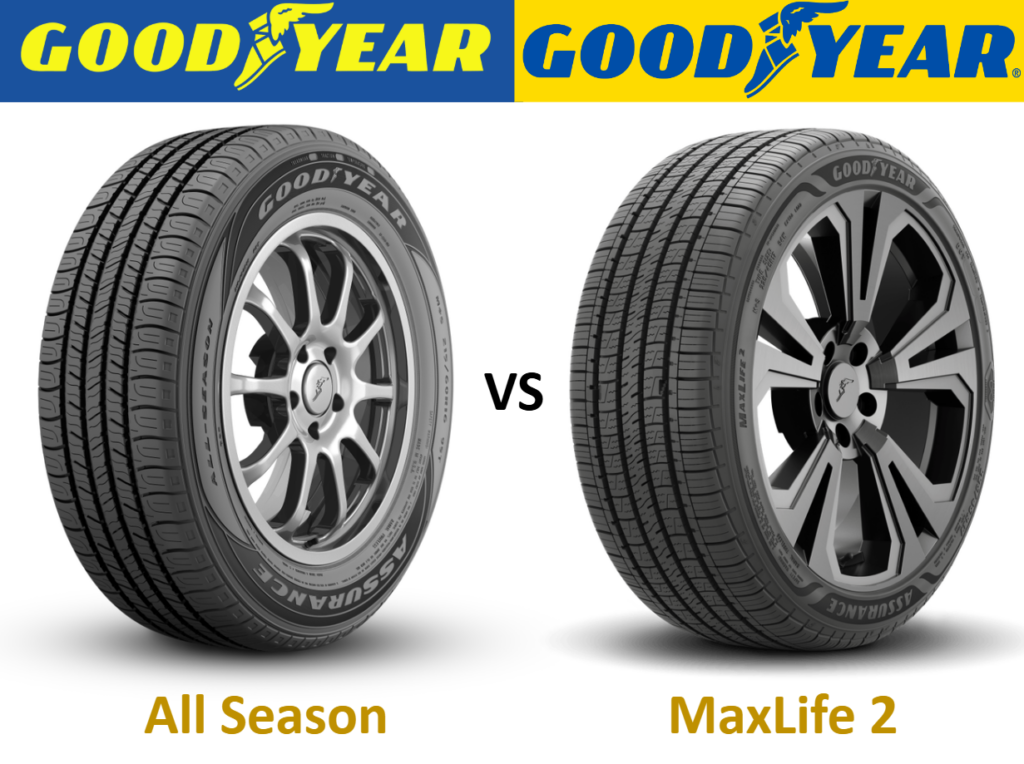
Goodyear Assurance All-Season vs Goodyear Assurance MaxLife 2 brings together Goodyear’s standard, value-focused all-season tire and its premium, long-life alternative. The Assurance All-Season targets dependable everyday performance at a lower price, while the MaxLife 2 is built around extended tread life and stronger long-term value. But does chasing more mileage mean sacrificing wet grip, snow traction, comfort, or affordability? This head-to-head reveals the real trade-offs—and which Goodyear is the smarter choice.
Table of Contents
Results : Goodyear Assurance All Season vs Goodyear Assurance MaxLife 2
The test results are based on Treadwell data from Discount Tire. The graph below compares the Goodyear Assurance All Season vs Goodyear Assurance MaxLife 2 across key performance categories.
For subjective evaluations, each point is treated as equivalent to a 5% difference. For example, if Tire A scores a 4 and Tire B scores a 3, Tire A is considered 5% better than Tire B in that category.
Wet
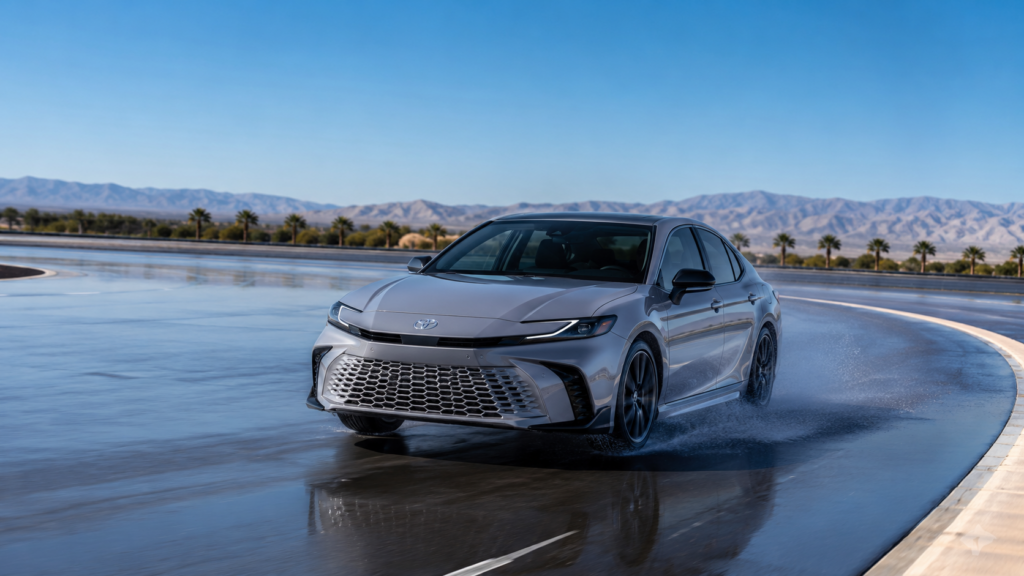
The Goodyear Assurance MaxLife 2 is clearly stronger in wet conditions. It stops in 155 feet, which is 33 feet shorter than the Assurance All-Season’s 188 feet, giving it a 21% wet–braking advantage. Wet handling also improves from 2.5 to 4 out of 5, with the MaxLife 2 rated 7.5% better. Overall, the MaxLife 2 delivers noticeably stronger wet grip, control, and braking confidence.
Assurance MaxLife 2 :
- +21% Wet Braking
- +7.5% Wet Handling
Winter
The Goodyear Assurance All-Season performs better in winter conditions, scoring 3.5 out of 5 compared with 2 out of 5 for the Assurance MaxLife 2. That is a 1.5-point difference, with the MaxLife 2 rated 7.5% lower overall. In short, the standard Assurance All-Season is the stronger choice for winter grip, while the MaxLife 2 focuses more heavily on tread life.
Assurance MaxLife 2 :
- -7.5% Snow
Mileage
The Goodyear Assurance MaxLife 2 delivers a median mileage of 51,000 miles, which is 22,500 miles more than the Assurance All-Season’s 28,500 miles. This gives the MaxLife 2 a substantial 79% mileage advantage, making it the much stronger choice for drivers prioritizing longer tread life and fewer tire replacements.
Assurance MaxLife 2 :
- +79% Mileage
Dry
The Goodyear Assurance MaxLife 2 stops in 130 feet, which is 10 feet shorter than the Assurance All-Season’s 140 feet, giving it an 8% dry–braking advantage. However, the Assurance All-Season scores 4 out of 5 for dry handling compared with 3 out of 5 for the MaxLife 2, making the MaxLife 2 5% weaker in this area. Overall, the MaxLife 2 brakes better in the dry, while the standard Assurance All-Season feels sharper and more responsive through corners.
Assurance MaxLife 2 :
- +8% Dry Braking
- -5% Dry Handling
Noise Vibration & Harshness (NVH)
Both tires score 3.5 out of 5 for quietness, so there is no difference in road noise. However, the Assurance MaxLife 2 scores 4 out of 5 for ride comfort, which is 0.5 points higher than the Assurance All-Season’s 3.5 out of 5, giving it a 2.5% comfort advantage. Overall, both tires are equally quiet, but the MaxLife 2 delivers a slightly smoother ride.
Assurance MaxLife 2 :
- 0% Quiet Ride
- +2.5% Comfort
Fuel Consumption
The Goodyear Assurance All-Season scores 3 out of 5 for fuel efficiency, compared with 2 out of 5 for the Assurance MaxLife 2. That is a 1-point difference, with the MaxLife 2 rated 5% lower. Overall, the standard Assurance All-Season is the better choice for drivers who want lower rolling resistance and improved fuel economy.
Assurance MaxLife 2 :
- -5% Fuel Efficiency
Price
In size 215/55R17, the Goodyear Assurance All-Season costs $168, while the Assurance MaxLife 2 costs $193. That makes the MaxLife 2 $25, or 15%, more expensive. The higher price mainly pays for its much longer tread life and stronger braking performance, while the standard Assurance All-Season remains the more affordable option.
Tire size: 215/55R17
- Assurance All Season : $ 168
- Assurance MaxLife 2 : $ 193
Difference: +15% more expensive for Assurance MaxLife 2
Conclusion:
From my perspective, the Goodyear Assurance MaxLife 2 is the stronger overall tire, with much better wet and dry braking, a more comfortable ride, and a major 79% mileage advantage. However, it costs 15% more and gives up some winter grip, dry handling, and fuel efficiency. The standard Assurance All-Season is the better budget choice, offering sharper handling, stronger winter performance, and better efficiency, while the MaxLife 2 is worth the premium for drivers who prioritize safety, comfort, and long-term tread life.
Dr Edwin Pang