
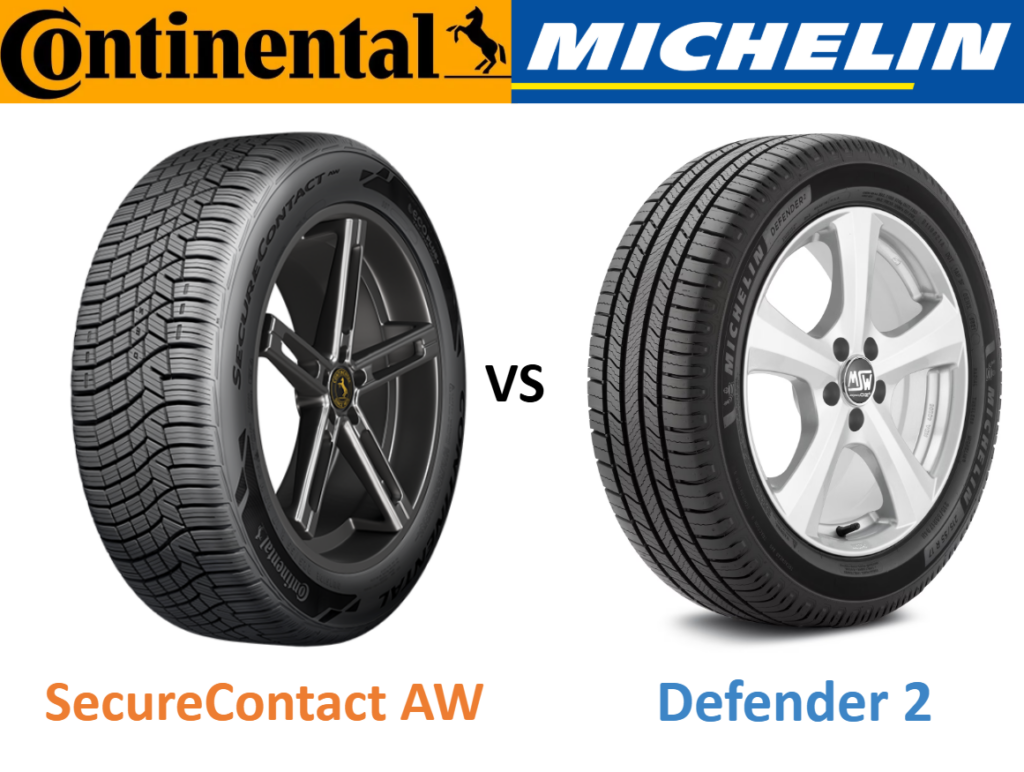
Continental SecureContact AW vs Michelin Defender 2: This is a battle between two very different all-season philosophies. On one side, the new Continental SecureContact AW enters as a modern all-weather tire, bringing 3-Peak Mountain Snowflake certification and year-round confidence into the mix. On the other, the Michelin Defender 2 represents the traditional mileage-focused all-season tire, built around long tread life, comfort, and everyday durability. So the big question is simple: can Continental’s new all-weather challenger take on one of Michelin’s strongest mileage kings?
Table of Contents
Results: Continental SecureContact AW vs Michelin Defender 2
Results below were taken in combination from the Tire Rack’s “Continental’s All Weather Test & Tire Rack’s “Premium Touring Tires to Elevating the Journey – 2024” test. The graph below shows the comparison between Continental SecureContact AW vs Michelin Defender 2 based on the relevant performance category. The Continental SecureContact AW was set as a reference hence at the 100% mark. Note that for subjective evaluation, we equate 1 point as 5%. Hence for example if tire A is graded 7 while tire B is graded 6, A is better than B by 5%.
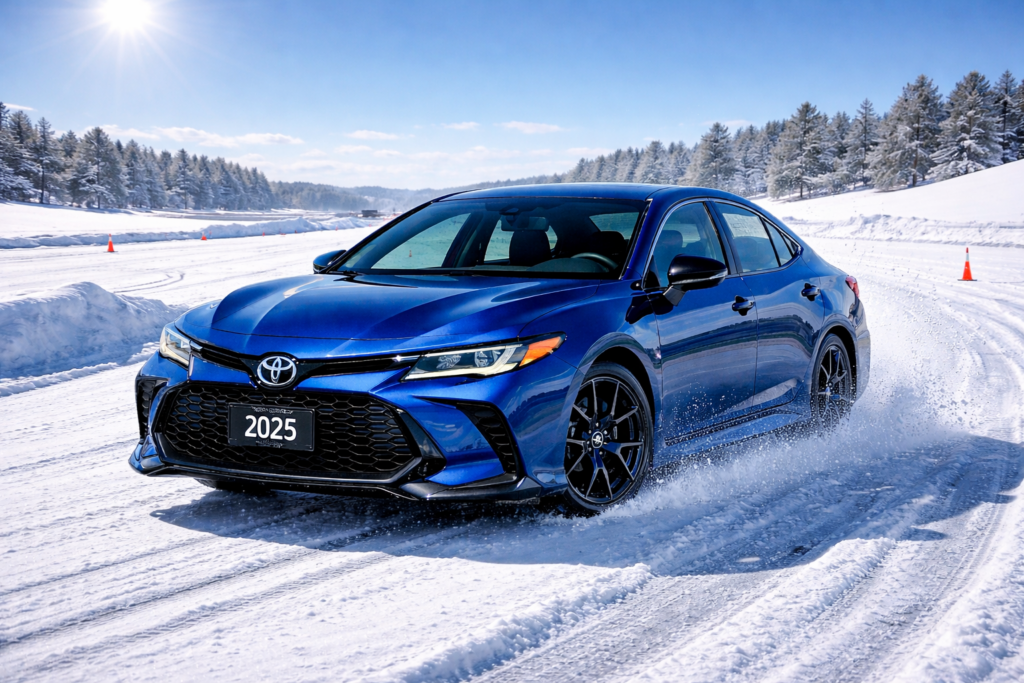
The tire size of interest is 215/55R17 which is a common tire size for Toyota Camry. You can check out our latest tire size table for more information. The testing vehicle is a 2025 Toyota Camry.
Wet
In wet braking, the Michelin Defender 2 has a very small edge, stopping about 1% better than the Continental SecureContact AW. However, in wet handling, the SecureContact AW clearly turns the tables, delivering around 6% better lap time performance than the Defender 2.
Defender 2 :
- +1% in wet braking
- -6% in wet handling (lap time)
Dry
In dry braking, the Michelin Defender 2 holds the advantage, delivering around 3% better stopping performance than the Continental SecureContact AW. This shows that Michelin’s traditional mileage-focused all-season tire still performs strongly on dry roads.
Defender 2 :
- +3% in dry braking
Snow
In snow braking, the Continental SecureContact AW completely dominates, delivering around 21% better stopping performance than the Michelin Defender 2. The gap becomes even bigger in snow acceleration, where the SecureContact AW holds a massive 30% advantage in pulling traction. In subjective snow handling, the difference is smaller, but the SecureContact AW still leads by around 6%.
Overall, snow is where the Continental SecureContact AW clearly separates itself. As a true all-weather tire, it delivers far stronger braking, acceleration, and handling confidence than the traditional Michelin Defender 2.
Defender 2 :
- -21% in Snow braking
- -30% in Snow Acceleration
- -6% in Snow handling (subj)
Ice
In ice braking, the Continental SecureContact AW also holds the advantage, delivering around 3% better stopping performance than the Michelin Defender 2. The gap is not as dramatic as in snow, but it still shows the SecureContact AW’s winter-focused tuning.
Defender 2 :
- -3% in Ice braking
Mileage & UTQG ratings
In UTQG treadwear, the Michelin Defender 2 has the clear advantage with a 840 rating compared to the Continental SecureContact AW at 700, giving Michelin around a 20% higher treadwear rating. This also matches the mileage warranty difference, where the Defender 2 is backed by an 80,000-mile warranty versus 60,000 miles for the SecureContact AW.
Overall, the Michelin Defender 2 is clearly the stronger mileage-focused tire, while the Continental SecureContact AW trades some tread life for stronger all-weather capability.
| Brand | Tireline | Size | Tread Wear | Traction | Temperature |
|---|---|---|---|---|---|
| Continental | SecureContact AW | All | 700 | A | A |
| Michelin | Defender 2 | All | 840 | B | B |
Price
In size 215/55R17, the Continental SecureContact AW is priced at $182, while the Michelin Defender 2 costs $207, making the Defender 2 around 14% more expensive.
Tire size: 215/55R17
- SecureContact AW : $ 182
- Defender 2: $ 207
Difference: +14% more expensive for Defender 2.
Summary
From my point of view, the Continental SecureContact AW is the more complete all-weather tire, especially if you need proper winter confidence. Its biggest advantages are snow braking, snow acceleration, wet handling, and ice braking, making it the stronger choice for drivers who face colder and more unpredictable conditions. The Michelin Defender 2, on the other hand, is still the better traditional mileage-focused all-season tire, with stronger dry braking, slightly better wet braking, a higher UTQG treadwear rating, and a longer 80,000-mile warranty. Overall, I would pick the SecureContact AW for all-weather safety and winter capability, while the Defender 2 makes more sense if long tread life, dry-road confidence, and mileage value are the main priorities.
Dr Edwin Pang