
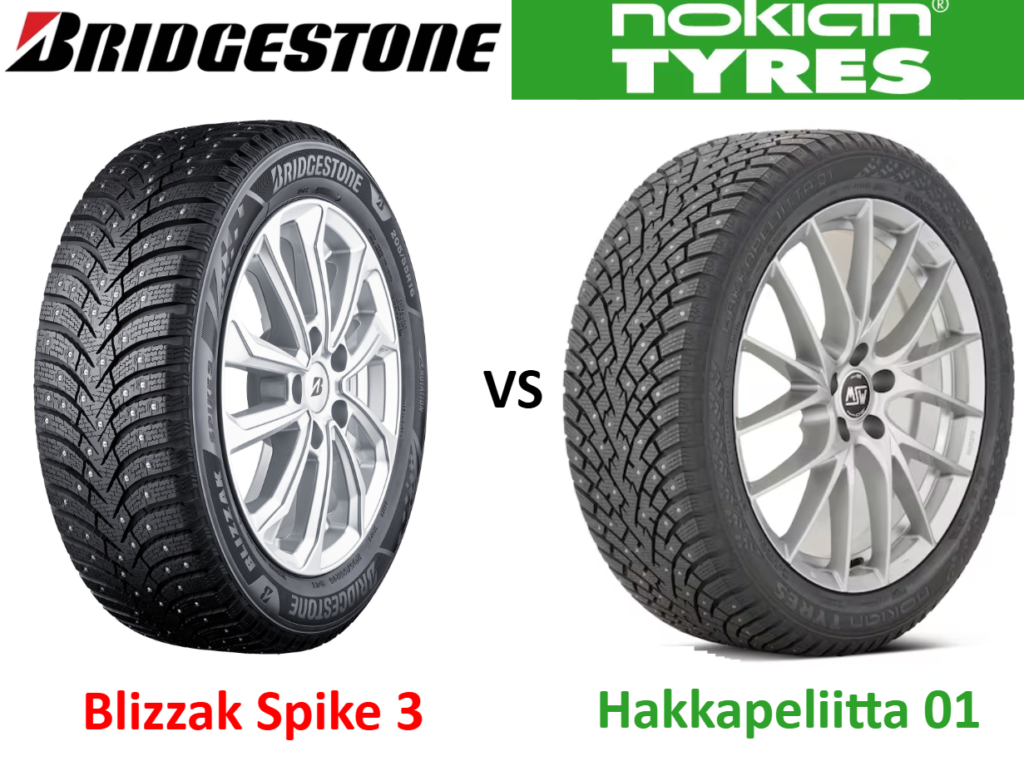
Bridgestone Blizzak Spike 3 vs Nokian Hakkapeliitta 01 SUV: Two premium studded winter tires face off in the 2026 Vi Bilägare winter tire test. Nokian enters with its heavily hyped retractable stud technology, promising exceptional ice grip with less road wear. But Bridgestone Spike 3 brings a controversy of its own, raising questions about an unfair advantage and even a potential disqualification. Is this genuine innovation, or has someone pushed the limits too far? Let’s find out!
Table of Contents
Results : Bridgestone Blizzak Spike 3 vs Nokian Hakkapeliitta 01 SUV
The results were taken from Vi Bilagare 2026 studded tire test. The graph below shows the comparison between Bridgestone Blizzak Spike 3 vs Nokian Hakkapeliitta 01 SUV based on the relevant performance category. The Bridgestone Blizzak Spike 3 was set as a reference hence at the 100% mark. The handling criteria shown in the test are evaluated objectively through lap times except for dry handling.
Note that for subjective evaluation, we equate 1 point as 5%. Hence for example if tire A is graded 5 while tire B is graded 4, A is better than B by 5%. The tire size of interest is 215/65R17 which is a common tire size for Audi A3 and the Skoda Kodiaq. You can check out our latest tire size table for more information. The testing vehicle of choice is a Volkswagen Tiguan.
Ice
In ice acceleration, the Bridgestone Blizzak Spike 3 takes just 8.46 seconds, compared with 10.43 seconds for the Nokian Hakkapeliitta 01 SUV, giving Bridgestone a 1.97-second advantage, with Nokian trailing by 19%. The gap is even bigger in ice braking, where Bridgestone stops 2.53 meters shorter, outperforming Nokian by 23%. However, ice handling is practically identical, with just 0.13 seconds separating the two.
But here comes the controversy. After running-in, Bridgestone’s studs protruded 1.5 mm, compared with just 1.0 mm for Nokian, exceeding Bridgestone’s 1.2 mm approved specification and leading to disqualification from the test ranking. Now, assuming every extra 0.1 mm of stud protrusion gives a 3% ice grip advantage, Bridgestone’s additional 0.5 mm could theoretically explain 15 percentage points of its performance advantage. Even with this simple linear adjustment, Bridgestone would still lead by roughly 8% in ice braking and 4% in ice acceleration. But is the relationship really linear? We don’t know. And more importantly, was this a deliberate attempt to gain an advantage, or simply a production quality issue? The test cannot establish intent.
Hakkapeliitta 01 SUV : (TESTED)
- -19% in ice acceleration
- -23% in ice braking
- 0% in ice handling
Hakkapeliitta 01 SUV : (Stud Protrusion Corrected)
- –4 in ice acceleration
- -8% in ice braking
- 0% in ice handling
Snow
On snow, the Nokian Hakkapeliitta 01 SUV takes the lead across all three disciplines. In snow acceleration, Nokian is just 0.03 seconds quicker, giving it a 1% advantage over the Bridgestone Blizzak Spike 3. In snow braking, Nokian stops 0.48 meters shorter, outperforming Bridgestone by 3%. The gap widens slightly in snow handling, where Nokian completes the lap 2.12 seconds faster, another 3% advantage.
Overall, Nokian wins all three snow tests, but the margins remain relatively small, showing just how closely matched these two tires are on snow.
Hakkapeliitta 01 SUV :
- +1% in snow acceleration
- +3% in snow braking
- +3% in snow handling
Wet
On wet roads, the Nokian Hakkapeliitta 01 SUV takes a clean sweep across all three disciplines. In wet braking, Nokian stops 2.38 meters shorter, giving it a 4% advantage over the Bridgestone Blizzak Spike 3. In wet handling, Nokian completes the lap 0.79 seconds faster, outperforming Bridgestone by 2%. The biggest difference comes in aquaplaning resistance, where Nokian reaches 69.0 km/h, compared with Bridgestone’s 65.3 km/h, a 3.7 km/h improvement, or 6% better performance.
Overall, Nokian clearly wins on wet roads, with its biggest advantage coming in aquaplaning resistance, an important safety factor in heavy rain.
Hakkapeliitta 01 SUV :
- +4% in wet braking
- +2% in wet handling
- +6% in aquaplaning
Dry
On dry roads, the Nokian Hakkapeliitta 01 SUV takes the lead in braking, stopping 2.83 meters shorter than the Bridgestone Blizzak Spike 3, giving it a 5% advantage. However, Bridgestone fights back in dry handling, scoring 3 out of 5, compared with Nokian’s 2 out of 5, giving Bridgestone a 5% advantage based on our subjective rating scale.
Overall, Nokian delivers better dry braking, while Bridgestone offers better steering feel and handling characteristics. Neither tire dominates both disciplines.
Hakkapeliitta 01 SUV :
- +5% in dry braking
- -5% in subjective dry handling
Fuel Consumption
In fuel consumption, the Nokian Hakkapeliitta 01 SUV uses 6.519 L/100 km, compared with 6.575 L/100 km for the Bridgestone Blizzak Spike 3. This gives Nokian a small 1% advantage in fuel efficiency, with both tires delivering almost identical results.
Hakkapeliitta 01 SUV :
- +1% in fuel consumption
Noise
In road noise at 70 km/h, the Nokian Hakkapeliitta 01 SUV records just 65.6 dB, compared with 68.1 dB for the Bridgestone Blizzak Spike 3. This makes Nokian 2.5 dB quieter, giving it a 4% advantage on our relative comparison scale.
Hakkapeliitta 01 SUV :
- +4% in interior noise (-2.5 dB)
Price
For tire size 215/65 R17, the Bridgestone Blizzak Spike 3 costs €182, compared with €196 for the Nokian Hakkapeliitta 01 SUV. This makes Nokian €14 more expensive, representing an 8% price premium. Considering Nokian’s stronger snow, wet and dry braking performance, along with its quieter ride, the additional cost seems well justified.
Tire size: 215/65 R17
- Blizzak Spike 3 : € 182
- Hakkapeliitta 01 SUV : € 196
Difference: +8% more expensive for Hakkapeliitta 01 SUV.
Conclusion
From my perspective as a tire expert, the Nokian Hakkapeliitta 01 SUV is my clear recommendation. Bridgestone delivers impressive ice braking and acceleration, but its excessive stud protrusion resulted in disqualification, making those advantages questionable. Beyond unfair performance gains, excessive studs increase road wear and noise, and can create legal compliance issues.
Nokian offers better snow and wet performance, shorter dry braking, 2.5 dB less noise, and slightly better fuel efficiency. Its innovative retractable stud technology also demonstrates how winter grip and reduced road wear can coexist. For just 8% more, I would confidently choose Nokian. Performance matters, but fair testing, safety and regulatory compliance matter just as much.
Dr Edwin Pang