
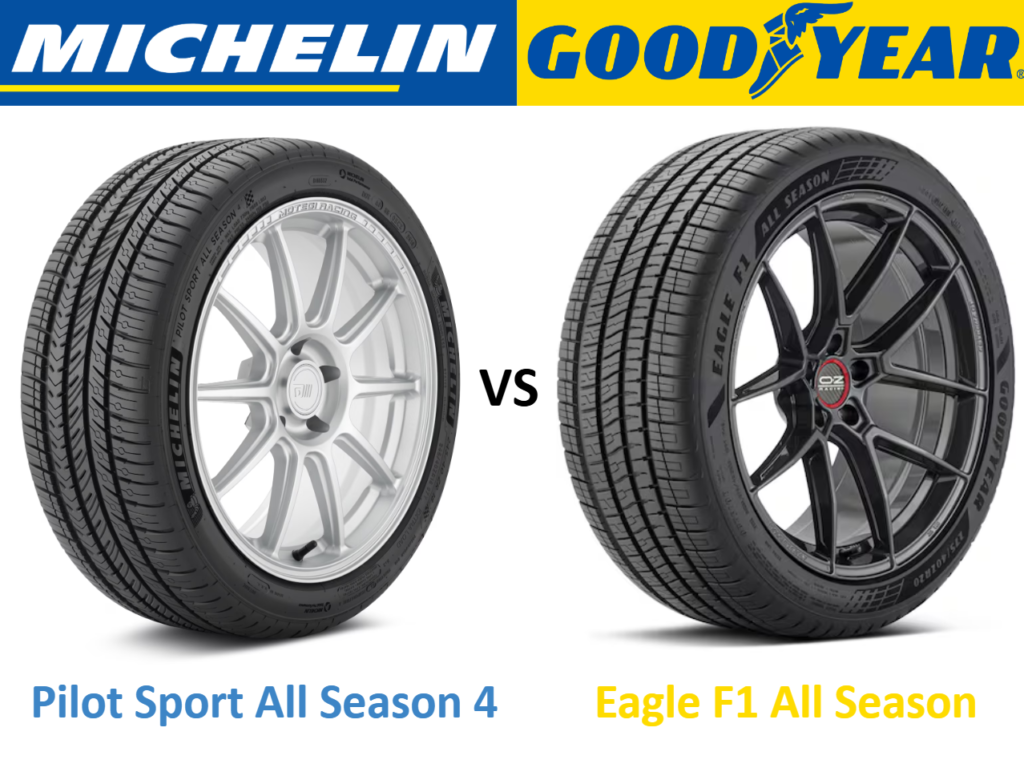
Michelin Pilot Sport All Season 4 vs Goodyear Eagle F1 All Season: The Michelin Pilot Sport All Season 4 is one of the benchmarks in ultra-high-performance all-season tires. But Goodyear’s new Eagle F1 All Season has arrived to challenge it—and this battle could shake up your shortlist. Can Goodyear take the fight to Michelin in the wet and still deliver sharp dry handling? And what’s the price of that performance—comfort, tread life, or grip when the snow arrives? I’m Dr. Edwin Pang. Let’s find out who delivers the better balance—and what you give up along the way.
Table of Contents
Results : Michelin Pilot Sport All Season 4 vs Goodyear Eagle F1 All Season
The test results are based on Treadwell data from Discount Tire. The graph below compares the Michelin Pilot Sport All Season 4 vs Goodyear Eagle F1 All Season across key performance categories.
For subjective evaluations, each point is treated as equivalent to a 5% difference. For example, if Tire A scores a 4 and Tire B scores a 3, Tire A is considered 5% better than Tire B in that category.
Wet
The Michelin Pilot Sport All Season 4 stops in 130 feet in the wet, 3 feet shorter than the Goodyear Eagle F1 All Season at 133 feet, giving Michelin a 2% braking advantage. Both score 4 out of 5 for wet handling response, with no difference. Overall, Michelin has a small edge in wet braking, while both tires deliver the same wet handling response.
Eagle F1 All Season :
- -2% Wet Braking
- 0% Wet Handling
Winter
The Michelin Pilot Sport All Season 4 and Goodyear Eagle F1 All Season both score 1.5 out of 5 for winter performance, with a 0-point difference or 0%. Neither tire has an advantage, and both receive a low winter rating.
Eagle F1 All Season :
- 0% Snow
Mileage
The Michelin Pilot Sport All Season 4 has a median mileage of 32,000 miles, lasting 2,000 miles longer than the Goodyear Eagle F1 All Season at 30,000 miles. Goodyear trails by 6%, giving Michelin the edge in tread life.
Eagle F1 All Season :
- -6% Mileage
Dry
The Michelin Pilot Sport All Season 4 stops in 113 feet in the dry, 3 feet shorter than the Goodyear Eagle F1 All Season at 116 feet, giving Michelin a 3% braking advantage. Michelin also scores 4 out of 5 for dry handling against Goodyear’s 3.5, a 0.5-point lead and a 2.5% advantage on your comparison scale. Overall, Michelin has the edge in both dry braking and handling.
Eagle F1 All Season :
- -3% Dry Braking
- -2.5% Dry Handling
Noise Vibration & Harshness (NVH)
The Michelin Pilot Sport All Season 4 and Goodyear Eagle F1 All Season both score 3.5 out of 5 for quiet ride and ride comfort, with a 0-point difference or 0% in both areas. Neither tire has an advantage, offering the same rated balance of noise and comfort.
Eagle F1 All Season :
- 0% Quiet Ride
- 0% Comfort
Fuel Consumption
The Michelin Pilot Sport All Season 4 scores 2 out of 5 for fuel efficiency, ahead of the Goodyear Eagle F1 All Season at 1.5. This is a 0.5-point lead, giving Michelin a 2.5% advantage on the comparison scale.
Eagle F1 All Season :
- -2.5% Fuel Efficiency
Price
For 225/45R18, the Goodyear Eagle F1 All Season costs $200 per tire, $20 less than the Michelin Pilot Sport All Season 4 at $220, making Goodyear 9% cheaper. That saves $80 on a set of four, giving Goodyear the advantage in upfront cost.
Tire size: 225/45R18
- Pilot Sport All Season 4 : $220
- Eagle F1 All Season : $200
Difference: -9% more cheaper for Eagle F1 All Season
Conclusion:
As a tire expert, I’d choose the Michelin Pilot Sport All Season 4 for its shorter wet and dry braking, stronger dry handling, better fuel-efficiency rating and 2,000-mile advantage in median tread life. At $20 more per tire, I think the extra performance makes it the stronger overall buy.
The Goodyear Eagle F1 All Season makes sense if your priority is saving $80 on a set while keeping equal wet handling, quietness and comfort ratings. The trade-off is slightly weaker braking and shorter tread life. With both scoring just 1.5 out of 5 for winter performance, I wouldn’t choose either for demanding winter driving.
Dr Edwin Pang