
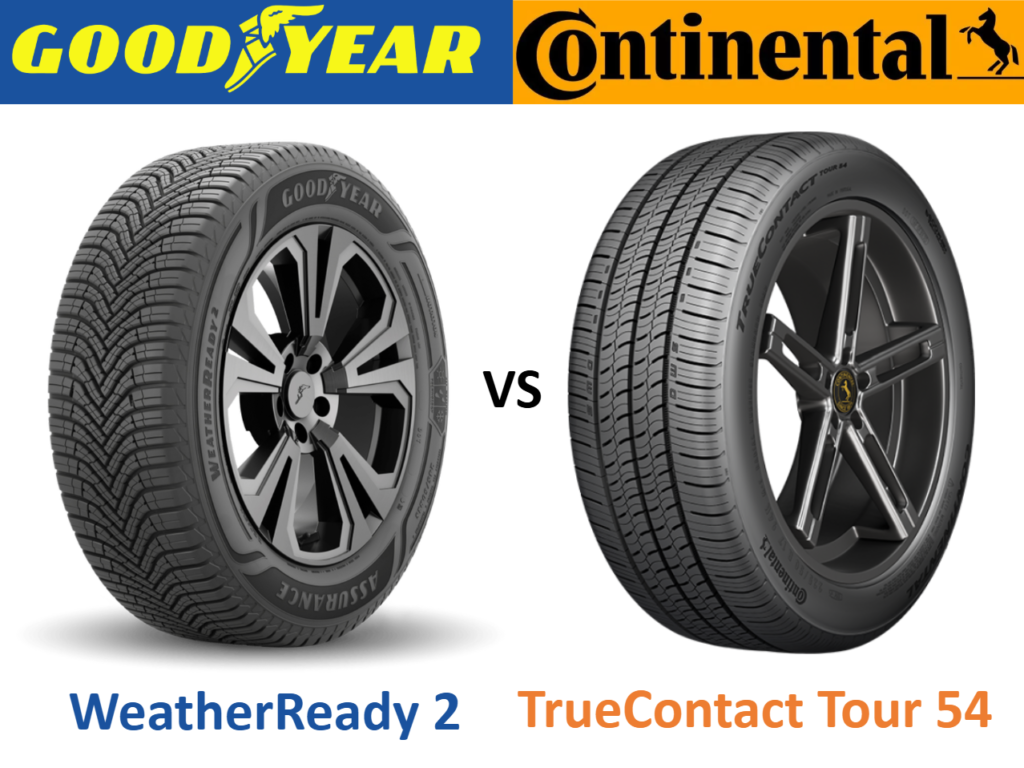
A dedicated all-weather tire against an all-season built to go the distance. This is the Goodyear Assurance WeatherReady 2 versus the Continental TrueContact Tour 54—and the battle goes far beyond snow grip. Does Goodyear’s winter capability come at the expense of mileage, comfort or efficiency? And what does Continental give up to keep those miles rolling? Let’s find out what you gain—and what you sacrifice—with each tire.
Table of Contents
Results: Goodyear Assurance WeatherReady 2 vs Continental TrueContact Tour 54
Results below were taken from the Tire Rack’s “Premium Touring Tires to Elevating the Journey – 2024” test. A total of 8 tires were tested this time around in Tire Rack’s own proving ground. The graph below shows the comparison between Goodyear Assurance WeatherReady 2 vs Continental TrueContact Tour 54 based on the relevant performance category. The Goodyear Assurance WeatherReady 2 was set as a reference hence at the 100% mark. Note that for subjective evaluation, we equate 1 point as 5%. Hence for example if tire A is graded 7 while tire B is graded 6, A is better than B by 5%.
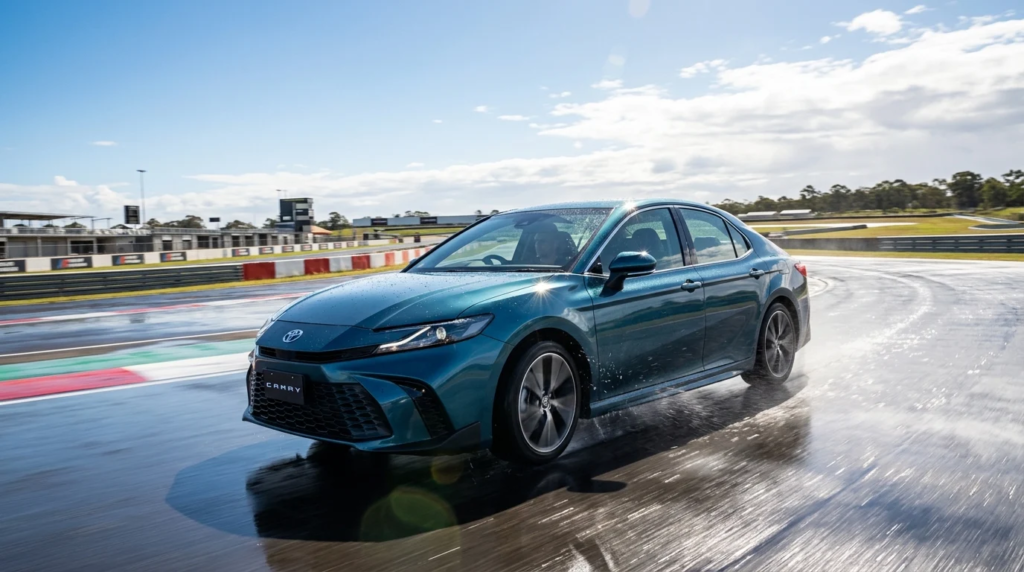
As both tires are categorized as all season tires, Tire Rack has included snow & ice in its testing portfolio. The tire size of interest is 215/55R17 which is a common tire size for Chevrolet Cruze Eco & Toyota Camry Hybrid XLE. You can check out our latest tire size table for more information. The testing vehicle is a 2025 Toyota Camry.
Wet
The Goodyear Assurance WeatherReady 2 and Continental TrueContact Tour 54 both stop in 153 feet, a difference of 0 feet or 0%. Continental scores 0.62 points lower in wet handling, a 3% disadvantage, with 6.63 versus Goodyear’s 7.25 out of 10. Continental also finishes the wet lap 0.35 seconds slower, a 1% disadvantage, taking 33.78 seconds against Goodyear’s 33.43 seconds.
Overall, both tires match each other in wet braking, but Goodyear has a small handling advantage, combining a higher driver rating with a slightly quicker lap.
TrueContact Tour 54 :
- 0% in wet braking
- -3% in wet handling (subj)
- -1% in wet handling (lap time)
Snow
Continental stops 10.47 feet shorter in snow, a 16% advantage, taking 66.85 feet against Goodyear’s 77.32 feet. In snow acceleration, Continental needs 0.34 feet more distance, a 1% disadvantage, at 31.46 versus 31.12 feet. Continental’s subjective handling score is 0.83 points lower, a 4% disadvantage, scoring 5.50 against Goodyear’s 6.33. However, Continental completes the snow lap 0.83 seconds quicker, a 1% advantage, at 56.38 versus 57.21 seconds.
Overall, Continental delivers the stronger snow braking result and a slightly faster lap, while Goodyear earns the higher handling rating and holds a small acceleration advantage.
TrueContact Tour 54 :
- +16% in Snow braking
- -1% in Snow traction
- -4% in Snow handling (subj)
- +1% in Snow handling (lap time)
Ice
Goodyear stops 0.50 feet shorter on ice, taking 55.20 feet against Continental’s 55.70 feet. This gives Continental a 1% disadvantage.
TrueContact Tour 54 :
- -1% in Ice braking
Mileage
Based on median mileage data from Discount Tire’s Treadwell, Continental delivers 4,500 miles more tread life, an 11% advantage, reaching 47,000 miles against Goodyear’s 42,500 miles. Overall, Continental has the edge in longevity, offering more miles before replacement.
TrueContact Tour 54 :
- +11% in Ice braking
Dry
Continental stops 2 feet shorter in the dry, a 2% advantage, taking 132 feet against Goodyear’s 134 feet. However, Continental scores 0.44 points lower in dry handling, a 2% disadvantage, with 6.94 versus Goodyear’s 7.38. Overall, Continental has a small dry braking advantage, while Goodyear earns the higher handling rating.
TrueContact Tour 54 :
- +2% in dry braking
- -2% in dry handling (subj)
Noise/Comfort/Ride Quality
Goodyear scores 0.08 points higher for combined noise, comfort and ride quality, with 7.83 versus Continental’s 7.75 out of 10. The percentage difference rounds to 0%, making both tires effectively equal in this category.
TrueContact Tour 54 :
- 0% in average of Noise, Comfort & Ride Quality.
Price
In 215/55R17, the Continental TrueContact Tour 54 costs $23 less per tire, making it 11% cheaper, at $180 versus $203 for the Goodyear Assurance WeatherReady 2. For four tires, that means $92 saved, with Continental costing $720 against Goodyear’s $812.
Tire size: 215/55R17
- Assurance WeatherReady 2 : $203
- TrueContact Tour 54 : $180
Difference: -11% more cheaper for TrueContact Tour 54
Summary
In my tire expert view, the Continental TrueContact Tour 54 is the clear overall winner in these results. It costs 11% less, delivers 11% more median mileage in Discount Tire’s Treadwell data, and matches Goodyear in wet braking and comfort. The biggest surprise is snow braking: this mileage-focused all-season stops 10.47 feet shorter, a 16% advantage, against the all-weather WeatherReady 2. For me, that braking advantage carries more weight than a small handling difference.
Goodyear earns higher handling ratings in wet, dry and snow conditions, alongside small advantages in ice braking and snow acceleration. Those are its strengths, but I find the higher price and shorter tread life difficult to justify here. Its 3PMSF badge confirms a snow-traction threshold against a reference tire; it does not guarantee better snow braking than every all-season competitor. Continental wins this comparison convincingly, although these results cannot establish superiority across every winter condition.
Dr Edwin Pang