
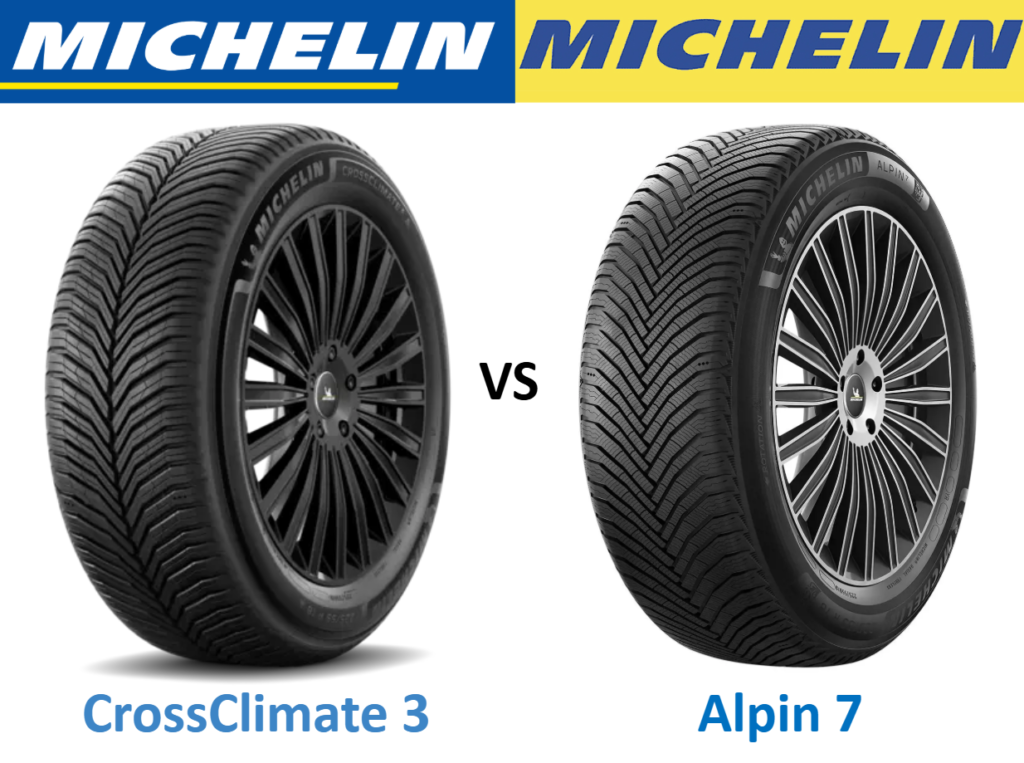
Michelin CrossClimate 3 vs Michelin Alpin 7: One Michelin for every season. One built to conquer winter. The CrossClimate 3 carries the Three-Peak Mountain Snowflake symbol—but can this all-season tire really challenge the dedicated Central European winter specialist, the Alpin 7?
Choose year-round convenience, and how much snow grip are you giving up? Choose the winter specialist, and what happens when the roads turn wet or dry? It’s all-season versatility versus winter expertise. Let’s find out how close this battle really is.
Table of Contents
Results: Michelin CrossClimate 3 vs Michelin Alpin 7
Results below were taken from 2026 Tyre Review’s Winter range Test with a total of 6 tires tested. The graph below shows the comparison between Michelin CrossClimate 3 vs Michelin Alpin 7 based on the relevant performance category. The Michelin CrossClimate 3 was set as a reference hence at the 100% mark.
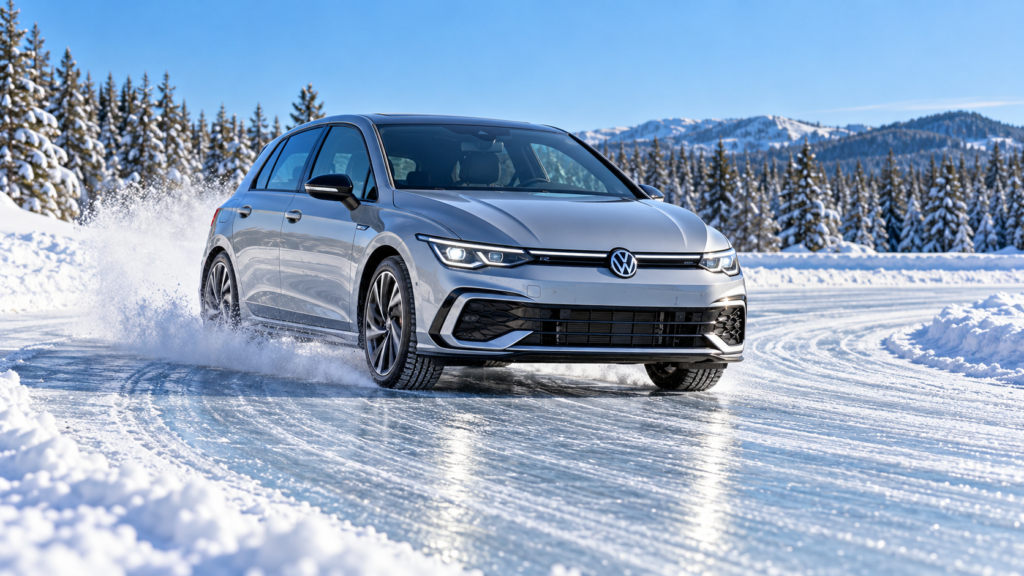
Since we are talking about tires having the converted 3 peak mountain logo, snow performances was tested. The tire size of interest is 225/40 R18 which is a common tire size for BMW 3 Series & Audi A3. You can check out our latest tire size table for more information. The testing vehicle is a VW Golf 7.
Wet
The Michelin Alpin 7 stops 0.88 metres shorter, giving it a 3% advantage over the CrossClimate 3 in wet braking. It also completes the wet handling lap 3.67 seconds faster, a 4% advantage, and resists straight aquaplaning at a 0.82 km/h higher speed, a 1% advantage.
Overall, the Alpin 7 leads in all three wet tests, with its biggest advantage in handling. The CrossClimate 3 stays close in aquaplaning resistance.
Alpin 7 :
- +3% in wet braking
- +4% in wet handling
- +1% in straight aquaplaning
Snow
The Michelin Alpin 7 stops 0.19 metres shorter on snow, giving it a 1% advantage over the CrossClimate 3. It also completes the snow handling lap 2.25 seconds faster, a 2% advantage. However, the CrossClimate 3 accelerates 0.07 seconds quicker, giving it a 1% advantage.
Overall, the CrossClimate 3 competes closely with the dedicated winter tire on snow. The Alpin 7 leads in braking and handling, while the all-season tire edges ahead in acceleration.
Alpin 7 :
- +1% in snow braking
- -1% in snow acceleration
- +2% in snow handling
Ice
The Michelin Alpin 7 stops 0.10 metres shorter on ice, giving it a 1% advantage over the CrossClimate 3. It also accelerates 0.31 seconds quicker, a 4% advantage. Overall, the Alpin 7 leads in both ice tests, with a clearer advantage in acceleration. The CrossClimate 3 comes very close in ice braking.
Alpin 7 :
- +1% in ice braking
- +4% in ice acceleration
Dry
The Michelin CrossClimate 3 stops 3.63 metres shorter than the Alpin 7 in dry braking, giving it a 10% advantage. It also completes the dry handling lap 1.65 seconds faster, a 2% advantage.
Overall, the CrossClimate 3 wins both dry tests, with its strongest advantage in braking. This is where its all-season versatility pays off against the dedicated winter tire.
Alpin 7 :
- -9% in dry braking
- -2% in dry handling
Rolling Resistance
The Michelin CrossClimate 3 has 0.02 kg/t lower rolling resistance than the Alpin 7. The difference rounds to 0%, making them effectively equal. Overall, neither tire offers a meaningful rolling resistance advantage in this test.
Alpin 7 :
- 0% in Rolling resistance
Price
In 235/45 R18, the Michelin Alpin 7 costs €200 per tire, compared with €178 for the CrossClimate 3. That makes the Alpin 7 €22 more expensive per tire, a 12% premium, or €88 more for a set of four.The CrossClimate 3 offers the lower purchase price, adding to its appeal as a tire you can use throughout the year.
Tire size: 235/45 R18
- CrossClimate 3 : € 178
- Alpin 7 : € 200
Difference: +12% more expensive for Alpin 7
Conclusion from a Tire Expert’s Perspective:
As a tire engineer, I’m impressed by how closely the CrossClimate 3 competes on snow and ice, while delivering better dry braking and handling at a 12% lower price. Mileage wasn’t measured in this test, but I would expect the all-season tire to last considerably longer in year-round use, especially through warmer weather.
I’d choose the Alpin 7 for its stronger wet performance and extra grip in most snow and ice tests. The trade-off is weaker dry performance and a higher price. For milder winters and year-round convenience, I’d favour the CrossClimate 3; for frequent winter conditions, I’d take the Alpin 7.
Dr Edwin Pang