
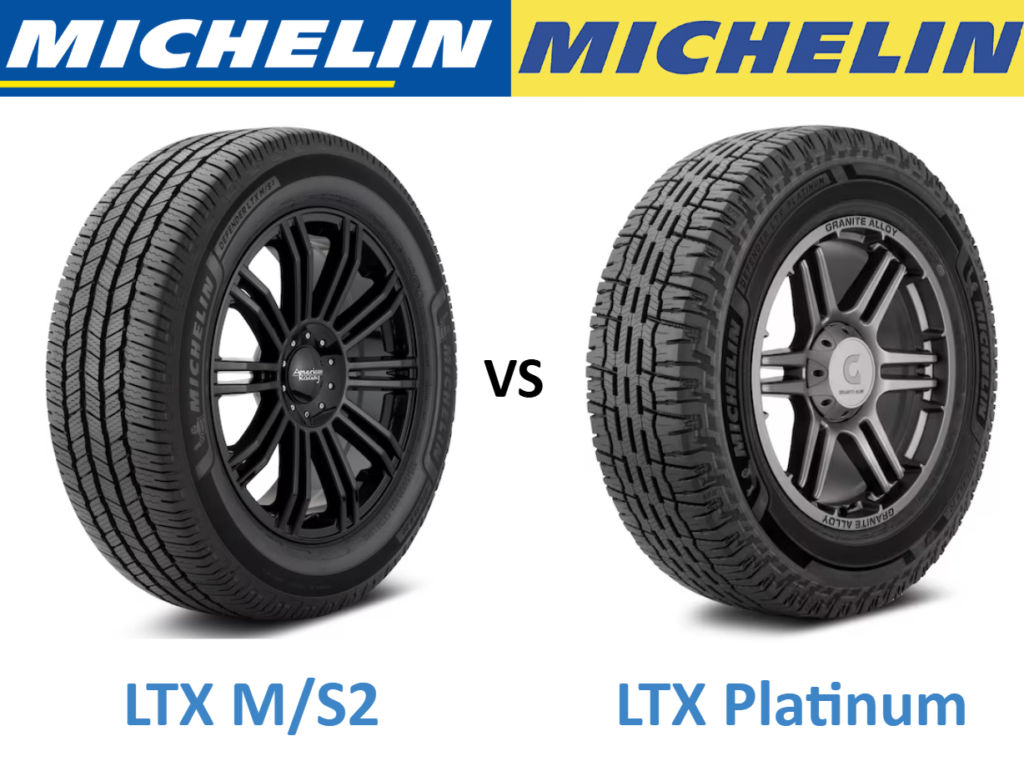
Michelin Defender LTX M/S2 vs LTX Platinum: Two Defenders, two different missions. The M/S2 targets everyday pickups and SUVs with balanced all-season performance, while the Platinum is engineered specifically for luxury heavy-duty pickups, with durability at its core.
But does paying for Platinum buy you a better tire? This battle pits braking, comfort and efficiency against serious staying power—and the tread life estimates suggest one could be the mileage king of this matchup. The question is: what does it sacrifice to earn that crown?
Table of Contents
Results : Michelin Defender LTX M/S2 vs LTX Platinum
The test results are based on Treadwell data from Discount Tire. The graph below compares the Michelin Defender LTX M/S2 vs LTX Platinum across key performance categories.
For subjective evaluations, each point is treated as equivalent to a 5% difference. For example, if Tire A scores a 4 and Tire B scores a 3, Tire A is considered 5% better than Tire B in that category.
Wet
The Defender LTX M/S2 stops in 168 feet on wet roads, compared with 186 feet for the LTX Platinum. That extra 18 feet puts the Platinum 10% behind in wet braking performance. In wet handling, the M/S2 scores 4/5 against the Platinum’s 3.5/5, leaving the Platinum 0.5 points and 2.5% behind. With shorter stops and better handling, the M/S2 wins this wet-weather battle.
LTX Platinum :
- -10% Wet Braking
- -2.5% Wet Handling
Winter
The Defender LTX M/S2 earns a 3.5/5 winter rating, compared with 2/5 for the LTX Platinum. This 1.5-point gap puts the Platinum 7.5% behind on your relative performance scale, making the M/S2 the stronger choice for winter conditions.
LTX Platinum :
- -7.5% Snow
Mileage
The Defender LTX Platinum delivers a median lifespan of 104,851 miles, compared with 77,649 miles for the M/S2. That is 27,202 extra miles, giving the Platinum a 35% mileage advantage.
It was also recently ranked No. 1 for tire life in Treadwell’s 2026 top 10 light-truck and SUV tire ranking, making the Platinum the mileage king of this matchup.
LTX Platinum :
- +35% Mileage
Dry
The Defender LTX M/S2 stops in 140 feet on dry roads, while the LTX Platinum needs 148 feet. That extra 8 feet puts the Platinum 5% behind in dry braking performance. Both tires score 3.5/5 for dry handling, with no difference between them. The M/S2 takes the dry-weather win through its shorter stopping distance.
LTX Platinum :
- -5% Dry Braking
- 0% Dry Handling
Noise Vibration & Harshness (NVH)
The Defender LTX Platinum scores 4/5 for quiet ride, ahead of the M/S2’s 3.5/5. That 0.5-point lead gives the Platinum a 2.5% advantage in the quiet ride rating. Both tires score 3.5/5 for ride comfort, so they are equally comfortable. The Platinum edges ahead overall thanks to its quieter ride.
LTX Platinum :
- +2.5% Quiet Ride
- 0% Comfort
Fuel Consumption
The Defender LTX M/S2 scores 4/5 for fuel efficiency, compared with 2.5/5 for the LTX Platinum. This 1.5-point gap puts the Platinum 7.5% behind on the relative rating scale, giving the M/S2 the edge in fuel efficiency.
LTX Platinum :
- -7.5% Fuel Efficiency
Price
In 265/60R20, the Defender LTX M/S2 costs $349 per tire, while the Defender LTX Platinum (LT) costs $375. That makes the Platinum $26 per tire, or 7%, more expensive, adding $104 for a set of four.
Tire size: 265/60R20
- LTX M/S2 : $349
- LTX Platinum (LT) : $375
Difference: +7% more expensive for LTX Platinum
Conclusion:
As a tire expert, I’m seriously impressed by the LTX Platinum’s mileage. Its 104,851-mile median lifespan and 35% advantage over the M/S2 are outstanding, earning it first place in Treadwell’s 2026 truck and SUV tire-life ranking. Add a quieter ride for just 7% more upfront, and it makes a strong case for high-mileage drivers.
I would choose the Defender LTX M/S2 for its better wet and dry braking, stronger winter rating, higher fuel-efficiency rating and lower price. The Platinum wins on longevity, while the M/S2 offers the stronger balance of everyday performance.
Dr Edwin Pang