
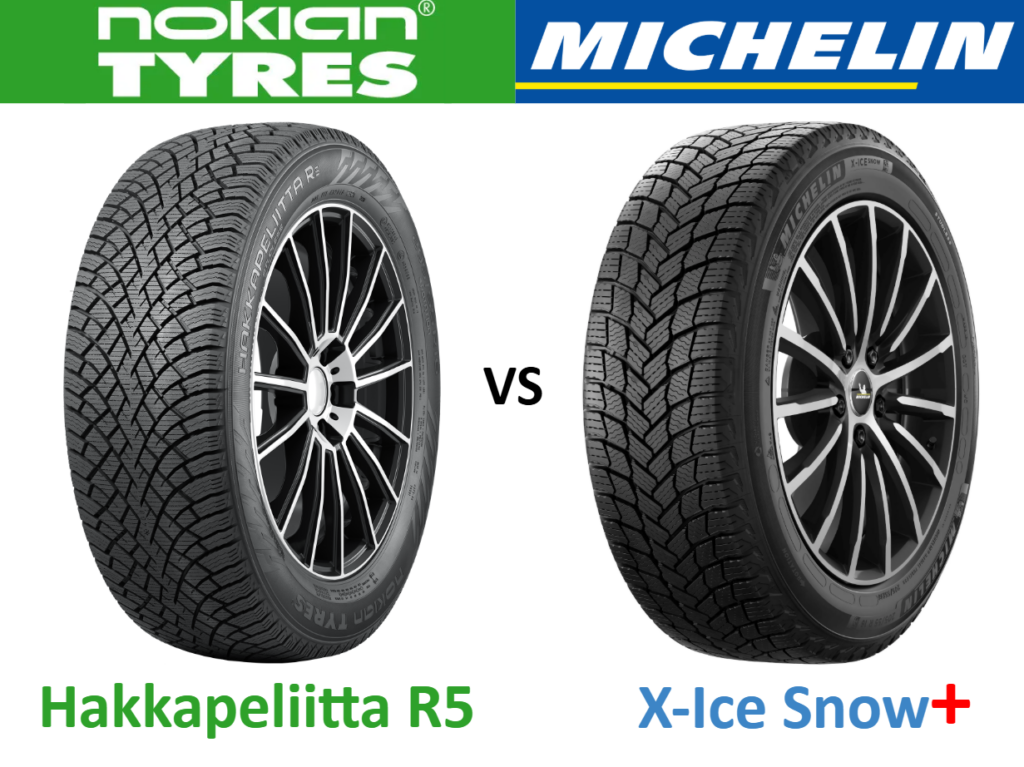
The Nokian Hakkapeliitta R5 vs Michelin X-Ice Snow+ is one of the most exciting studless winter tire battles this season. Michelin enters with the new X-Ice Snow+, taking aim directly at Nokian’s proven Hakkapeliitta R5 — a tire built around serious Nordic ice and snow performance. Can the new X-Ice Snow+ finally take the fight to the R5 on ice and snow, while maintaining Michelin’s strength in wet conditions? Let’s find out.
Table of Contents
Results: Nokian Hakkapeliitta R5 vs Michelin X-Ice Snow+
Results below were taken from 2026 Aftonbladet Winter Tire Test with a total of 12 tires tested. The graph below shows the comparison between Nokian Hakkapeliitta R5 vs Michelin X-Ice Snow+ based on the relevant performance category. The Nokian Hakkapeliitta R5 being the older tire was set as a reference hence at the 100% mark.
Note that for subjective ratings, 1 point is equivalent to 10%. So if tire A has a 4 point rating & tire B has a 3 point rating, tire A is better than tire B by 10%. The tire size of interest is a 205/55 R16 which is a common tire size for Toyota Corolla. The testing vehicle is a Volkswagen Golf.
Ice
On ice, the Nokian Hakkapeliitta R5 has the clear advantage. It stops 4.8 meters shorter than the Michelin X-Ice Snow+, a 9% advantage, and accelerates 1.3 seconds quicker, giving it a much stronger 15% advantage.
The R5 is also 0.6 seconds faster around the ice handling lap, worth 1%, while its subjective ice handling score is 1 point higher, equal to 5%. Overall, the R5 is clearly stronger on ice, especially in braking and acceleration.
X-Ice Snow+ :
- -9% in ice braking
- -15% in ice acceleration
- -1% in ice handling (lap time)
- -5% in ice handling (subj)
Snow
On snow, the Michelin X-Ice Snow+ stops 0.6 meters shorter than the Nokian Hakkapeliitta R5, giving it a small 1% advantage. Snow acceleration is identical at 6.6 seconds, so there is no difference between them.
In snow handling, the R5 is 0.9 seconds faster around the lap, a 2% advantage, while its subjective score is 1 point higher, equal to 5%. Overall, snow performance is close, but the R5 has the edge in handling while Michelin is marginally better in braking.
X-Ice Snow+ :
- +1% in snow braking
- 0% in snow acceleration
- -2% in snow handling (lap time)
- -5% in snow handling (subj)
Wet
In the wet, the Michelin X-Ice Snow+ has the clear advantage. It stops 3.1 meters shorter than the Nokian Hakkapeliitta R5, giving it a 10% advantage, and is 1.0 second faster around the wet handling lap, worth 3%.
The Michelin also scores 1 point higher in subjective wet handling, equal to a 5% advantage. Overall, the X-Ice Snow+ is clearly the stronger wet-weather tire.
X-Ice Snow+ :
- +10% in wet braking
- +3% in wet handling (lap time)
- +5% in wet handling (subj)
Dry
In the dry, the two tires are almost identical. The Michelin X-Ice Snow+ stops just 0.1 meter shorter than the Nokian Hakkapeliitta R5, which is effectively a 0% difference. Subjective dry handling is also identical at 9 points, so there is no difference between them. Overall, dry performance is essentially tied.
X-Ice Snow+ :
- 0% in dry braking
- 0% in dry handling (subjective)
Subjective Noise
For noise, the Nokian Hakkapeliitta R5 scores 1 point higher than the Michelin X-Ice Snow+, which equals a 5% advantage. Overall, the R5 is the quieter and more refined tire.
X-Ice Snow+ :
- -5% in subj noise
Price
For tire size 205/55 R16, the Nokian Hakkapeliitta R5 costs €148, while the Michelin X-Ice Snow+ costs €135. That makes the Michelin €13 cheaper, or about 9% less expensive than the R5. This gives the X-Ice Snow+ a useful price advantage, especially considering its strong wet performance.
Tire size: 205/55 R16
- Hakkapeliitta R5 : € 148
Difference: +10% more cheaper for X-Ice Snow+
Conclusion
From my perspective, the Nokian Hakkapeliitta R5 is the stronger choice for drivers who prioritize ice grip, snow handling and refinement, with its biggest advantage coming on ice. The Michelin X-Ice Snow+, however, is clearly stronger in the wet, matches the Nokian closely in dry and snow braking, and is also cheaper.
Dr Edwin Pang