
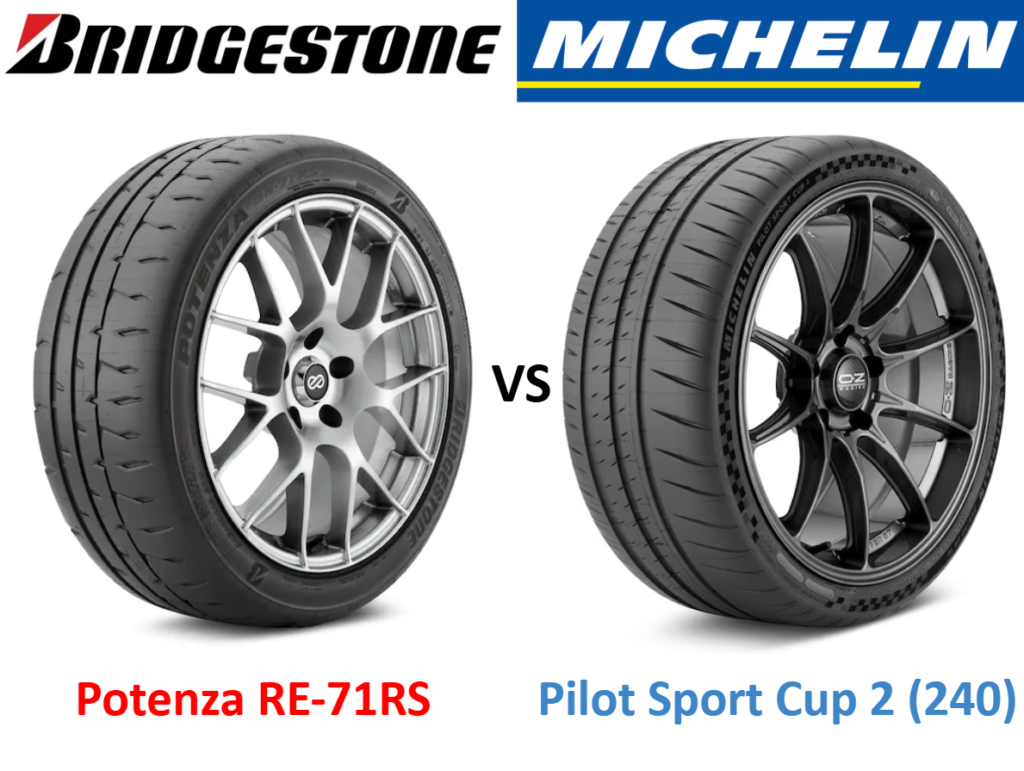
Bridgestone Potenza RE-71RS vs Michelin Pilot Sport Cup 2 (240) — the ultimate track-day tire showdown. In this battle of ultra-high performance rubber, two fan favorites go head-to-head: the grippy, aggressive RE-71RS known for blistering lap times and the Pilot Sport Cup 2 (240) with motorsport-inspired tech and impressive precision. Who truly reigns supreme? We’ll break it down across dry grip & performance, wet handling, and track-day mileage to see which tire gives you the most confidence — and the most fun — on both road and track.
Table of Contents
Results
Results below were taken from the Tire Rack’s “Extreme Performance Summer & Track Tire Test”. A total of 7 tires were tested this time around at Tire Rack’s own proving ground & the road course race track . The graph below shows the comparison between Bridgestone Potenza RE-71RS vs Michelin Pilot Sport Cup 2 (240) based on the relevant performance category. The Bridgestone Potenza RE-71RS was set as a reference hence at the 100% mark. Note that for subjective comfort evaluation, we equate 1 point as 5%. Hence for example if tire A is graded 7 while tire B is graded 6, A is better than B by 5%.
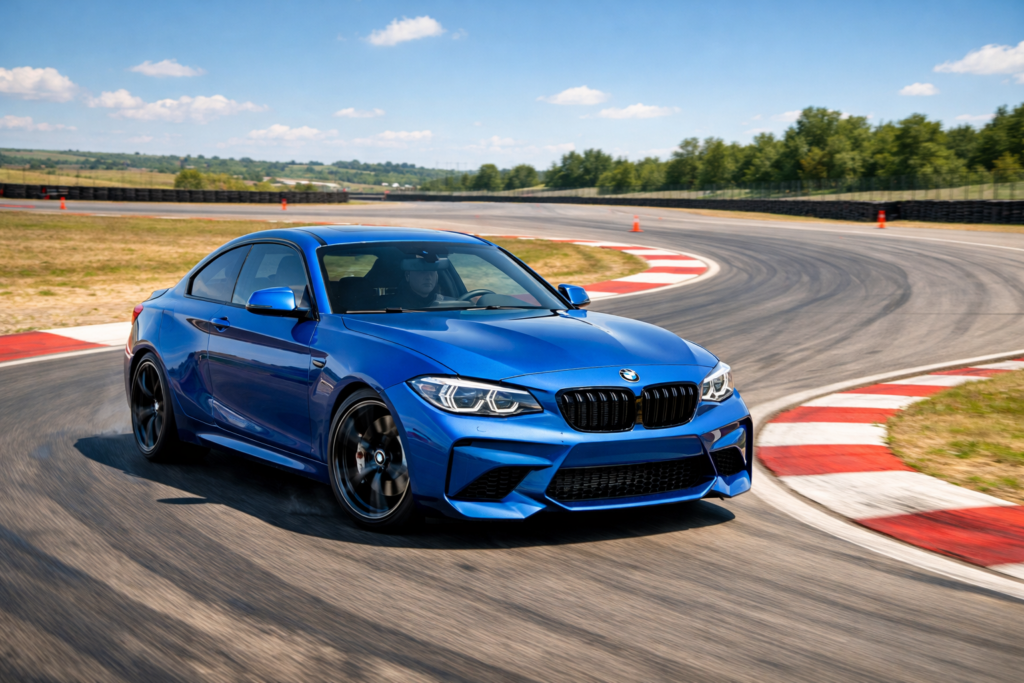
As both tires are mainly focused on track performances, the dry performance naturally takes dominance over the wet. However as this is a street legal tire, it is also crucial to know how your wet performance is as you never know when you need it. The tire size of interest is a 275/35R18 which is a common size for Jaguar F-type and BMW 5 series. You can check out our latest tire size table for more information. The testing vehicle of choice was a BMW M2.
Dry
In dry conditions, the Bridgestone Potenza RE-71RS consistently comes out ahead of the Michelin Pilot Sport Cup 2 (240). Under braking, the Bridgestone stops 4.2 feet shorter, delivering a clear 4% advantage when pushing hard on dry tarmac. That advantage carries into driver feel as well, where the RE-71RS scores 0.8 points higher in subjective dry handling, translating to a meaningful 4% edge in confidence and responsiveness.
On the stopwatch, the gap remains consistent. The Bridgestone completes the dry handling course 0.7 seconds quicker, a 3% advantage, and on the full dry race-track lap it extends that lead to 2.5 seconds, equivalent to a 2% gain in outright pace.
Overall, both tires are serious track weapons, but in dry conditions the RE-71RS proves to be the sharper and more forgiving tool at the limit, while the Cup 2 (240) rewards precision yet demands more commitment to extract its best performance.
Pilot Sport Cup 2 (240) :
- -4% in dry braking
- -4% in dry handling (subj)
- -3% in dry handling (lap time)
- -2% in dry handling track day (lap time)
Wet
In wet conditions, the two tires separate clearly in controllability rather than outright braking. Under wet braking, the Bridgestone Potenza RE-71RS stops just 0.1 feet shorter than the Michelin Pilot Sport Cup 2 (240) — effectively identical, translating to a 0% difference in straight-line stopping performance.
Once cornering is involved, the gap opens up. In subjective wet handling, the Bridgestone scores 1.37 points higher, giving it a decisive 7% advantage in driver confidence and control. That advantage is confirmed by the stopwatch, where the RE-71RS laps the wet handling course 1.36 seconds quicker, equivalent to a 4% gain in wet pace.
Overall, wet braking is a draw, but the RE-71RS is clearly the more manageable and confidence-inspiring tire when the road is damp. The Cup 2 (240) remains capable, yet it demands far more precision, while Bridgestone delivers a broader and more forgiving wet operating window.
Pilot Sport Cup 2 (240) :
- ~0% in wet braking
- -7% in wet handling (lap time)
- -4% in wet handling (lap time)
Wear
In track wear, both tires show their priorities clearly. The Bridgestone Potenza RE-71RS, even after running twice as many laps, loses about 1.0 mm evenly across the tread, with localized 2.0 mm wear on the leading edges. The wear is uniform and controlled, showing strong consistency under sustained track use.
The Michelin Pilot Sport Cup 2 (240) wears more aggressively in key areas, with 1.5–2.0 mm loss on the outer shoulder and up to 2.5 mm on the leading edges, equating to roughly 50–150% more localized wear than the Bridgestone’s average loss. Overall, the RE-71RS wears more evenly and predictably, while the Cup 2 (240) trades faster, concentrated wear for peak grip.
Price
For 275/35R18, both tires are priced exactly the same. The Bridgestone Potenza RE-71RS and the Michelin Pilot Sport Cup 2 (240) both retail at $394, resulting in a 0% price difference.
Tire size: 275/35R18
- Potenza RE-71RS: $ 394
- Pilot Sport Cup 2 (240): $ 394
Difference: 0%
Summary
From my perspective as a tire engineer, both of these are serious track-day weapons, but they shine in different ways. The Bridgestone Potenza RE-71RS stands out for its consistency — it brakes harder, laps quicker, manages wet conditions better, and wears more evenly over long sessions, making it the more forgiving and repeatable choice for frequent track use. The Michelin Pilot Sport Cup 2 (240), on the other hand, rewards precision with razor-sharp response and a motorsport-like feel, appealing to drivers who value ultimate feedback and are willing to manage its narrower operating window. Same price, same segment — the real choice comes down to whether you prioritize consistency and durability, or precision and feel at the limit.
Dr Edwin Pang