
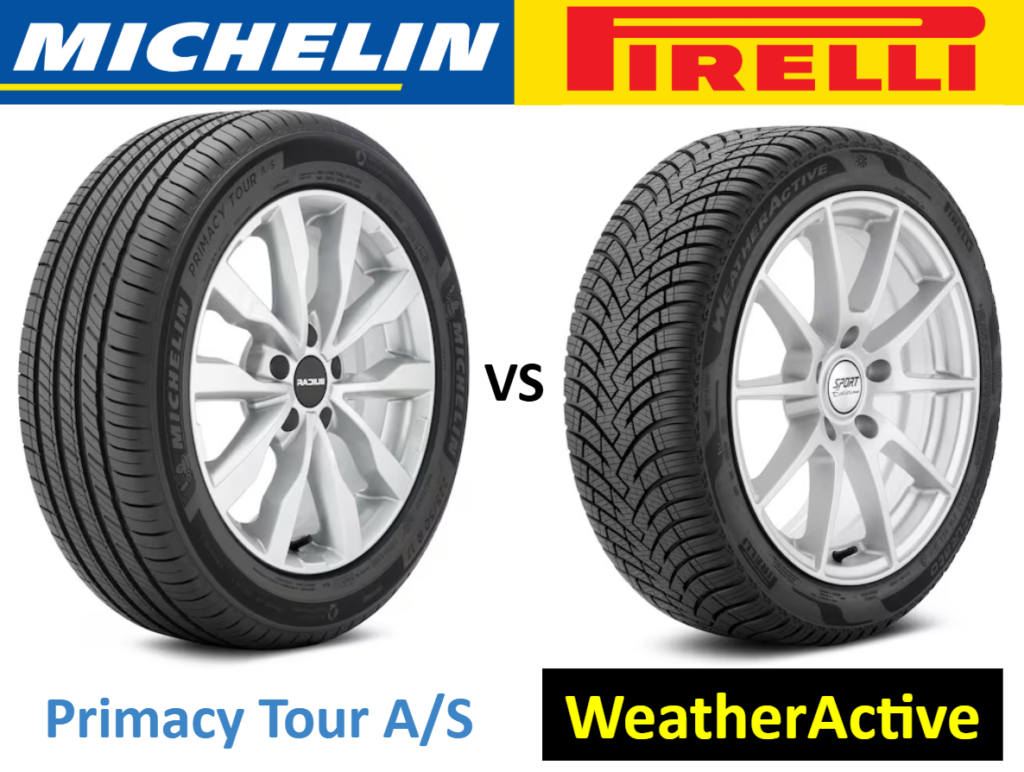
Michelin Primacy Tour A/S vs Pirelli Cinturato WeatherActive — a clean clash between all-season refinement and all-weather capability. One is built around comfort, quietness, and long-distance confidence; the other leans into stronger wet and winter grip for drivers who face tougher conditions year-round. This head-to-head will expose the real differences in wet, dry, comfort, snow, ice, and mileage — and show where all-season ends and all-weather truly begins.
Table of Contents
Results: Michelin Primacy Tour A/S vs Pirelli Cinturato WeatherActive
Results below were taken from the Tire Rack’s “Premium Touring Tires to Elevating the Journey – 2024” test. A total of 8 tires were tested this time around in Tire Rack’s own proving ground. The graph below shows the comparison between Michelin Primacy Tour A/S vs Pirelli Cinturato WeatherActive based on the relevant performance category. The Michelin Primacy Tour A/S was set as a reference hence at the 100% mark. Note that for subjective evaluation, we equate 1 point as 5%. Hence for example if tire A is graded 7 while tire B is graded 6, A is better than B by 5%.
As both tires are categorized as all season/weather tires, Tire Rack has included snow & ice in its testing portfolio. The tire size of interest is 215/55R17 which is a common tire size for Chevrolet Cruze Eco & Toyota Camry Hybrid XLE. You can check out our latest tire size table for more information. The testing vehicle is a 2025 Toyota Camry.
Wet
In wet braking, the Michelin Primacy Tour A/S stops 7 feet shorter than the Pirelli Cinturato WeatherActive at 140 ft vs 147 ft, giving Michelin a 5% advantage. In subjective wet handling, Michelin feels more secure and predictable, scoring 0.44 points higher at 7.19 vs 6.75, which equals a 2% edge in driver confidence. On wet handling lap time, the gap is much smaller, with Michelin circulating the course 0.16 seconds quicker at 34.03 s vs 34.19 s, a difference that rounds to 0% in real-world pace.
Overall, Michelin delivers stronger wet braking and clearer driver confidence, while Pirelli stays close on outright wet speed but cannot quite match Michelin’s wet safety margin.
Cinturato WeatherActive :
- -5% in wet braking
- -2% in wet handling (subj)
- ~0% in wet handling (lap time)
Dry
In dry braking, the Michelin Primacy Tour A/S stops 14 feet shorter than the Pirelli Cinturato WeatherActive at 123 ft vs 137 ft, giving Michelin a 10% advantage. In subjective dry handling, Michelin again feels more precise and stable, scoring 0.56 points higher at 7.25 vs 6.69, which equals an 3% edge in driver confidence.
Overall, Michelin shows a clear dry-road advantage with much stronger braking and a more confident, controlled feel, while Pirelli trails behind when conditions turn fully dry.
Cinturato WeatherActive :
- -10% in dry braking
- -3% in dry handling (subj)
Noise/Comfort/Ride Quality
In noise, comfort, and ride quality, the Pirelli Cinturato WeatherActive feels noticeably more compliant and relaxed, scoring 0.50 points higher than the Michelin Primacy Tour A/S at 8.17 vs 7.67, which equals a 3% comfort advantage. Michelin remains well controlled and composed, but transmits slightly more road texture compared to Pirelli’s softer, more absorbent character.
Cinturato WeatherActive :
- +3% in average of Noise, Comfort & Ride Quality.
Snow
What surprised us most is that the non–3-Peak Mountain Snowflake Michelin Primacy Tour A/S can actually beat the 3PMSF-rated Pirelli Cinturato WeatherActive in straight-line snow safety. In snow braking, Michelin stops 4.0 feet shorter, a 5% advantage, and in snow acceleration it needs 1.6 feet less distance, another 5% gain when pulling away on snow.
Once corners are involved, the balance clearly shifts. In subjective snow handling, Pirelli feels more controlled and confidence-inspiring, scoring 0.67 points higher, which equals a 3% advantage in driver feel. That control advantage shows on the stopwatch too, where Pirelli laps the snow course 1.33 seconds quicker, a 2% gain.
Overall, Michelin delivers a surprising edge in straight-line snow braking and traction despite lacking a 3PMSF rating, while Pirelli justifies its all-weather certification with stronger control and speed when cornering in snow.
Cinturato WeatherActive :
- -5% in Snow braking
- -5% in Snow Acceleration
- +3% in Snow handling (subj)
- +2% in Snow handling(lap time)
Ice
In ice braking, the Pirelli Cinturato WeatherActive stops 7.0 feet shorter than the Michelin Primacy Tour A/S, giving Pirelli a 15% advantage. In ice acceleration, Pirelli again pulls ahead, reaching speed 0.60 seconds quicker, which equals a 11% gain in traction efficiency.
Cinturato WeatherActive :
- +15% in Ice braking
- +11% in Ice acceleration
Mileage
On mileage warranty, the Pirelli Cinturato WeatherActive is rated for 60,000 miles, which is 5,000 miles more than the Michelin Primacy Tour A/S at 55,000 miles. That longer life claim is reinforced by UTQG ratings, where Pirelli carries a 700 treadwear rating, 160 points higher than Michelin’s 540.
| Brand | Tireline | Size | Tread Wear | Traction | Temperature |
|---|---|---|---|---|---|
| Pirelli | Cinturato WeatherActive | All | 700 | A | A |
| Michelin | Primacy Tour AS | All | 540 | B | B |
Price
In 215/55R17, the Pirelli Cinturato WeatherActive is priced at $197, while the Michelin Primacy Tour A/S comes in at $234. That makes the Michelin $37 more expensive, or 19% higher for the same size.
Tire size: 215/55R17
- Cinturato WeatherActive : $ 197
- Primacy Tour A/S: $ 234
Difference: +19% more expensive for Primacy Tour A/S.
Summary
From my perspective as a tire engineer, this comparison comes down to performance focus versus all-weather resilience. The Michelin Primacy Tour A/S clearly excels in dry and wet braking precision, offering sharper control and a more connected feel on normal roads, which will appeal to drivers who value safety margins and on-road confidence. The Pirelli Cinturato WeatherActive, on the other hand, stands out with better snow and ice control, higher ride comfort, and stronger longevity credentials, making it the more reassuring choice when conditions turn rough or unpredictable.
Dr Edwin Pang