
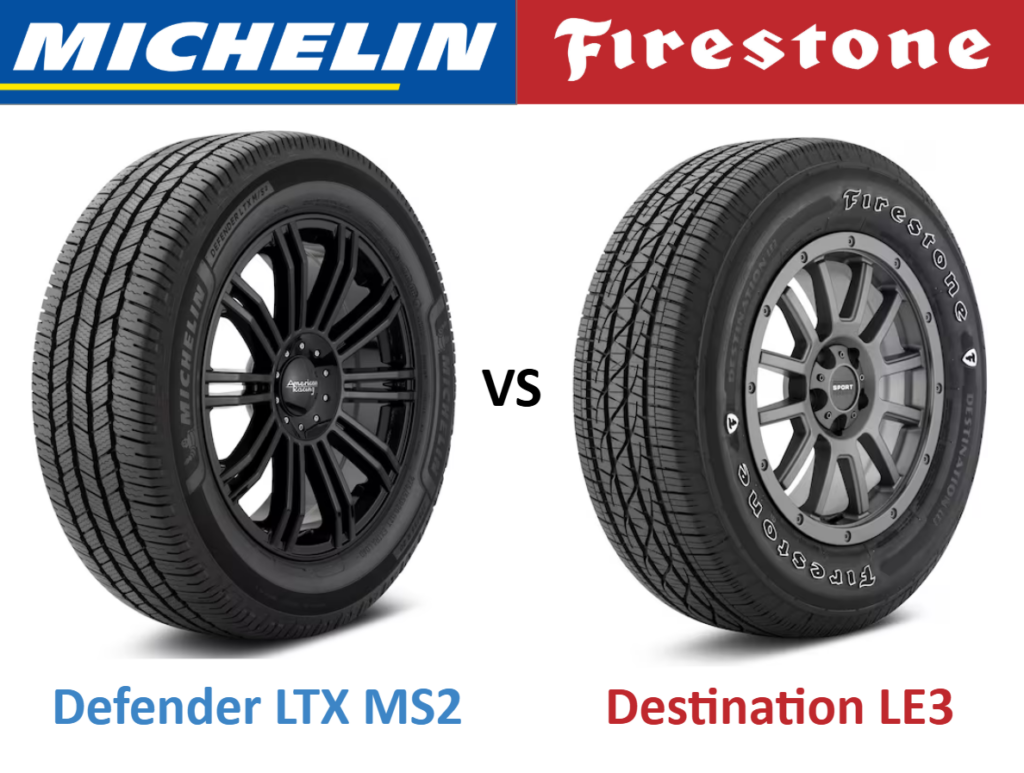
Michelin Defender LTX M/S2 vs Firestone Destination LE3 — a straight-up highway all-season truck & SUV battle. The Defender LTX M/S2 is built for maximum mileage and long-term stability, while the Destination LE3 focuses on comfort, wet grip, and everyday value. Same segment, different priorities — longevity vs livability. Which one fits how you actually drive?
Table of Contents
Results: Michelin Defender LTX M/S2 vs Firestone Destination LE3
Results below were taken from the Tire Rack’s “2024 Highway All-Season” test. A total of 8 tires were tested this time around in Tire Rack’s own proving ground. The graph below shows the comparison between Michelin Defender LTX M/S2 vs Firestone Destination LE3 based on the relevant performance category. The Michelin Defender LTX M/S2 was set as a reference hence at the 100% mark. Note that for subjective evaluation, we equate 1 point as 5%. Hence for example if tire A is graded 7 while tire B is graded 6, A is better than B by 5%.
As both tires are categorized as all season tires, Tire Rack has included snow & ice in its testing portfolio. The tire size of interest is 265/70R17 which is a common tire size for Chevrolet Silverado & GMC Sierra. You can check out our latest tire size table for more information. The testing vehicle is a 2024 Toyota Tacoma TRD Sport.
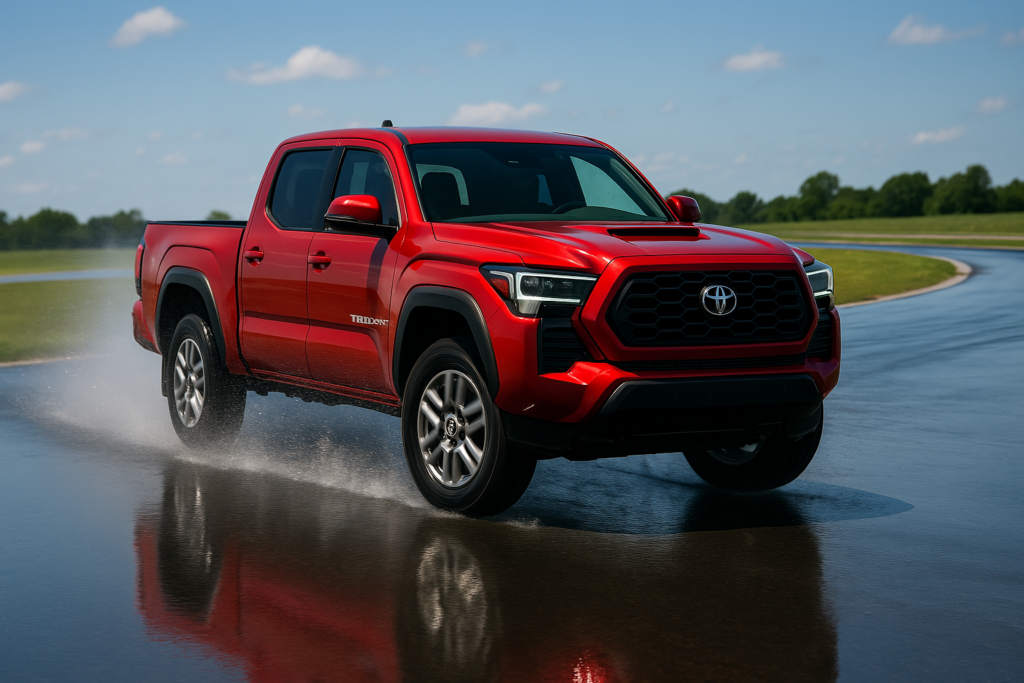
Wet
In wet braking, the Michelin Defender LTX M/S2 stops 1 foot shorter than the Firestone Destination LE3 (168 vs 169 ft), which is about a 1% advantage. In subjective wet handling, Michelin feels clearly more secure, scoring 0.69 points higher (7.00 vs 6.31), translating to roughly an 3% difference in driver confidence. On the wet handling lap, Michelin is also quicker, completing the course 0.36 seconds faster (37.51 vs 37.87 s), a 1% edge in outright wet grip.
Overall, the wet performance gap is small in absolute terms but consistent — Michelin edges ahead in braking, control, and lap speed, while Firestone stays close without quite matching the same level of wet confidence.
Destination LE3 :
- -1% in wet braking
- -3% in wet handling (subj)
- -1% in wet handling (lap time)
Dry
In dry braking, the Firestone Destination LE3 stops 6 feet shorter than the Michelin Defender LTX M/S2 (134 vs 140 ft), giving Firestone a clear 4% advantage. In subjective dry handling, Michelin feels slightly more stable and predictable, scoring 0.31 points higher (6.25 vs 5.94), which equals about a 2% edge in driver confidence.
Overall, Firestone strikes back hard on outright dry stopping power, while Michelin counters with calmer, more composed dry-road control — a clean split between braking performance and handling feel.
Destination LE3 :
- +4% in dry braking
- -2% in dry handling (subj)
Noise/Comfort/Ride Quality
In noise, comfort, and ride quality, the Michelin Defender LTX M/S2 feels noticeably more refined, scoring 0.41 points higher than the Firestone Destination LE3 (7.33 vs 6.92). That difference works out to roughly a 2% advantage in overall ride comfort and noise isolation. In real-world driving, Michelin delivers a quieter, smoother, and more settled highway experience, while Firestone remains comfortable but doesn’t quite match the same level of refinement over long distances.
Destination LE3 :
- -2% in average of Noise, Comfort & Ride Quality.
Snow
In snow braking, the Michelin Defender LTX M/S2 stops 11.5 feet shorter than the Firestone Destination LE3 (70.20 vs 81.72 ft), a decisive 14% advantage. On snow acceleration, Michelin again pulls ahead, needing 7.5 feet less distance to get moving (38.89 vs 46.37 ft), which equals a 16% improvement. In subjective snow handling, Michelin feels more controlled and predictable, scoring 0.66 points higher (5.33 vs 4.67), or about a 3% edge in driver confidence. On the snow handling lap, Michelin is also quicker by 0.74 seconds (27.09 vs 27.83 s), translating to a 3% advantage.
Overall, the gap in snow is clear and consistent — Michelin delivers stronger braking, traction, and control, while Firestone trails behind when conditions turn truly wintery.
Destination LE3 :
- -14% in Snow Braking
- -16% in Snow Acceleration
- -3% in Snow handling (subj)
- -3% in Snow handling(lap time)
Ice
On ice braking, the Firestone Destination LE3 stops 0.6 feet shorter than the Michelin Defender LTX M/S2 (46.60 vs 47.20 ft), which is about a 1% advantage. In ice acceleration, Firestone also gets moving quicker, reaching speed 0.29 seconds faster than Michelin (5.68 vs 5.97 s), translating to a 5% edge in traction off the line.
Overall, ice performance slightly favors Firestone — the differences are small, but it shows marginally better bite and responsiveness on slippery ice, while Michelin stays close without leading in this specific condition.
Destination LE3 :
- +1% in Ice braking
- +5% in Ice acceleration
Wear/UTQG rating
When you line up treadwear and mileage warranty, the Michelin Defender LTX M/S2 clearly aims for longer life: it carries an UTQG treadwear rating of 820 vs 700 for the Firestone Destination LE3, which suggests Michelin should wear about 17% slower under similar conditions (820 ÷ 700 ≈ 1.17). The mileage warranties reflect that too — 75,000 miles for Michelin against 70,000 miles for Firestone, which is roughly a 7% longer backed distance.
In simple terms, Michelin is positioned for greater longevity both in estimated tread life and in the warranty promise, while Firestone offers solid durability but lags behind in projected wear and coverage distance.
| Brand | Tireline | Size | Tread Wear | Traction | Temperature |
|---|---|---|---|---|---|
| Michelin | Defender LTX M/S2 | All | 820 | B | A |
| Firestone | Destination LE3 | All | 700 | A | B |
Price
For size 265/70R17, the Firestone Destination LE3 at $202 comes in about 34% cheaper than the Michelin Defender LTX M/S2 at $270 (Destination LE3 is 34% less expensive).
In short, Firestone delivers a significantly lower upfront cost, while Michelin asks you to pay more — about one-third extra — for its higher rated treadwear, longer mileage warranty, and generally stronger all-around performance.
Tire size: 265/70R17
- Defender LTX MS2 : $270
- Destination LE3 : $202
Difference: -34% more cheaper for Destination LE3
Summary
From a tire expert’s point of view, here’s my take: the Michelin Defender LTX M/S2 gives you better wet traction, longer tread life, stronger snow capability, quieter ride, and a higher mileage warranty, which makes it ideal if you prioritize longevity, confidence in all conditions, and overall peace of mind. The Firestone Destination LE3 delivers very good everyday performance for notably less money, with slightly better ice response and excellent dry braking for its class, making it a smart value pick if budget and solid all-season performance are your top priorities.
Dr Edwin Pang