
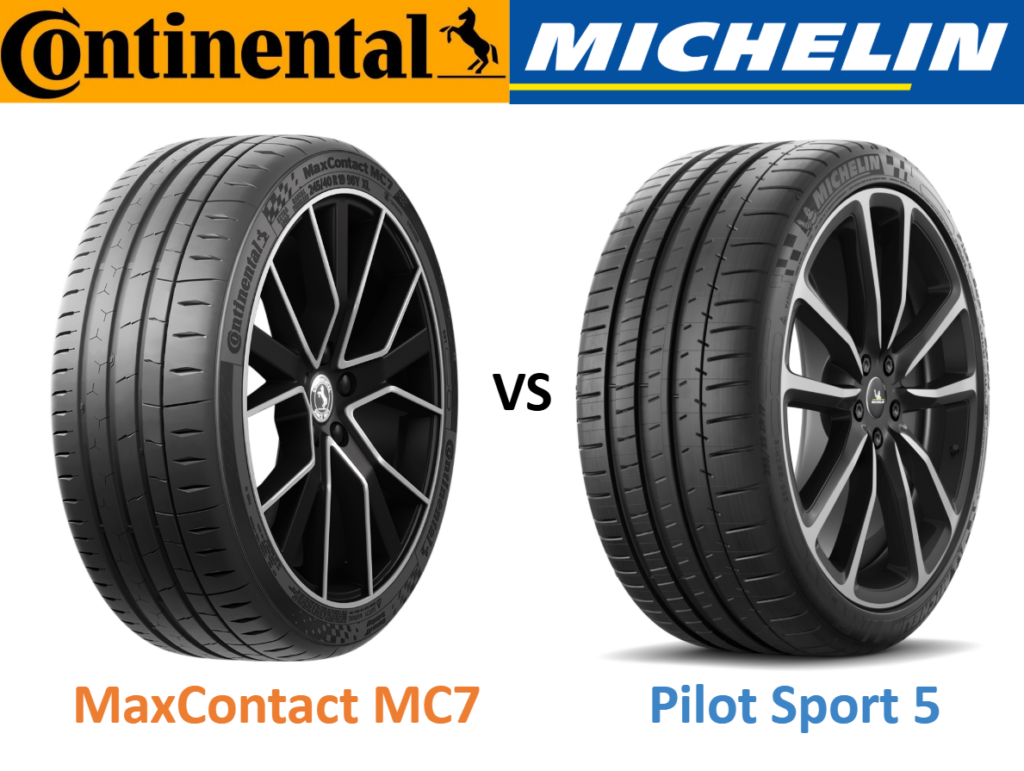
Continental MaxContact MC7 vs Michelin Pilot Sport 5 — two of the prime contenders in today’s ultra-high-performance summer tire segment. Both are widely regarded as benchmark UHP choices, blending strong wet and dry performance with everyday usability. This comparison puts two of the best UHP tires head-to-head to see where each one truly excels.
Table of Contents
Results: Continental MaxContact MC7 vs Michelin Pilot Sport 5
The results presented here come from our own 2024 Top Tire Review Best UHP Tire Test, where six of Asia’s best summer UHP tire models were evaluated. The accompanying graph shows a side-by-side comparison between the Continental MaxContact MC7 vs Michelin Pilot Sport 5 with the Continental MaxContact MC7 used as the 100% performance benchmark across all categories.
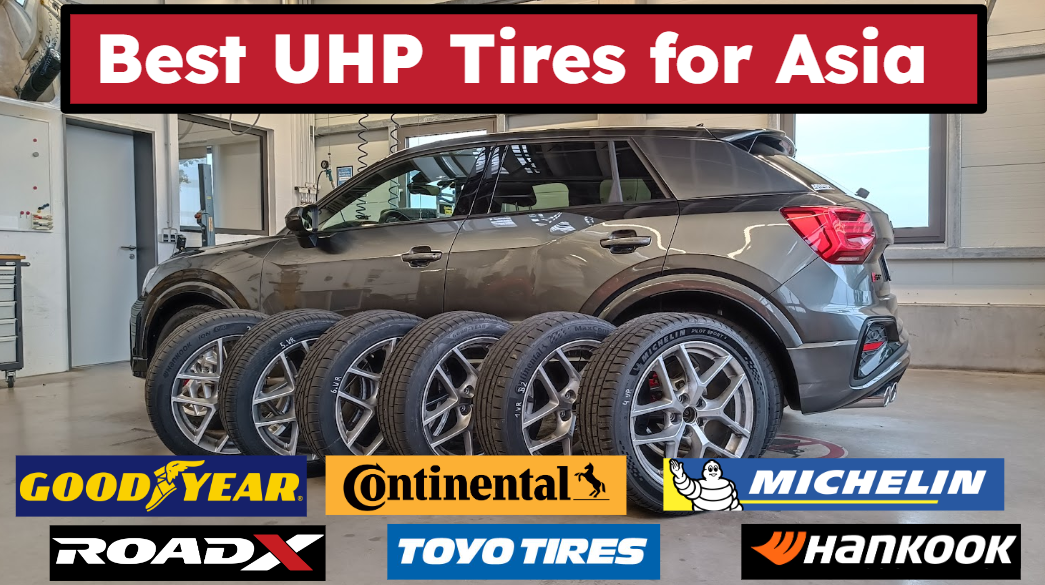
The tire size of interest is the 235/45R18 tire size, a popular choice for vehicles like the Honda Accord & Tesla model 3. For further insights into various tire sizes, feel free to consult our latest tire size table. The tests were conducted using a sporty Audi SQ2 as the test vehicle.

Wet
In wet braking, the Continental MaxContact MC7 stops 1.0 meter shorter than the Michelin Pilot Sport 5, a 3% advantage. In wet handling, the MC7 laps 0.88 seconds quicker, translating to a 1% lead, and it also feels more secure subjectively, scoring 0.2 points higher, a 2% difference. In straight-line aquaplaning, the Michelin resists lift-off 0.2 km/h longer, but this equals a 0% practical difference.
Overall, the MaxContact MC7 holds a clear edge in wet braking confidence and cornering control, while the Pilot Sport 5 only marginally counters in aquaplaning, with no meaningful real-world advantage.
Pilot Sport 5:
- -3% in wet braking
- -1% in wet handling (lap time)
- -2% in wet handling (subj)
- ~0% in aquaplaning
Dry
In dry braking, the Continental MaxContact MC7 stops 1.0 meter shorter than the Michelin Pilot Sport 5, giving it a 3% advantage. In dry handling, the MC7 laps 0.91 seconds quicker, which equals a 2% lead, and it also feels more precise to drive, scoring 0.3 points higher subjectively, a 3% difference.
On dry roads, the MaxContact MC7 delivers sharper braking and more confident handling, clearly edging out the Pilot Sport 5 in overall dry performance.
Pilot Sport 5:
- -3% in dry braking
- -2% in dry handling (lap time)
- -3% in dry handling (subj)
Comfort & Noise
In subjective comfort, the Continental MaxContact MC7 scores 0.6 points higher than the Michelin Pilot Sport 5, which equals a 3% advantage, feeling noticeably more compliant and refined over uneven surfaces. For interior noise, the Michelin is 0.2 dB quieter, but this translates to a 2% real-world difference.
Pilot Sport 5:
- -3% in subjective comfort
- +2% in exterior noise (-0.2 dB)
Rolling Resistance
In rolling resistance, the Continental MaxContact MC7 measures 0.21 N/kN lower than the Michelin Pilot Sport 5, giving it a 3% advantage in efficiency.
Pilot Sport 5:
- +3% in rolling resistance
Price
In size 225/40 R18, the Michelin Pilot Sport 5 is priced RM 42 higher than the Continental MaxContact MC7, making it 5% more expensive.
Tire size: 225/40 R18
- MaxContact MC7 : RM 831
- Pilot Sport 5 : RM 873
Difference: +5% more expensive for Pilot Sport 5
Summary
The Continental MaxContact MC7 stands out with stronger wet and dry braking, sharper handling, better comfort, and slightly lower rolling resistance, making it the more performance-focused and value-driven choice in this test. The Michelin Pilot Sport 5 counters with marginally better aquaplaning resistance and a well-known balance aimed at everyday usability. It’s important to note that wear was not evaluated, which is often a key reason drivers choose Michelin. Ultimately, this is a classic performance-versus-longevity trade-off—maximum grip and sharpness versus long-term durability expectations.
Dr Edwin Pang