
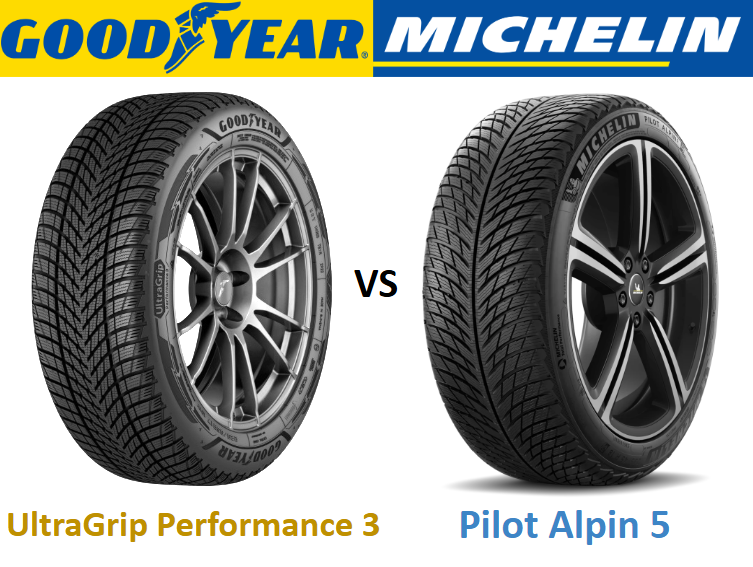
Goodyear UltraGrip Performance 3 vs Michelin Pilot Alpin 5 — a middle-European winter showdown: wet-leaning agility and sharp steering vs proven cold-road bite and composed control. Who takes the crown when roads mix wet, slush, and light snow?
Table of Contents
Results: Goodyear UltraGrip Performance 3 vs Michelin Pilot Alpin 5
Results below were taken from 2025 ADAC Winter Tire Test with a total of 31 tires tested. The graph below shows the comparison between Goodyear UltraGrip Performance 3 vs Michelin Pilot Alpin 5 plus based on the relevant performance category. The Goodyear UltraGrip Performance 3 was set as a reference hence at the 100% mark.

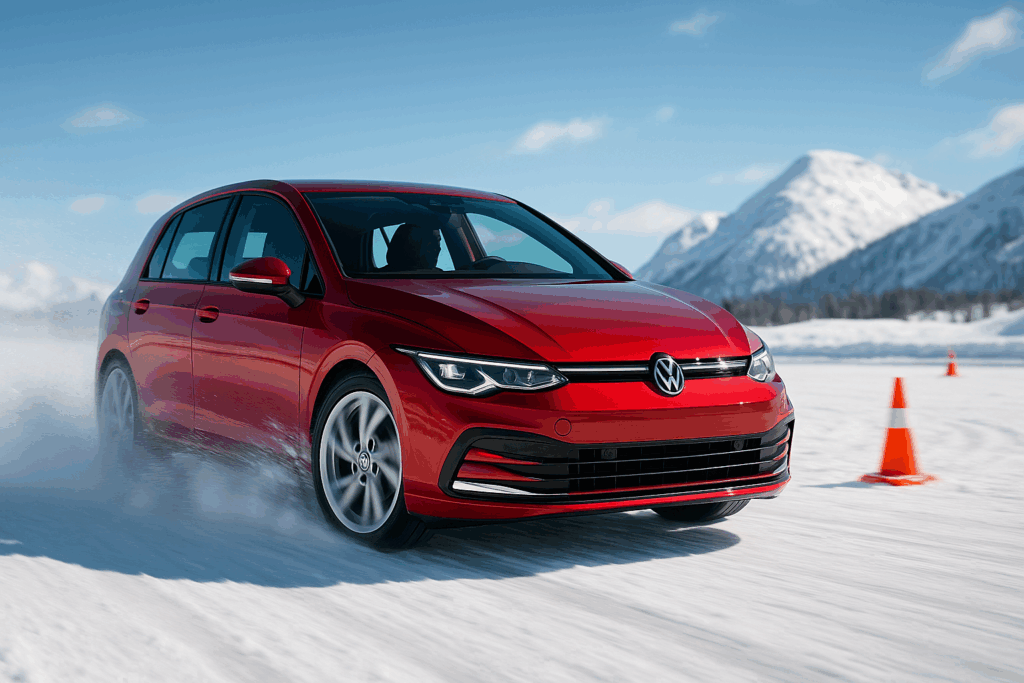
Since we are talking about the middle European winter segment with both tires having the converted 3 peak mountain logo, snow performances was tested. The tire size of interest is 225/40 R18 which is a common tire size for Subaru Impreza & BMW 3 Series. You can check out our latest tire size table for more information. The testing vehicle is a Volkswagen Golf.
Wet
In wet braking, the Goodyear UltraGrip Performance 3 stops in 31.7 m, about 0.5 m shorter than the Michelin Pilot Alpin 5 at 32.2 m — roughly 2% better. In straight–line aquaplaning, Goodyear again leads with 77.1 km/h versus 75.2 km/h for Michelin, a 1.9 km/h or 2% advantage. Overall, Goodyear shows stronger wet-surface confidence, combining shorter stops and higher aquaplaning resistance.
Pilot Alpin 5 :
- -2% in wet braking
- -2% in straight aquaplaning
Snow
In snow braking, the Michelin Pilot Alpin 5 stops in 9.4 m, around 0.3 m shorter than the Goodyear UltraGrip Performance 3’s 9.7 m — about 3% better. For snow traction, Michelin again leads with 245 N versus Goodyear’s 242 N, a 3 N or roughly 1% advantage. Overall, Michelin shows a slight edge on snow, offering both stronger traction and marginally quicker stops.
Pilot Alpin 5 :
- +3% in snow braking
- +1% in snow traction
Ice
In ice braking, the Michelin Pilot Alpin 5 stops in 16.3 m, around 0.4 m shorter than the Goodyear UltraGrip Performance 3 at 16.7 m — about 2% better. The difference is small but consistent, showing Michelin’s slight edge in ice grip and braking finesse under frozen conditions.
Pilot Alpin 5 :
- +2% in ice braking
Mileage
In wear, the Goodyear UltraGrip Performance 3 lasts 76,500 km, about 9,500 km longer than the Michelin Pilot Alpin 5’s 67,000 km — roughly 12% better durability. Abrasion is identical at 50 mg/km/t for both, meaning material loss per distance is the same. Overall, Goodyear clearly wins in longevity, offering longer life without sacrificing tread integrity.
Pilot Alpin 5 :
- -12% in mileage
- ~0% in abrasion
Dry
In dry braking, the Michelin Pilot Alpin 5 stops in 41.4 m, about 0.9 m shorter than the Goodyear UltraGrip Performance 3 at 42.3 m — roughly 2% better. Michelin shows a clear edge in grip and braking precision on dry asphalt, giving it the advantage when temperatures are cold but roads are clear.
Pilot Alpin 5 :
- +2% in dry braking
Noise
In noise, the Goodyear UltraGrip Performance 3 measures 71.2 dB, slightly quieter than the Michelin Pilot Alpin 5 at 71.5 dB — about 0.3 dB or roughly 0%. The difference is minimal, but Goodyear offers a touch more refinement for cabin comfort on smooth winter roads.
Pilot Alpin 5 :
- ~0% in exterior noise
Fuel Consumption
Fuel consumption is identical for both, with the Goodyear UltraGrip Performance 3 and Michelin Pilot Alpin 5 each recording 5.8 l/100 km — showing equal rolling efficiency. Neither tire holds an advantage here, indicating both are well-balanced in energy use for winter driving.
Pilot Alpin 5 :
- 0% in rolling resistance
Price
For tire size 225/40 R18, the Michelin Pilot Alpin 5 costs €153, about €9 higher than the Goodyear UltraGrip Performance 3 at €144 — roughly 6% more expensive.
Tire size: 225/40 R18
- UltraGrip Performance 3 : € 144
- Pilot Alpin 5 : € 153
Difference: +6% more expensive for Pilot Alpin 5
Conclusion from a Tire Expert’s Perspective:
As a tire expert, both the Goodyear UltraGrip Performance 3 and Michelin Pilot Alpin 5 impressed me for different reasons. Goodyear clearly dominates in wet grip and aquaplaning, and it lasts about 12% longer — making it the smart, value-driven choice for mild, rainy winters. Michelin, on the other hand, feels more composed on snow and ice, stopping slightly shorter and offering finer control on frozen roads. In short, Goodyear excels in wet and wear, while Michelin shines in snow and precision.
Dr Edwin Pang