
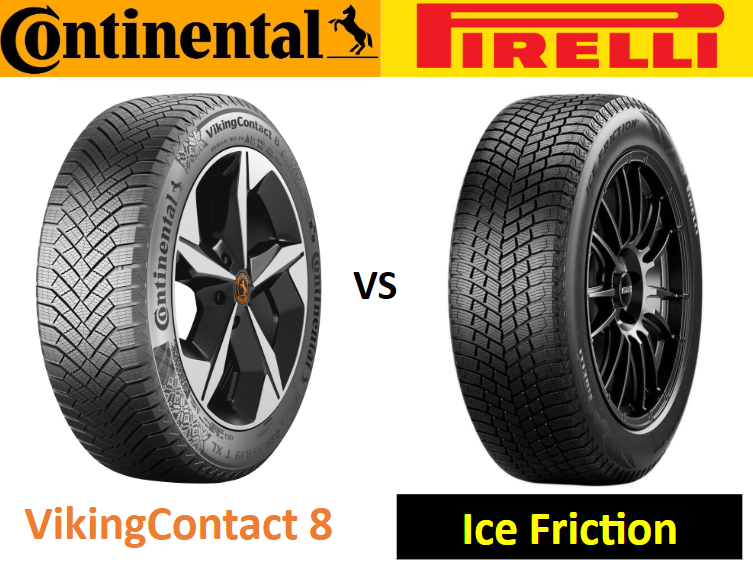
Continental VikingContact 8 vs Pirelli Ice Friction — this is the studless winter showdown we’ve been waiting for. Continental VikingContact 8 comes in as the benchmark with its proven ice/snow traction and ultra-soft compound tuning, but Pirelli just dropped the all-new Ice Friction in 2025, targeting exactly this Nordic-style segment. One is the established reference, the other is the hungry challenger with fresh tech. Let’s see if the newcomer can actually unseat the king of friction winter tires.
Table of Contents
Results: Continental VikingContact 8 vs Pirelli Ice Friction
Results below were taken from 2025 Vi Bilägare Studless Tire Test with a total of 8 studless tires tested. The graph below shows the comparison between Continental VikingContact 8 vs Pirelli Ice Friction based on the relevant performance category. The Continental VikingContact 8 was set as a reference hence at the 100% mark.

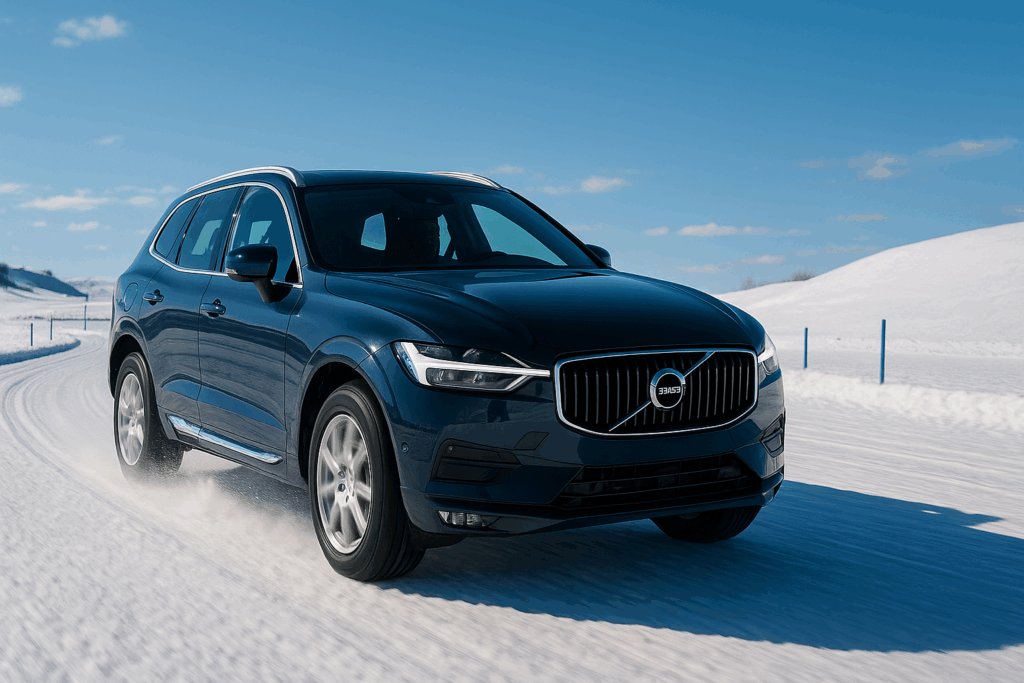
Note that for subjective ratings, 1 point is equivalent to 5%. So if tire A has a 4 point rating & tire B has a 3 point rating, tire A is better than tire B by 5%. The tire size of interest is a 235/60 R18 which is a common tire size for Honda CR-V and Kia Sorento. The testing vehicle is a Volvo XC60.
Ice
On ice braking, Continental VikingContact 8 stops in 11.76 m while Pirelli Ice Friction needs 11.87 m, so the Pirelli is 0.11 m longer, about 1% behind. In ice traction, Continental accelerates in 5.24 s while Pirelli needs 5.44 s, so the Pirelli is 0.20 s slower, roughly 4% down. In ice handling, Continental laps in 56.9 s versus Pirelli’s 59.2 s, so the Pirelli is 2.3 s slower, again about 4% off.
In summary across these winter grip metrics, VikingContact 8 is consistently a step ahead.
Pirelli Ice Friction :
- -1% in ice braking
- -4% in ice traction
- -4% in ice handling
Snow
On snow braking, Pirelli Ice Friction stops in 12.01 m while Continental VikingContact 8 needs 12.17 m, so the Pirelli is 0.16 m shorter, about 1% better. Snow traction is identical at 1.92 s for both, so no advantage. In snow handling, Continental laps in 69.2 s and Pirelli in 69.5 s, so the Pirelli is 0.3 s slower, effectively 0% difference. Overall Pirelli edges it slightly on pure snow braking, but overall they trade blows and sit in the same snow performance window.
Pirelli Ice Friction :
- +1% in snow braking
- ~0% in snow traction
- ~0% in snow handling
Wet
In wet braking, Pirelli Ice Friction stops in 48.85 m while Continental VikingContact 8 needs 50.3 m, so the Pirelli is 1.45 m shorter, about 3% better. In wet handling, Pirelli laps in 62.0 s versus Continental’s 62.9 s, so the Pirelli is 0.9 s quicker, around 1% ahead. Overall in the wet, the new Pirelli Ice Friction has a small but clear edge over the VikingContact 8.
Pirelli Ice Friction :
- +3% in wet braking
- +1% in wet handling (lap time)
Dry
In dry braking, Pirelli Ice Friction stops in 43.63 m while Continental VikingContact 8 needs 44.41 m, so the Pirelli is 0.78 m shorter, about 2% better. On subjective dry handling, Pirelli scores 5 points to Continental’s 4, so the Pirelli is 1 point ahead, roughly 5% better in feel and response. On dry, the Pirelli Ice Friction is the sharper, shorter-stopping tire.
Pirelli Ice Friction :
- +2% in dry braking
- +5% in dry handling (subjective)
Noise
Continental VikingContact 8 measures 69.1 dB while Pirelli Ice Friction is at 70.3 dB, so the Pirelli is 1.2 dB louder, about 2% higher in noise.
Pirelli Ice Friction :
- -2% in exterior noise (+1.2 dB)
Fuel Consumption
Pirelli Ice Friction uses 6.4 l/100 km while Continental VikingContact 8 needs 6.5 l/100 km, so the Pirelli consumes 0.1 l/100 km less, about 2% better.
Pirelli Ice Friction :
- +2% in full consumption
Price
For 235/60R18, Continental VikingContact 8 costs €268 and Pirelli Ice Friction costs €216, so the Pirelli is €52 cheaper, which is 24% lower.
Tire size: 235/60R18
- VikingContact 8 : € 268
- Pirelli Ice Friction : € 216
Difference: -24% more cheaper for Pirelli Ice Friction
Conclusion
From a tire engineer’s view, Continental VikingContact 8 is clearly the stronger ice tire — shorter traction and handling times show its compound and siping are still the reference there. But you pay for that: in 235/60R18 it’s 24% more expensive, and the new 2025 Pirelli Ice Friction hits back with better wet and dry braking plus slightly lower fuel use. So it’s ice dominance vs. all-round value — and that’s the real trade-off.
Dr Edwin Pang