
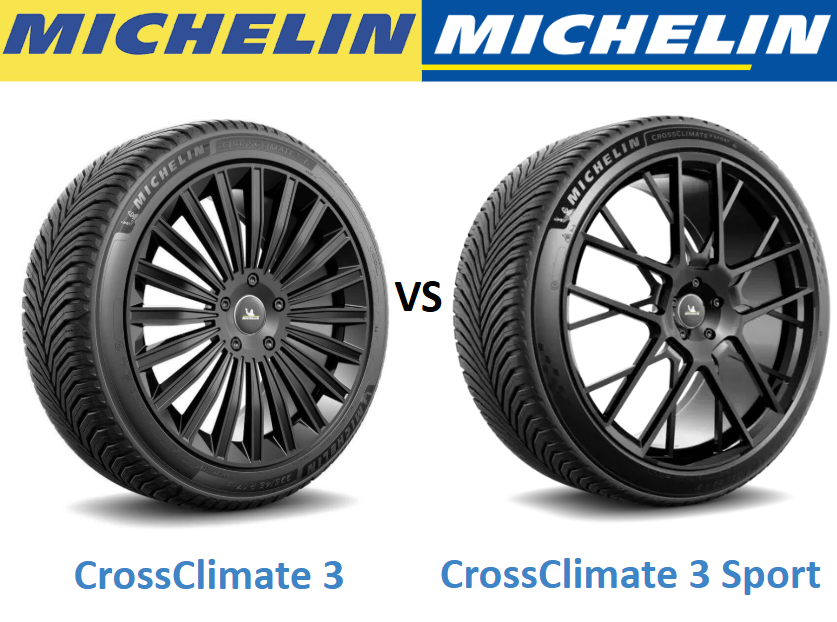
Michelin CrossClimate 3 vs Michelin CrossClimate 3 Sport: First, this duel was tested by Tyre Reviews—and the Sport drew first blood on pure pace. Now, Round 2: an independent AutoBild re-test, same tire size, same test—plus a bonus mileage/abrasion test. Expect Michelin CrossClimate 3 Sport to press its edge in dry/wet braking and handling, while the standard Michelin CrossClimate 3 may claw back with stronger aquaplaning stability, comfort, and potentially longer tread life. Pace vs endurance—let’s see who really wears the crown when wear counts.
Table of Contents
Results: Michelin CrossClimate 3 vs CrossClimate 3 Sport
Results below were taken from AutoBild’s 2025 All Season Tire Test with a total of 15 tires tested including a reference winter & summer tire. The graph below shows the comparison between Michelin CrossClimate 3 vs Michelin CrossClimate 3 Sport based on the relevant performance category. The Michelin CrossClimate 3 was set as a reference hence at the 100% mark.

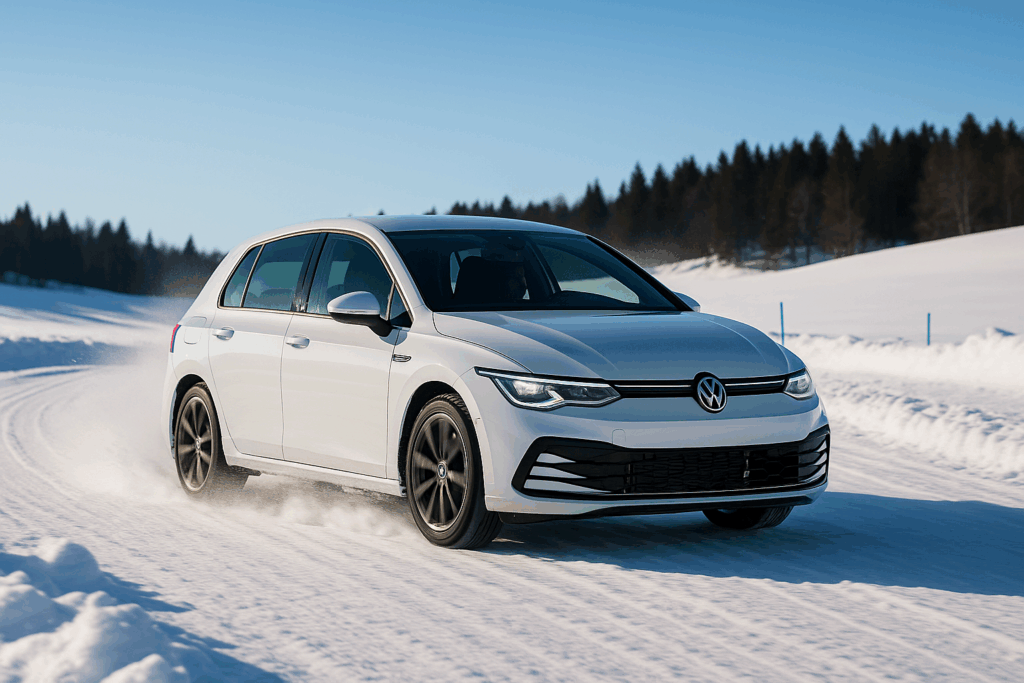
Since we are talking about the all season with 3 peak mountain certification segment, the snow performances was tested. The tire size of interest is 225/40 R18 which is a common tire size for Volkswagen Golf & Audi A3. You can check out our latest tire size table for more information. The testing vehicle is a Volkswagen Golf.
Wet
Previously at Tyre Reviews, CrossClimate 3 Sport was +10% in wet braking, +4% in wet handling, and –3% in aquaplaning versus CC3.
Now with AutoBild: the Sport is 1.7 m shorter in wet braking (4%), 2.2 km/h faster in wet handling (3%), and 1.5 km/h higher in straight-line aquaplaning speed (2%).
Conclusion: the Sport still leads in the wet, but the gap tightens from the earlier +10%/+4% to about +4%/+3%, while aquaplaning flips from a –3% penalty to a +2% edge.
CrossClimate 3 Sport :
- +4% in wet braking
- +3% in wet handling
- +2% in straight aquaplaning
Snow
Previously at Tyre Reviews, CrossClimate 3 Sport was ~0% in snow braking, ~0% in snow traction, and –1% in snow handling versus CrossClimate 3.
With AutoBild’s data: in snow braking the Sport is 1.8 m longer (8% worse). In snow traction it delivers 46 N less (~2% worse). In snow handling it’s 0.7 km/h slower (~1% worse).
Conclusion: AutoBild’s snow results tilt slightly toward the standard CrossClimate 3 across braking, traction, and handling, widening the gap beyond Tyre Reviews’ near-parity.
CrossClimate 3 Sport :
- -7% in snow braking
- -2% in snow traction
- -1% in snow handling
Mileage
AutoBild’s endurance add-ons change the story: in wear (mileage), the CrossClimate 3 Sport runs 17,500 km less than the CrossClimate 3, which is 27% lower, and in abrasion (lower is better) the CrossClimate 3 Sport sheds 105 g more tread, 12% worse.
Conclusion: the CrossClimate 3 clearly wins durability, with longer life and lower tread loss.
CrossClimate 3 Sport :
- -27% in mileage
- -12% in abrasion
Dry
Previously at Tyre Reviews, CrossClimate 3 Sport was +4% in dry braking and +2% in dry handling versus CrossClimate 3.
With AutoBild’s data, the Sport stops 1.6 m shorter in dry braking (4% better) and is 1.3 km/h quicker in dry handling (1% faster).
Conclusion: AutoBild confirms the Sport’s braking edge at roughly the same +4%, while the handling gap tightens to about +1%—still a small but clear advantage for the Sport.
CrossClimate 3 Sport :
- +4% in dry braking
- +1% in dry handling
Exterior Noise
For noise, the CrossClimate 3 Sport is just 0.1 dB louder than the CrossClimate 3—effectively a ~0% difference—so it’s a tie; both sound the same in practice.
CrossClimate 3 Sport :
- ~0% in exterior noise (+0.1 dB)
Rolling Resistance
Previously at Tyre Reviews, CrossClimate 3 Sport was +3% better in rolling resistance (lower is better) versus CrossClimate 3.
With AutoBild, the Sport is 0.26 N/kN lower, which is ~4% better.
Conclusion: AutoBild confirms the CrossClimate 3 Sport’s small but consistent efficiency edge in rolling resistance.
CrossClimate 3 Sport :
- +4% in rolling resistance
Price
For 225/40 R18, the CrossClimate 3 is €127 while the CrossClimate 3 Sport is €135—€8 (+6%) more, so you’re paying a small premium for the Sport’s performance edge.
Tire size: 225/40 R18
- CrossClimate 3 : € 127
- CrossClimate 3 Sport : € 135
Difference: +6% more expensive for CrossClimate 3 Sport
Conclusion from a Tire Expert’s Perspective:
As a tire engineer looking at AutoBild’s retest, the gaps between CrossClimate 3 Sport and CrossClimate 3 are much smaller than what Tyre Reviews saw—same size, same class. Why? We need to investigate further and wait for more independent results before calling this definitive.
With these results, I’d pick the Michelin CrossClimate 3. The CrossClimate 3 Sport is only ~1–3% quicker in wet and ~1% in dry handling, but CC3 delivers ~27% longer mileage, ~13% lower abrasion, similar noise, and costs ~6% less. In real ownership terms—tread life, total cost, and balanced year-round performance—the standard Michelin CrossClimate 3 is the smarter choice.
Dr Edwin Pang