
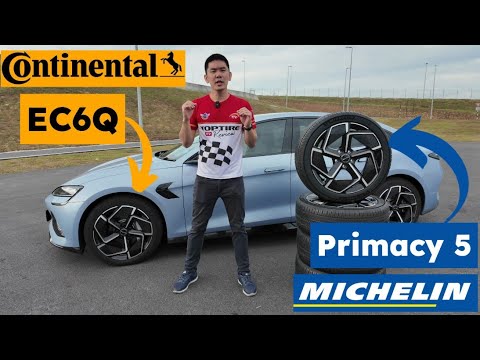
Continental EcoContact 6Q vs Michelin Primacy 5 — Touring Showdown Begins! This isn’t just another tire test — this is our very own showdown, and it’s a big one. On one side, the Continental EcoContact 6Q, the exact OE tire fitted on the popular EV, the BYD Seal. On the other, the brand-new Michelin Primacy 5, built with the latest wet braking and longevity tech from Michelin’s touring arsenal. It’s a clash of OEM precision vs. aftermarket innovation — and we’ve tested them head-to-head in wet, dry, comfort, and handling. Let the battle begin.
Table of Contents
Results: Continental EcoContact 6Q vs Michelin Primacy 5
The results featured here are taken directly from our TopTireReview test of Continental EcoContact 6Q vs Michelin Primacy 5 conducted at the Sepang Driving Experience Center. The accompanying graph presents a side-by-side comparison of the Continental EcoContact 6Q vs Michelin Primacy 5 across various performance categories, with the Continental EcoContact 6Q serving as the benchmark at the 100% mark.

The tire size of interest is the 235/45R19 tire size, a popular choice for vehicles like the BYD Seal & Hyundai Sonata. For further insights into various tire sizes, feel free to consult our latest tire size table. The tests were conducted using an EV BYD Seal as the test vehicle.

Wet
In wet braking from 70 to 10 km/h, the Michelin Primacy 5 stops in 45.1 meters, while the Continental EcoContact 6Q takes 47.9 meters — a 2.8 meter difference, giving Michelin a 6% shorter stopping distance. On the wet circle test, where we measure the maximum speed before losing grip, the Primacy 5 holds on at 40 km/h compared to just 35 km/h for the EcoContact 6Q — a 5 km/h advantage, or 14% higher grip threshold.
Overall, Michelin Primacy 5 clearly leads in wet performance with both shorter braking and significantly better lateral grip.
Primacy 5:
- +6% in wet braking
- +14% in wet circle
Dry
In dry braking from 70 to 10 km/h, the Michelin Primacy 5 stops in 23.8 meters, while the Continental EcoContact 6Q takes 24.2 meters — a 0.4 meter difference, giving Michelin a 2% advantage. However, in subjective dry handling, the EcoContact 6Q scores slightly higher at 7.25 versus 7.0 for the Primacy 5, indicating marginally better steering feedback and agility.
While Michelin edges ahead in straight-line braking, the Continental offers a more responsive and confident feel through corners.
Primacy 5:
- +2% in dry braking
- -1% in dry handling
NVH
In terms of subjective noise and comfort, both the Continental EcoContact 6Q and Michelin Primacy 5 score equally at 7 out of 10. There’s no noticeable difference in ride quality or cabin quietness between the two — both deliver a smooth and well-damped touring experience.
Firehawk Sport:
- 0% in subjective noise
- 0% in subjective comfort
Price
For the 235/45 R19 size, the Michelin Primacy 5 is priced at €242, while the Continental EcoContact 6Q costs €219. That makes the Primacy 5 11% more expensive than the EcoContact 6Q.
Tire size: 235/45 R19
- EcoContact 6Q : € 219
- Primacy 5 : € 242
Difference: +11% more expensive for Primacy 5
Part 2 Update
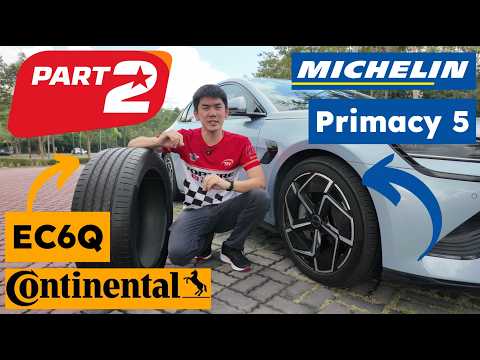
After thousands of kilometres of real-world driving, we can now add the missing wear and energy-efficiency results to this comparison. The outcome reveals a major trade-off between longer tyre life and lower EV energy consumption.
Wear
Based on the current real-world wear rate, the Continental EcoContact 6Q is projected to reach 1.6 mm at around 20,000 km, while the Michelin Primacy 5 is projected to reach about 35,000 km.
That gives Michelin an estimated 77% mileage advantage.
Both tyres were driven by the same driver in broadly similar conditions, but this was not a perfectly controlled laboratory test. The BYD Seal is also a heavy EV, so the absolute mileage should be treated cautiously. The key result is the percentage difference.
Primacy 5:
- +77% in mileage
Efficiency
The result reverses for energy consumption. The EcoContact 6Q recorded 18 kWh/100 km, compared with 22 kWh/100 km for the Primacy 5. That means the Continental used around 18% less energy, saving about 4 kWh every 100 km.
Primacy 5:
- -18% in efficiency
Summary
From my perspective as a tyre expert, the Michelin Primacy 5 clearly leads in wet performance with shorter braking, stronger lateral grip and an estimated 77% more projected mileage. The Continental EcoContact 6Q counters with slightly sharper dry handling, a lower price and around 18% lower energy consumption, while comfort and noise remain evenly matched. The final trade-off is clear: Michelin delivers stronger safety and longer tyre life, while Continental delivers better EV efficiency and lower upfront cost.
Dr Edwin Pang