
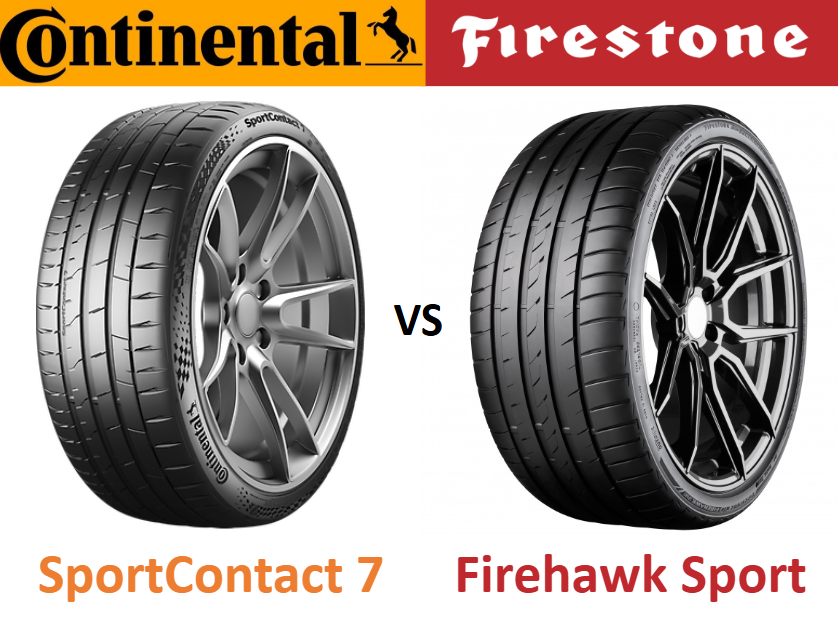
Continental SportContact 7 vs Firestone Firehawk Sport — it’s a clash in the ultra-ultra high performance (UUHP) segment where cutting-edge grip meets raw driving thrill. On one side, the SportContact 7, Continental’s flagship built to dominate both dry and wet tracks with precision. On the other, Firestone’s Firehawk Sport, a bold contender tuned for spirited driving and everyday performance. Two big names, one hot segment — who truly rules the road? Let the battle begin.
Table of Contents
Results: Continental SportContact 7 vs Firestone Firehawk Sport
The results featured here are from the 2025 ADAC Summer Tire Test, with 16 model of the finest tires were tested. Wear bring a extremely priced and expensive test were provided to our delight. The accompanying graph presents a side-by-side comparison of the Continental SportContact 7 vs Firestone Firehawk Sport across various performance categories, with the Continental SportContact 7 serving as the benchmark at the 100% mark.

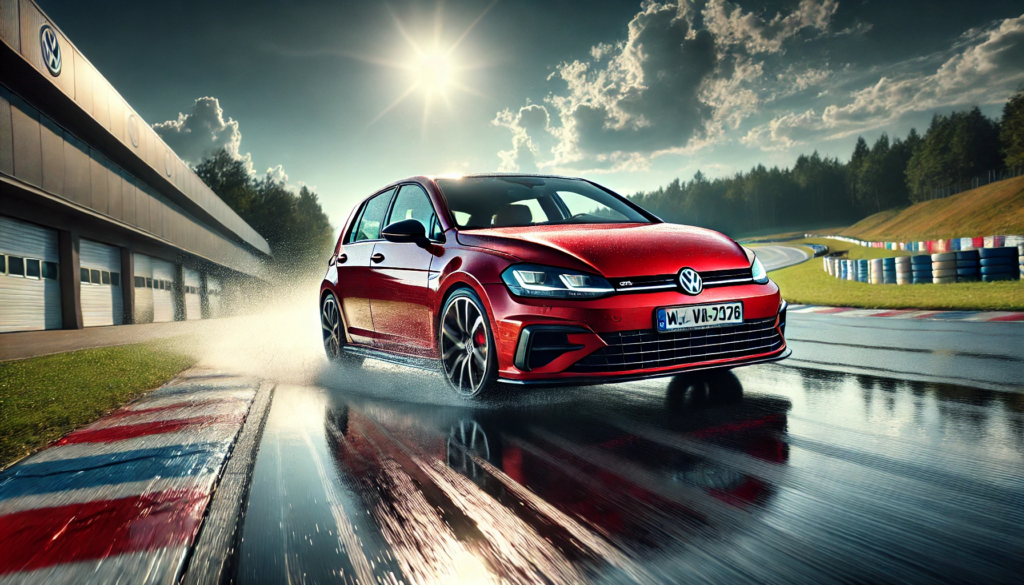
The tire size of interest is the 225/40R18 tire size, a popular choice for vehicles like the BMW 3 series Audi A4. For further insights into various tire sizes, feel free to consult our latest tire size table. The tests were conducted using a standard Volkswagen Golf as the test vehicle.
Wet
In wet braking, the Continental SportContact 7 stops in 28.4 meters, while the Firestone Firehawk Sport needs 30.9 meters to come to a halt. That’s a 2.5-meter difference, giving the Continental a 9% advantage. In straight-line aquaplaning, the SportContact 7 holds grip up to 79.6 km/h, compared to 77.5 km/h for the Firehawk Sport — a 2.1 km/h or 3% edge.
From a wet performance perspective, the Continental SportContact 7 clearly outperforms the Firehawk Sport, especially in braking.
Firehawk Sport:
- -8% in wet braking
- -3% in straight aquaplaning
Dry
In dry braking, the Continental SportContact 7 comes to a stop in 35.2 meters, while the Firestone Firehawk Sport takes 35.9 meters — a 0.7-meter gap, giving the Continental a 2% advantage.
Firehawk Sport:
- -2% in dry braking
Wear
In terms of wear, the Continental SportContact 7 lasts 43,400 km, compared to 34,500 km for the Firestone Firehawk Sport — a clear 8,900 km or 26% advantage for the Continental. When it comes to abrasion, the SportContact 7 shows lower tread loss at 63.4 mg/km/t versus 81.1 mg/km/t for the Firehawk, translating to a 22% lower abrasion rate.
Overall, the SportContact 7 offers significantly better durability and tread efficiency over time.
Firehawk Sport:
- -21% in mileage
- -22% in abrasion
Noise
Both the Continental SportContact 7 and Firestone Firehawk Sport register the same exterior noise level at 72.3 dB, showing no measurable difference in external rolling noise.
Firehawk Sport:
- 0% in exterior noise
Fuel Consumption
Fuel consumption is identical for both the Continental SportContact 7 and the Firestone Firehawk Sport at 5.5 liters per 100 km, showing no difference in rolling resistance impact on efficiency.
Firehawk Sport:
- 0% in fuel consumption
Price
In 225/40 R18, the Firestone Firehawk Sport is priced at €85, while the Continental SportContact 7 costs €100 — making the Firehawk 18% cheaper.
Tire size: 225/40 R18
- SportContact 7 : € 100
- Firehawk Sport : € 85
Difference: -18% more cheaper for Firehawk Sport
Summary
From my perspective as a tire expert, the clear winner is the Continental SportContact 7. It delivers stronger wet and dry braking, better mileage, and lower abrasion — all without any compromises in noise or fuel efficiency. The Firehawk Sport is cheaper, but the performance gap is too significant to overlook.
Dr Edwin Pang