
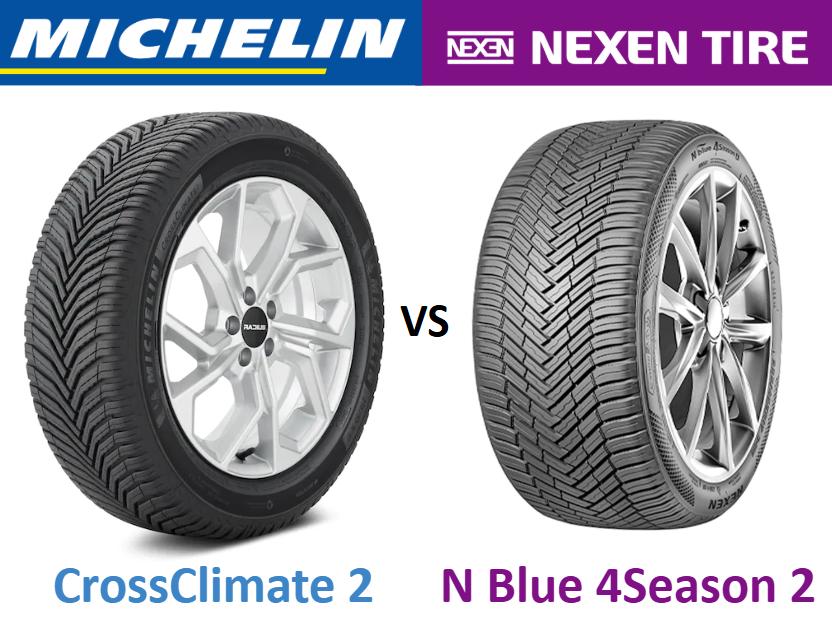
Michelin CrossClimate 2 vs Nexen N Blue 4Season 2 — this is the battle between the reigning all-season heavyweight and a bold budget underdog. The CrossClimate 2 has dominated tests with its unmatched wet grip, snow traction, and year-round dependability, setting the gold standard for all-season performance. But now, Nexen’s N Blue 4Season 2 enters the ring, promising surprising capabilities at a fraction of the price. Can the underdog upset the champion, or will Michelin prove once again why it’s the benchmark everyone is chasing in the all-season game? Let the showdown begin.
Table of Contents
Results: Michelin CrossClimate 2 vs Nexen N Blue 4Season 2
Results below were taken from the Autobild’s 2024 Sports Car All Season Tire Test. A total of 13 tires were tested this time around with an intriguing winter & summer refence to gauge the all season performances. The graph below shows the comparison between Michelin CrossClimate 2 vs Nexen N Blue 4Season 2 based on the relevant performance category. The Michelin CrossClimate 2 was set as a reference hence at the 100% mark.

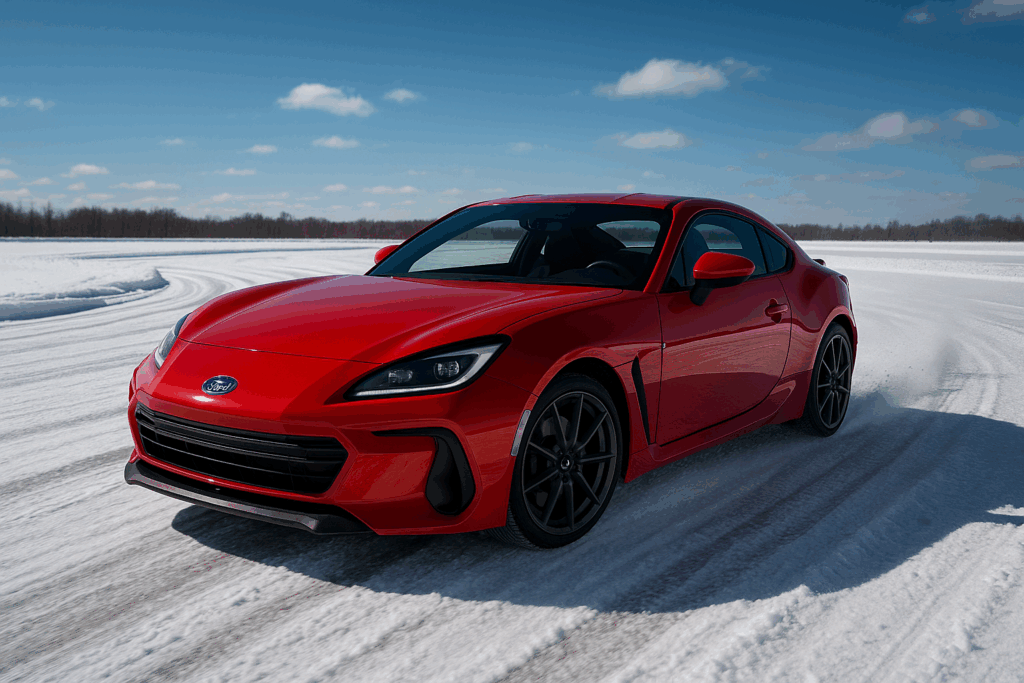
As both tires are categorized as all season tires with a 3 peak mountain logo on it, an extensive snow testing was conducted. The tire size of interest is a 225/40R18 which is a common tire size for Toyota GR Yaris and Volkswagen Golf GTI. You can check out our latest tire size table for more information. The testing vehicle of choice is a Subaru BRZ.
Wet
The Nexen N Blue 4Season 2 stops 0.3 meters shorter in wet braking than the Michelin CrossClimate 2, a 1% advantage. But Michelin counters with better wet handling at 73.3 km/h versus Nexen’s 72 km/h, a 2% edge. Most notably, the CrossClimate 2 resists aquaplaning until 78.4 km/h, while Nexen loses grip at 67.8 km/h — a huge 14% difference.
Despite Nexen’s slight braking edge, Michelin clearly leads in overall wet safety.
N Blue 4Season 2 :
- +1% in wet braking
- -2% in wet handling (average speed)
- -14% in straight aquaplaning
Snow
In snow braking, the Michelin CrossClimate 2 stops 0.9 meters shorter than the Nexen N Blue 4Season 2, giving it a 4% advantage. For snow traction, Michelin pulls with 2767 N compared to Nexen’s 2534 N, delivering a 9% stronger grip. In snow handling, the CrossClimate 2 also takes the lead at 57.5 km/h versus Nexen’s 55.4 km/h — a 2 km/h or 4% edge.
Overall, Michelin outperforms Nexen across all snow metrics, offering stronger grip, better control, and safer stopping in winter conditions.
N Blue 4Season 2 :
- -4% in snow braking
- -8% in snow traction
- -4% in snow handling (average speed)
Dry
In dry braking, the Nexen N Blue 4Season 2 stops 0.5 meters shorter than the Michelin CrossClimate 2, a 1% advantage. Both tires are evenly matched in dry handling, each achieving 90.1 km/h. While Nexen takes a slight lead in braking, overall dry performance is effectively a draw.
N Blue 4Season 2 :
- +1% in dry braking
- ~0% in dry handling (average speed)
Noise
The Michelin CrossClimate 2 is noticeably quieter at 71.9 dB compared to Nexen’s 73.5 dB, making it 1.6 dB lower or about 2% quieter in measured rolling noise.
N Blue 4Season 2 :
- -2% in exterior noise (+1.6 dB)
Rolling Resistance
The Michelin CrossClimate 2 has a rolling resistance of 7.98 N/kN, significantly lower than the Nexen N Blue 4Season 2’s 9.23 N/kN. That’s a 14% advantage in efficiency for Michelin.
N Blue 4Season 2 :
- -14% in rolling resistance
Price
For 225/40 R18, the Nexen N Blue 4Season 2 costs €87, while the Michelin CrossClimate 2 is priced at €125 — making the Nexen 44% cheaper.
Tire size: 225/40 R18
- CrossClimate 2 : € 125
- N Blue 4Season 2 : € 87
Difference: -44% more cheaper for N Blue 4Season 2.
Conclusion
As a tire expert, the clear winner here is the Michelin CrossClimate 2. It outperforms the Nexen in snow grip, wet handling, aquaplaning resistance, noise, and rolling resistance — all critical for year-round safety and comfort. While Nexen offers a cheaper entry price and slightly better dry braking, Michelin’s all-round performance justifies the premium.
Dr Edwin Pang