
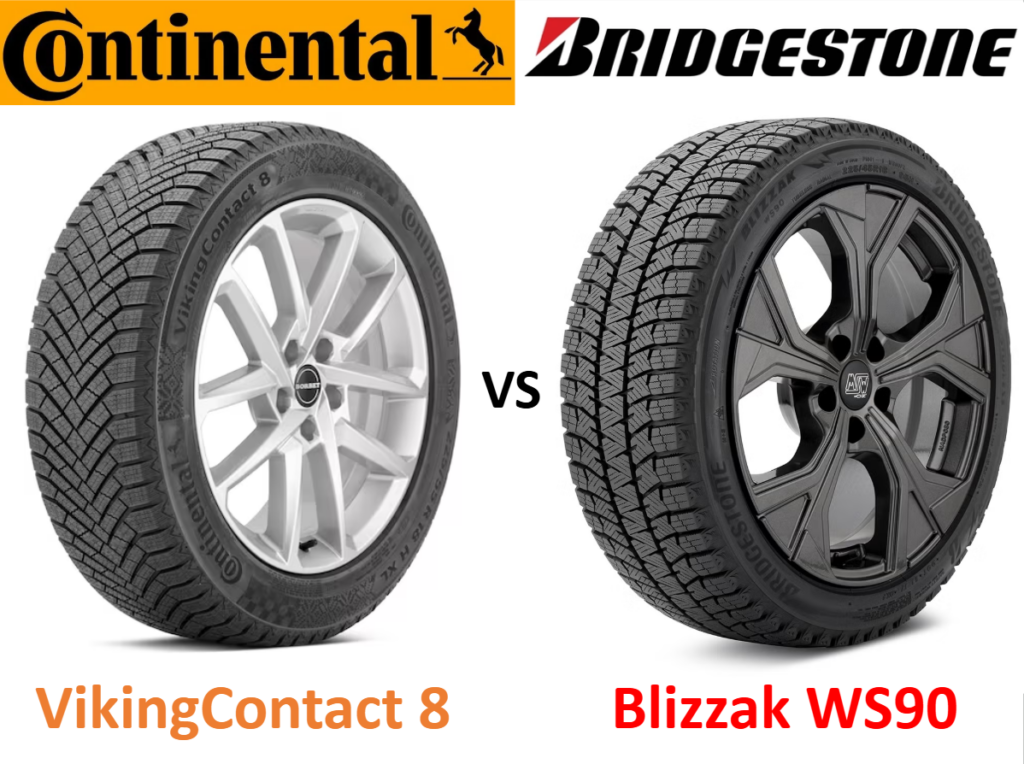
The Continental VikingContact 8 vs Bridgestone Blizzak WS90 battle brings together two heavyweights of the soft-compound, studless winter-tire world. Continental’s latest winter flagship takes on Bridgestone’s legendary Blizzak—one of the biggest names in snow and ice grip. Both are engineered for extreme winter conditions, but only one can claim the edge when the road turns white. Let the battle begin!
Table of Contents
Results: Continental VikingContact 8 vs Bridgestone Blizzak WS90
Results below were taken from the Tire Rack’s “All-Weather vs. Winter Tires: The Definitive Test“. A total of 10 tires were tested this time around in Tire Rack’s own proving ground. The graph below shows the comparison between Continental VikingContact 8 vs Bridgestone Blizzak WS90 based on the relevant performance category. The Continental VikingContact 8 was set as a reference hence at the 100% mark. Note that for subjective evaluation, we equate 1 point as 5%. Hence for example if tire A is graded 7 while tire B is graded 6, A is better than B by 5%.
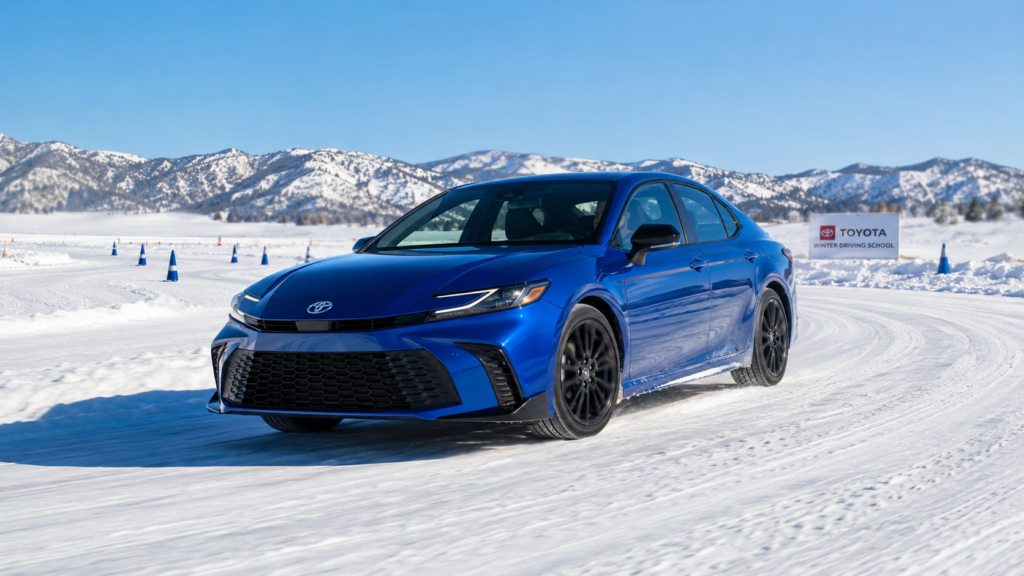
As both tires are categorized as all season tires, Tire Rack has included snow & ice in its testing portfolio. The tire size of interest is 215/55R17 which is a common tire size for Chevrolet Cruze Eco & Toyota Camry Hybrid XLE. You can check out our latest tire size table for more information. The testing vehicle is a 2025 Toyota Camry.
Snow
In snow braking, the Bridgestone Blizzak WS90 stopped 1.97 feet shorter, giving it a 3% advantage over the Continental VikingContact 8. It also required 0.56 feet less distance to accelerate, making it 2% better in snow traction.
The WS90 scored 0.08 points higher in subjective snow handling, but the difference rounds to 0%, making them effectively equal. It completed the snow-handling lap 0.53 seconds faster, a 1% advantage. Overall, the WS90 holds a narrow advantage in snow, particularly in braking, while handling performance is extremely close.
Blizzak WS90 :
- +3% in Snow braking
- +2% in Snow Acceleration
- 0% in Snow handling (subj)
- +1% in Snow handling(lap time)
Ice
In ice braking, the Bridgestone Blizzak WS90 stopped 4.60 feet shorter than the Continental VikingContact 8, giving it a significant 12% advantage. This is a clear win for the WS90 and its strongest advantage so far.
Blizzak WS90 :
- +12% in Ice braking
Wet
In wet braking, the Bridgestone Blizzak WS90 stopped just 0.20 feet shorter than the Continental VikingContact 8. With a 0% performance difference, the two tires are effectively equal in the wet.
Blizzak WS90 :
- 0% in wet braking
Dry
In dry braking, the Bridgestone Blizzak WS90 stopped 6.80 feet shorter than the Continental VikingContact 8, giving it a clear 7% advantage. This makes the WS90 the stronger tire for dry emergency braking.
Blizzak WS90 :
- +7% in dry braking
Noise/Comfort/Ride Quality
For noise, comfort and ride quality, the Continental VikingContact 8 scored 0.67 points higher than the Bridgestone Blizzak WS90, giving it a 3% advantage. The VikingContact 8 is the more refined and comfortable tire for everyday driving.
Blizzak WS90 :
- -3% in average of Noise, Comfort & Ride Quality.
Price
For a set of four, the Bridgestone Blizzak WS90 costs $84 less than the Continental VikingContact 8. At $162 per tire versus $183, the WS90 is 13% cheaper, strengthening its value advantage alongside its superior braking performance.
Tire size: 215/55R17
- VikingContact 8: $ 183
- Blizzak WS90 : $ 162
Difference: -13% more cheaper for Blizzak WS90
Summary
From my perspective as a tire expert, the Blizzak WS90 is the stronger performance and value choice, with better snow, ice and dry braking while costing 13% less. However, the VikingContact 8 is the more refined tire, delivering noticeably better comfort and ride quality while matching the WS90 in wet braking. Choose the WS90 for maximum winter grip and value, or the VikingContact 8 for a quieter, more comfortable winter drive.
Dr Edwin Pang