
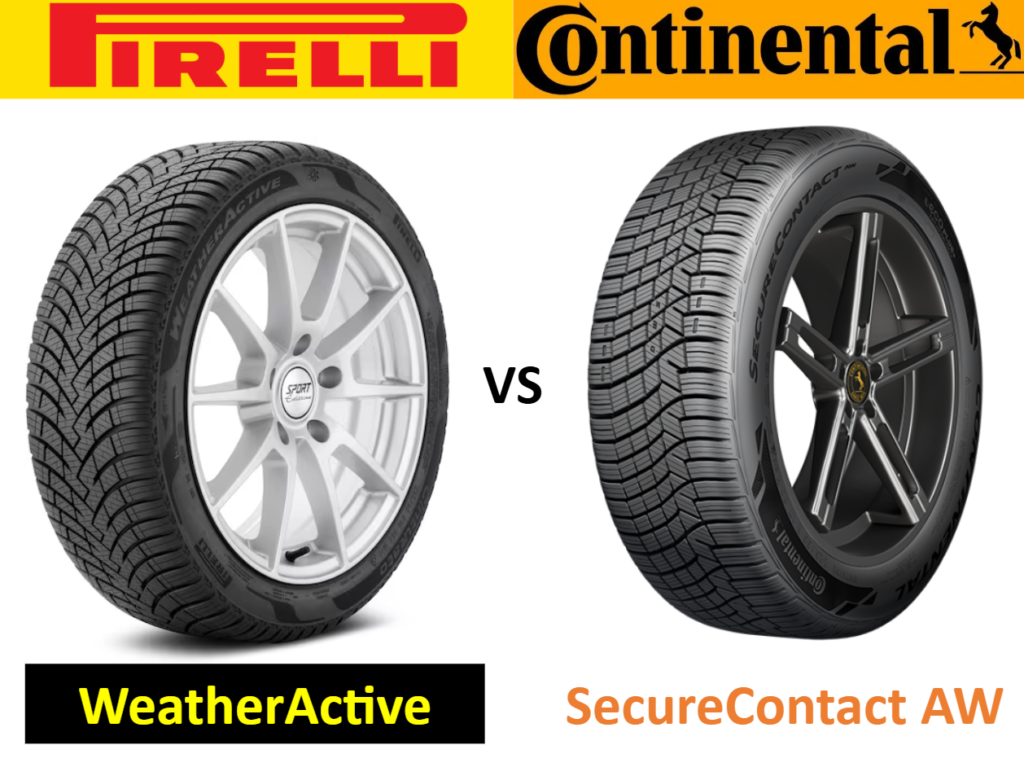
Pirelli Cinturato WeatherActive vs Continental SecureContact AW: Continental has finally entered North America’s all-weather fight—and it’s bringing a serious challenger. The all-new SecureContact AW is its first all-weather touring tire for this market, carrying the Three-Peak Mountain Snowflake symbol and promising strong wet grip alongside year-round comfort.
But the Pirelli Cinturato WeatherActive is already waiting. Can Continental’s newcomer deliver the wet braking and winter traction to win drivers over—and what does it give up along the way? We compare wet, dry, snow, ice, comfort and mileage to find out whether the SecureContact AW has what it takes.
Table of Contents
Results: Pirelli Cinturato WeatherActive vs Continental SecureContact AW
Results below were taken from the Tyre Review’s “All Weather Tire Test. The graph below shows the comparison between Pirelli Cinturato WeatherActive vs Continental SecureContact AW based on the relevant performance category. Pirelli Cinturato WeatherActive was set as a reference hence at the 100% mark.
As both tires are categorized as all weather tires, Tyre Review has included snow & ice in its testing portfolio. The tire size of interest is 235/45R18 which is a common tire size for Volkswagen Passat & Honda Accord. You can check out our latest tire size table for more information.
Wet
The Continental SecureContact AW stops in 31.97 metres, compared with 35.22 metres for the Pirelli Cinturato WeatherActive. That is 3.25 metres shorter, giving Continental a 10% advantage on the performance index. Continental also completes the wet handling lap 3.47 seconds faster, taking 72.69 seconds against Pirelli’s 76.16 seconds—a 5% advantage.
Pirelli leads in straight aquaplaning, reaching 71.01 km/h compared with Continental’s 69.59 km/h. Continental falls behind by 1.42 km/h, scoring 2% lower. Overall, Continental delivers stronger wet braking and handling, while Pirelli has a small edge in standing water.
SecureContact AW :
- +10% in wet braking
- +5% in wet handling
- -2% in aquaplaning
Snow
The Continental SecureContact AW stops in 16.16 metres on snow, compared with 17.71 metres for the Pirelli Cinturato WeatherActive. That is 1.55 metres shorter, giving Continental a 10% performance advantage. Continental also accelerates from 0–20 km/h in 3.75 seconds, beating Pirelli’s 4.05 seconds by 0.30 seconds, an 8% advantage.
In snow handling, Continental completes the lap in 86.28 seconds, compared with Pirelli’s 90.99 seconds. That is 4.71 seconds faster, a 5% advantage. Continental takes a clear win on snow, combining shorter braking distances with stronger acceleration and faster handling.
SecureContact AW :
- +10% in Snow braking
- +8% in Snow traction
- +5% in Snow handling
Ice
The Continental SecureContact AW stops in 6.15 metres on ice, compared with 6.26 metres for the Pirelli Cinturato WeatherActive. That is 0.11 metres shorter, giving Continental a 2% performance advantage. Continental also accelerates from 0–20 km/h in 5.94 seconds, beating Pirelli’s 6.14 seconds by 0.20 seconds, a 3% advantage. Continental leads in both ice tests, although the gaps are smaller than on snow.
SecureContact AW :
- +2% in Ice braking
- +3% in Ice traction
Mileage
According to Discount Tire’s Treadwell data, the Pirelli Cinturato WeatherActive has a median mileage of 36,500 miles, compared with 23,000 miles for the Continental SecureContact AW. That gives Pirelli 13,500 miles more, with Continental trailing by 37%. After Continental’s stronger wet and winter results, Pirelli fights back with a clear advantage in tyre life.
SecureContact AW :
- -37% in mileage
Dry
The Continental SecureContact AW stops in 41.03 metres in dry braking, compared with 41.78 metres for the Pirelli Cinturato WeatherActive. That is 0.75 metres shorter, giving Continental a 2% performance advantage. Continental also completes the dry handling lap in 77.26 seconds, beating Pirelli’s 78.58 seconds by 1.32 seconds, another 2% advantage. Continental leads in both dry tests, though the differences are modest.
SecureContact AW :
- +2% in dry braking
- +2% in dry handling
Noise
The Pirelli Cinturato WeatherActive and Continental SecureContact AW both score 9.5 points for comfort, giving a 0% difference. Pirelli is quieter in external pass-by noise, recording 71.1 dB against Continental’s 72.9 dB. That is 1.8 dB lower, with Continental scoring 3% lower on your noise index. Comfort is evenly matched, but Pirelli has the edge in external noise.
SecureContact AW :
- 0% in comfort
- -3% in exterior noise (+1.8 dB)
Rolling Resistance
The Continental SecureContact AW records 8.73 kg/t in rolling resistance, compared with Pirelli Cinturato WeatherActive’s 8.89 kg/t. That is 0.16 kg/t lower, giving Continental a 2% performance advantage and a small edge in efficiency.
SecureContact AW :
- +2% in rolling resistance
Price
For 235/45R18, Continental costs $218 per tyre, compared with $247 for Pirelli. That makes Continental $29 cheaper per tyre, a 12% saving, or $116 less for a set of four.
Tire size: 235/45R18
- Cinturato WeatherActive : $ 247
- SecureContact AW : $ 218
Difference: -12% more cheaper for SecureContact AW
Summary
In my view, the Continental SecureContact AW offers stronger wet, snow and ice performance, slightly better dry grip, and a 12% lower purchase price. But the big sacrifice is tyre life: its median mileage is 13,500 miles lower—a 37% shortfall against Pirelli.
The Pirelli Cinturato WeatherActive trades braking and handling performance for longer life, lower external noise and slightly better aquaplaning resistance, while matching Continental’s comfort. I would choose Continental for its stronger grip, especially in wet and winter conditions. For a driver covering high mileage in a milder climate, Pirelli’s longevity could justify paying more upfront.
Dr Edwin Pang