
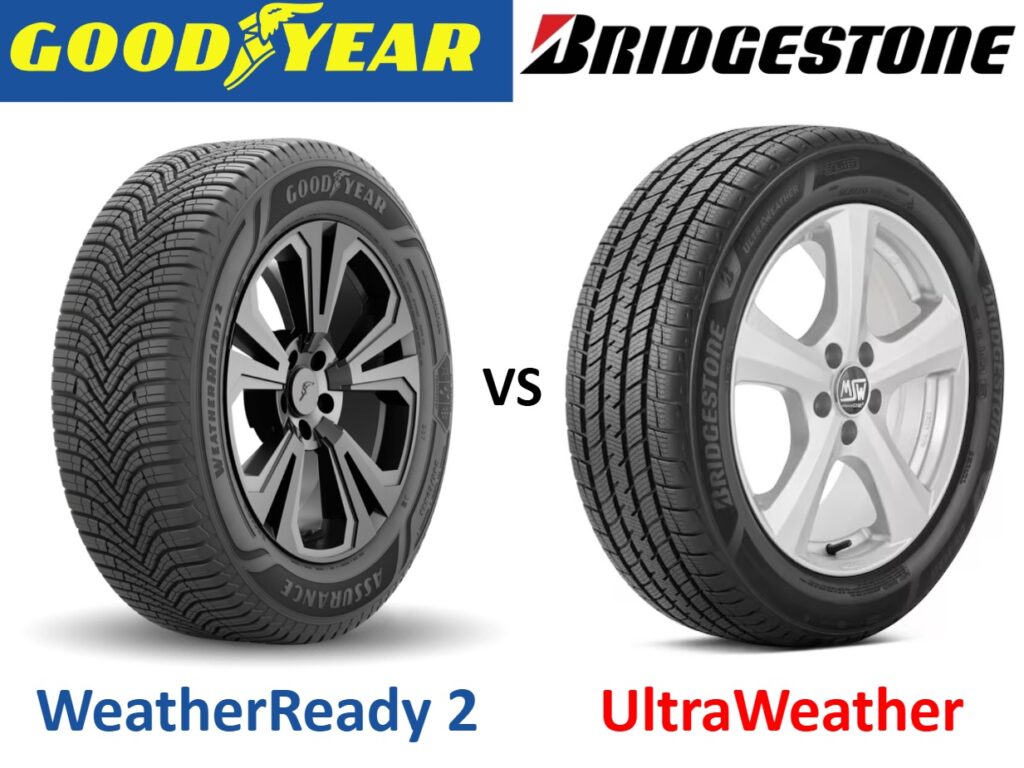
Goodyear Assurance WeatherReady 2 vs Bridgestone UltraWeather: The battle for all-weather supremacy has a new challenger. Launched in June 2026, the all-new Bridgestone UltraWeather enters the fight against Goodyear’s Assurance WeatherReady 2, raising the stakes for drivers seeking one tire for every season.
But can Bridgestone’s latest contender outshine Goodyear when it matters most? From rain-soaked roads to snowy mornings, this showdown reveals which tire delivers the stronger year-round package.
Table of Contents
Results : Goodyear Assurance WeatherReady 2 vs Bridgestone UltraWeather
The test results are based on Treadwell data from Discount Tire. The graph below compares the Goodyear Assurance WeatherReady 2 vs Bridgestone UltraWeather across key performance categories.
For subjective evaluations, each point is treated as equivalent to a 5% difference. For example, if Tire A scores a 4 and Tire B scores a 3, Tire A is considered 5% better than Tire B in that category.
Wet
The Goodyear Assurance WeatherReady 2 stops 20 ft shorter on new tread, at 145 ft versus 165 ft, putting the Bridgestone UltraWeather 12% behind in wet braking performance. With worn tread, Goodyear stops 14 ft shorter, at 192 ft versus 206 ft, leaving Bridgestone 7% behind.
Goodyear also scores 0.5 points higher for wet handling, at 4.5 versus 4.0, putting Bridgestone 2.5% behind. Overall, the WeatherReady 2 is the stronger wet-weather choice, combining shorter stopping distances with more responsive handling.
UltraWeather :
- -12% Wet Braking (new)
- -7% Wet Braking (worn)
- -2.5% Wet Handling
Winter
Both tires stop in 106 ft on snow, giving them identical snow braking performance. The Bridgestone UltraWeather scores 0.5 points higher for snow acceleration, at 2.0 versus 1.5, giving it a 2.5% advantage.
The Goodyear Assurance WeatherReady 2 scores 0.5 points higher for snow handling, at 2.0 versus 1.5, leaving Bridgestone 2.5% behind. Overall, Bridgestone has the edge when pulling away, while Goodyear offers better handling, with neither gaining an advantage in stopping distance.
UltraWeather :
- 0% Snow Braking
- +2.5% Snow Acceleration
- -2.5% Snow Handling
Mileage
The Goodyear Assurance WeatherReady 2 has an estimated median mileage of 42,500 miles versus 38,000 miles for the Bridgestone UltraWeather—a difference of 4,500 miles, leaving Bridgestone 11% behind. Goodyear therefore offers longer expected tread life, helping drivers go further before replacing their tires.
UltraWeather :
- -11% Mileage
Dry
The Goodyear Assurance WeatherReady 2 stops 14 ft shorter in dry braking, at 132 ft versus 146 ft, leaving the Bridgestone UltraWeather 10% behind in performance.
Goodyear also scores 0.5 points higher for dry handling, at 3.5 versus 3.0, putting Bridgestone 2.5% behind. Overall, Goodyear delivers stronger dry performance through shorter stops and more responsive handling.
UltraWeather :
- -10% Dry Braking
- -2.5% Dry Handling
Noise Vibration & Harshness (NVH)
The Bridgestone UltraWeather scores 0.5 points higher for quiet ride, at 3.5 versus 3.0, giving it a 2.5% advantage over the Goodyear Assurance WeatherReady 2. It also scores 0.5 points higher for ride comfort, at 4.0 versus 3.5, another 2.5% advantage. Overall, Bridgestone offers a quieter, more comfortable ride.
UltraWeather :
- +2.5% Quiet Ride
- +2.5% Comfort
Fuel efficiency
The Bridgestone UltraWeather scores 1.5 points higher for fuel efficiency, at 2.5 versus 1.0, giving it a 7.5% advantage over the Goodyear Assurance WeatherReady 2. This makes Bridgestone the stronger choice for drivers prioritizing fuel economy.
UltraWeather :
- +7.5% Fuel efficiency
Price
In 215/55R17, the Bridgestone UltraWeather costs $200 per tire, compared with $203 for the Goodyear Assurance WeatherReady 2. That makes Bridgestone $3 cheaper per tire, or approximately 1% less, saving $12 across a set of four. With such a small price gap, performance matters more than the initial saving.
Tire size: 215/55R17
- Assurance WeatherReady 2 : $203
- UltraWeather : $200
Difference: -1% more cheaper for UltraWeather
Conclusion:
In my tire expert view, the Goodyear Assurance WeatherReady 2 is the stronger overall choice, offering shorter wet and dry stopping distances, better handling, and longer estimated tread life. The Bridgestone UltraWeather counters with a quieter, more comfortable ride, better fuel efficiency, and a small snow acceleration advantage, while snow braking is identical.
Is the new UltraWeather better? For comfort and fuel economy, yes. But with only $3 per tire separating them, I would choose Goodyear for its stronger braking performance and longer life.
Dr Edwin Pang