
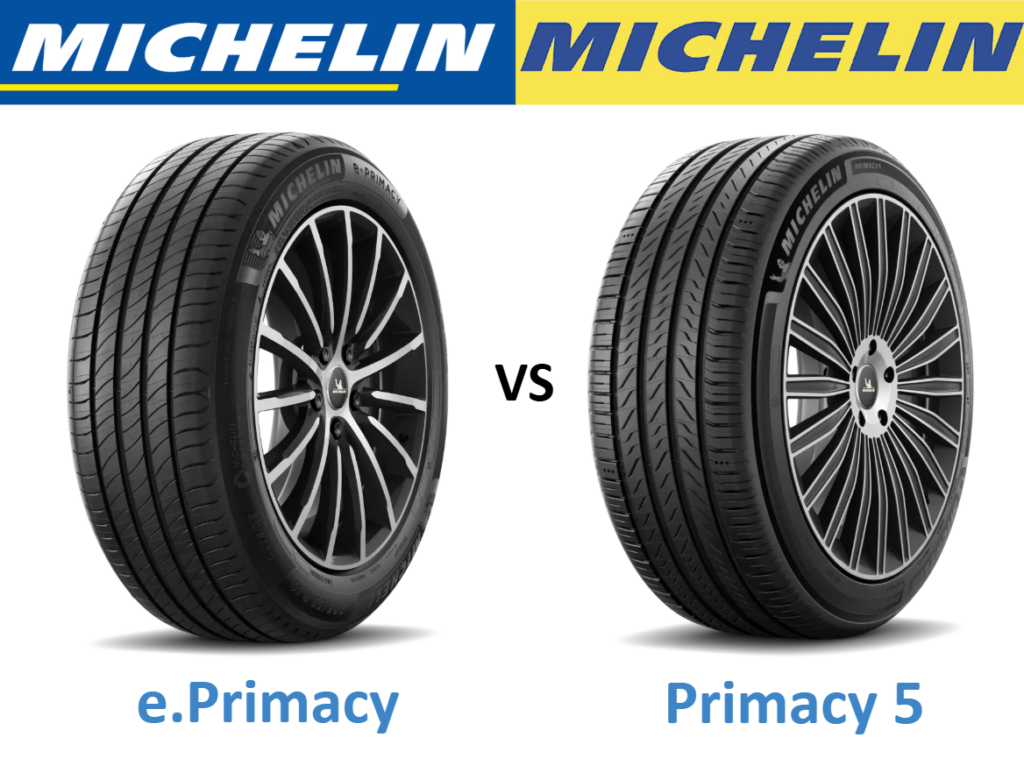
Michelin e.Primacy vs Michelin Primacy 5—one is an EV-focused tyre prioritising efficiency and low rolling resistance, while the other is a general summer touring tyre built for balanced performance. As the e.Primacy makes way for Michelin’s new Energy range, let’s take a trip down memory lane and see how these two tyres really compare.
Table of Contents
Results: Michelin e.Primacy vs Michelin Primacy 5
The results presented here are from the ABV’s 2025 Summer Tire Test, where 4 tire models were selected. The accompanying graph provides a side-by-side comparison of the Michelin e.Primacy vs Michelin Primacy 5 across various performance categories, with the Michelin e.Primacy serving as the benchmark at 100%.
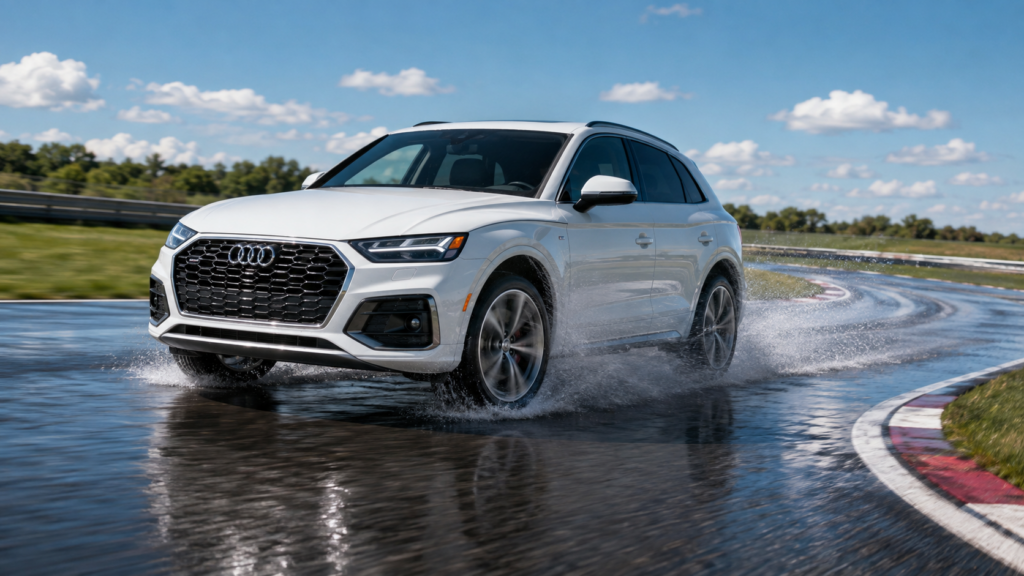
The tire size of interest is the 225/55 R18 tire size, a popular choice for vehicles like the Zeekr X & Chery Tiggo 7. For further insights into various tire sizes, feel free to consult our latest tire size table. The tests were conducted using a Audi Q5 as the test vehicle.
Wet
The Michelin Primacy 5 is clearly stronger in wet conditions. It stops in 48.78 metres, which is 5.90 metres shorter than the e.Primacy’s 54.68 metres—a 12% advantage. It also completes the wet handling lap 2.7 seconds faster, giving it a 3% advantage.
In straight aquaplaning, the Primacy 5 maintains grip at a speed 5.5 km/h higher than the e.Primacy—an 8% advantage. Overall, the Primacy 5 delivers safer and more capable wet-weather performance.
Primacy 5 :
- +12% in wet braking
- +3% in wet handling (lap time)
- +8% in aquaplaning
Dry
The Michelin e.Primacy has a small advantage in dry conditions. It stops in 38.11 metres, which is 0.45 metres shorter than the Primacy 5’s 38.56 metres—a 1% advantage. It also completes the dry handling lap 0.95 seconds faster, giving it a 2% advantage.
Subjectively, the e.Primacy scores 6.1 out of 10, which is 0.2 points higher than the Primacy 5—a 2% advantage. Overall, the e.Primacy is slightly better in the dry, but the differences are very small.
Primacy 5 :
- -1% in dry braking
- -2% in dry handling (lap time)
- -2% in dry handling (subj)
Mileage
The mileage figures are based on the 2023 ADAC Summer Tyre Test. The Primacy 5 result is estimated by applying Michelin’s claimed 16% mileage improvement over the Primacy 4+. The e.Primacy is projected to last 71,500 km, just 392 km longer than the Primacy 5’s estimated 71,108 km—a 1% advantage. In practical terms, their expected mileage is almost identical.
Primacy 5 :
- -1% in mileage
Interior Noise
The Michelin Primacy 5 records 63.3 decibels, making it just 0.3 decibels quieter than the e.Primacy at 63.6 decibels—a 0% difference when rounded. In real-world driving, both tyres should offer virtually identical interior noise levels.
Primacy 5 :
- ~0% in interior noise
Rolling Resistance
The Michelin e.Primacy has a rolling resistance of 6.3 N/kN, which is 0.5 N/kN lower than the Primacy 5 at 6.8 N/kN—a 7% advantage. This makes the e.Primacy the more energy-efficient tyre, helping to reduce fuel consumption or extend EV driving range.
Primacy 5 :
- -7% in rolling resistance
Price
In size 225/55 R18, the Michelin e.Primacy costs €180 per tyre, while the Primacy 5 costs €171. That makes the Primacy 5 €9 cheaper per tyre—a 5% saving, or €36 across a complete set. With stronger wet performance at a lower price, the Primacy 5 offers the better overall value.
Tire size: 225/55 R18
Difference: -5% cheaper for Primacy 5
Summary
From my perspective, the e.Primacy remains the better choice if maximum efficiency is your priority, thanks to its lower rolling resistance and slight dry-performance advantage. However, I would choose the Primacy 5 for most drivers because it delivers much stronger wet safety, similar mileage and noise, and costs 5% less. The e.Primacy wins on efficiency, but the Primacy 5 is the better all-round package.
Dr Edwin Pang