
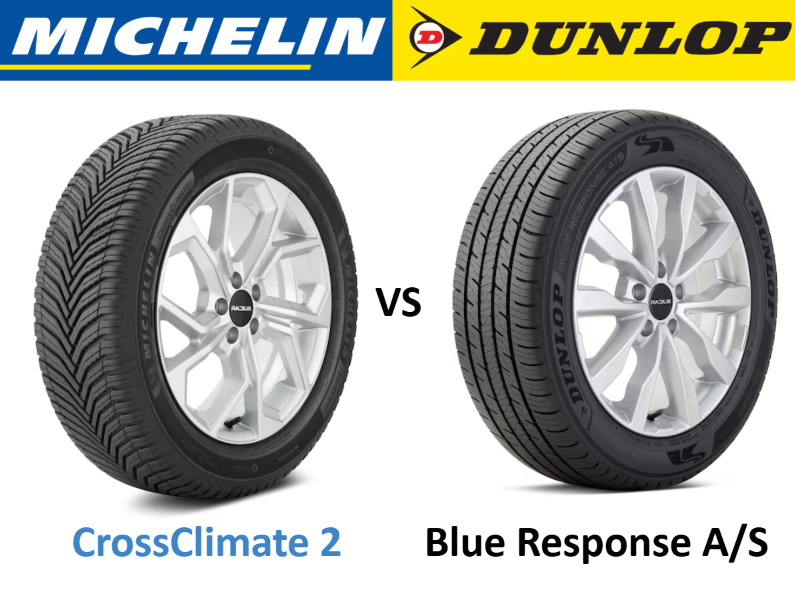
The Michelin CrossClimate 2 vs Dunlop Blue Response A/S is a battle between the proven all-weather king and a newly energized Dunlop brand under Sumitomo’s global control. Michelin brings the wet grip, winter confidence, and premium reputation, while Dunlop counters with value, efficiency, comfort, and strong treadwear. On paper, this looks like an easy Michelin win — but the data makes the Blue Response A/S surprisingly hard to ignore.
Table of Contents
Results : Michelin CrossClimate 2 vs Dunlop Blue Response A/S
The test results are based on Treadwell data from Discount Tire. The graph below compares the Michelin CrossClimate 2 vs Dunlop Blue Response A/S across key performance categories.
For subjective evaluations, each point is treated as equivalent to a 5% difference. For example, if Tire A scores a 4 and Tire B scores a 3, Tire A is considered 5% better than Tire B in that category.
Wet
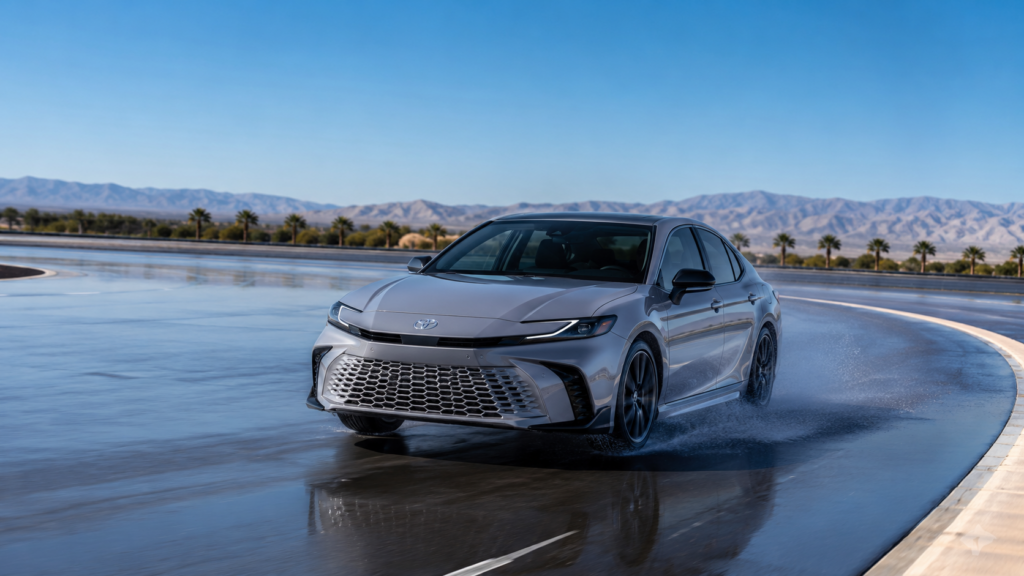
In the wet, the Michelin CrossClimate 2 has the clear advantage. It stops in 145 ft, while the Dunlop Blue Response A/S needs 155 ft, making the Dunlop 10 ft longer in wet braking and 6% behind Michelin. Wet handling is closer, with Michelin scoring 4.0 versus Dunlop’s 3.5, giving Michelin a 0.5-point advantage, while Dunlop is 2.5% behind based on the comparison data. Overall, the CrossClimate 2 is the stronger wet tire, especially when braking distance matters most.
Blue Response A/S :
- -6% Wet Braking
- -2.5% Wet Handling
Winter
In winter performance, the Michelin CrossClimate 2 is clearly ahead with a 4.5/5 rating, while the Dunlop Blue Response A/S scores 2.5/5. That gives Michelin a 2.0-point advantage, with Dunlop sitting 10% behind based on the comparison data. The biggest difference is certification: the CrossClimate 2 carries the Three-Peak Mountain Snowflake rating, while the Dunlop Blue Response A/S does not, making Michelin the much stronger choice for real winter confidence.
Blue Response A/S :
- -10% Snow
Mileage
For mileage, the Michelin CrossClimate 2 is clearly ahead with a median estimate of 57,500 miles, while the Dunlop Blue Response A/S is estimated at 40,500 miles. That means the Dunlop gives up around 17,000 miles of tread life, placing it 30% behind the Michelin based on the comparison data. So while the Dunlop may look attractive on price and efficiency, the CrossClimate 2 has the stronger long-term mileage advantage.
Blue Response A/S :
- -30% Mileage (Median)
Dry
In the dry, both tires are evenly matched in braking, with the Michelin CrossClimate 2 and Dunlop Blue Response A/S both stopping in 125 ft, meaning there is no braking distance difference and 0% difference between them. Dry handling is where Michelin pulls slightly ahead, scoring 4.0 versus Dunlop’s 3.5, giving Michelin a 0.5-point advantage, while Dunlop sits 2.5% behind based on the comparison data. Overall, dry braking is a tie, but the CrossClimate 2 still feels like the more controlled dry tire thanks to its stronger handling score.
Blue Response A/S :
- 0% Dry Braking
- -2.5% Dry Handling
Noise Vibration & Harshness (NVH)
For ride quality, the Dunlop Blue Response A/S has the advantage. In quiet ride, Dunlop scores 4.0/5, while the Michelin CrossClimate 2 scores 3.5/5, giving Dunlop a 0.5-point advantage and making it 2.5% better based on the comparison data. Ride comfort follows the same pattern, with Dunlop scoring 3.5/5 versus Michelin’s 3.0/5, again giving Dunlop a 0.5-point advantage and a 2.5% lead. Overall, while Michelin is stronger in wet and winter performance, Dunlop is the more comfortable and quieter tire for daily driving.
Blue Response A/S :
- +2.5% Quiet Ride
- +2.5% Comfort
Fuel Consumption
For fuel efficiency, the Dunlop Blue Response A/S has the clear advantage, scoring 3.0/5 compared to the Michelin CrossClimate 2 at 2.0/5. That gives Dunlop a 1.0-point advantage, making it 5% better based on the comparison data. Overall, the Dunlop should be the more efficient daily-driving tire, while the Michelin trades some efficiency for stronger wet, winter, and mileage performance.
Blue Response A/S :
- +5% Fuel Efficiency
Price
For price, the Dunlop Blue Response A/S is clearly the cheaper option. In size 215/55R17, the Michelin CrossClimate 2 costs $215, while the Dunlop Blue Response A/S costs $179. That makes the Dunlop $36 cheaper per tire, or about 17% cheaper than the Michelin. For a full set of four, that is a $144 saving, making the Blue Response A/S the stronger value choice upfront.
Tire size: 215/55R17
- CrossClimate 2 : $215
- Blue Response A/S : $179
Difference: -20% more cheaper for Blue Response A/S
Conclusion:
Overall, I would recommend the Michelin CrossClimate 2 for most Camry drivers because it delivers the stronger all-round package, especially in wet braking, wet handling, winter capability, and long-term mileage. It is also Three-Peak Mountain Snowflake rated, giving it a clear advantage in colder and more difficult conditions. The Dunlop Blue Response A/S still has real strengths: it is $36 cheaper per tire, quieter, more comfortable, and more fuel efficient, making it a good value-focused daily tire. But if safety, all-weather confidence, and longer tread life matter most, the CrossClimate 2 is the better tire.
Dr Edwin Pang